Carried · West Africa
Written on wood, then washed away.
For centuries, Qur’an learners in parts of West Africa and the Sahara have learned from wooden boards. The writing on a board does not last. What it teaches is meant to.
A board, a pen and ink
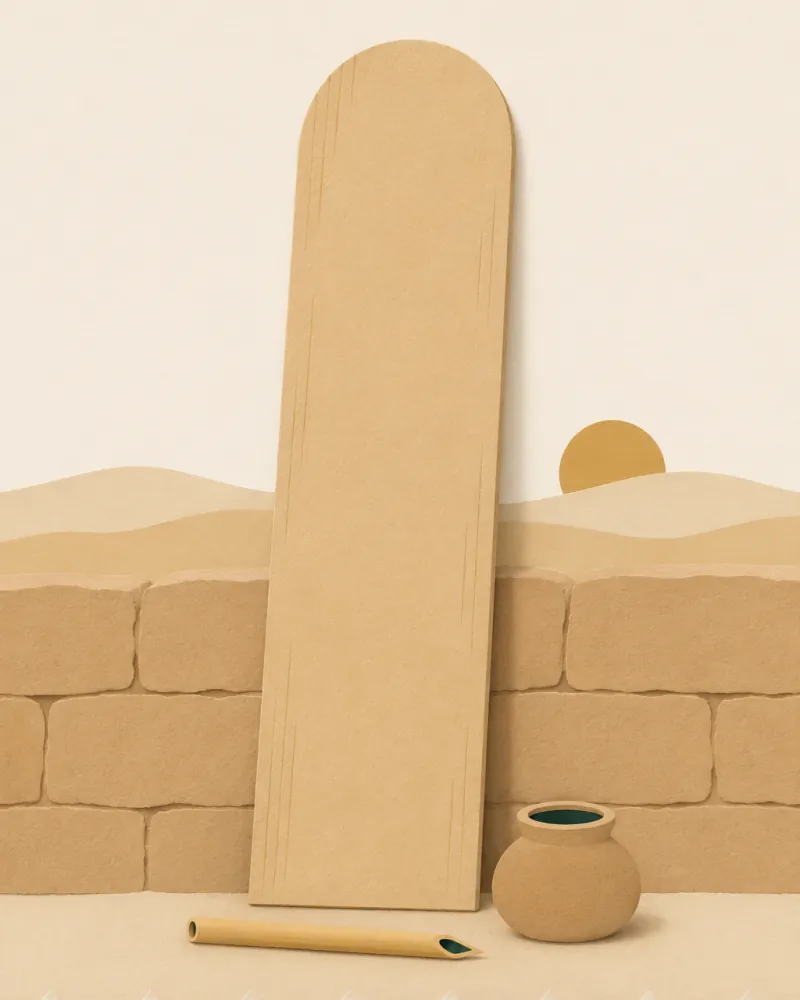
The board is called a lawḥ in Arabic, an allo in Hausa and an àlluwa in Wolof. Learners across parts of West Africa and the Sahara have used one for centuries.
In 1991 the anthropologist Geert Mommersteeg, who did his fieldwork in Djenné, Mali, described the tools of the Qur’an schools there. Each board was covered on both sides with a thin coating of white clay. The pen was cut from the stalk of a particular shrub. The ink was water, gum arabic and soot scraped from cooking pots.
Other places use other materials, and some board traditions cut their pens from reeds, so these details belong to Djenné. What the schools share is the board itself: a surface you write on, learn from, and wash clean.
Write, read, recite
In Djenné the teacher writes the first lessons. As students advance, they trace the writing, then copy it beneath the teacher’s example. Then they read the passage again and again.
When they are ready, the student recites it to the teacher. Only when it is right may the board be washed. The student cannot decide that alone; the teacher has to hear it first.
Then the next passage is written on the same board. Āyah after āyah, the same piece of wood carries the lessons forward, one passage at a time.
Where the water goes
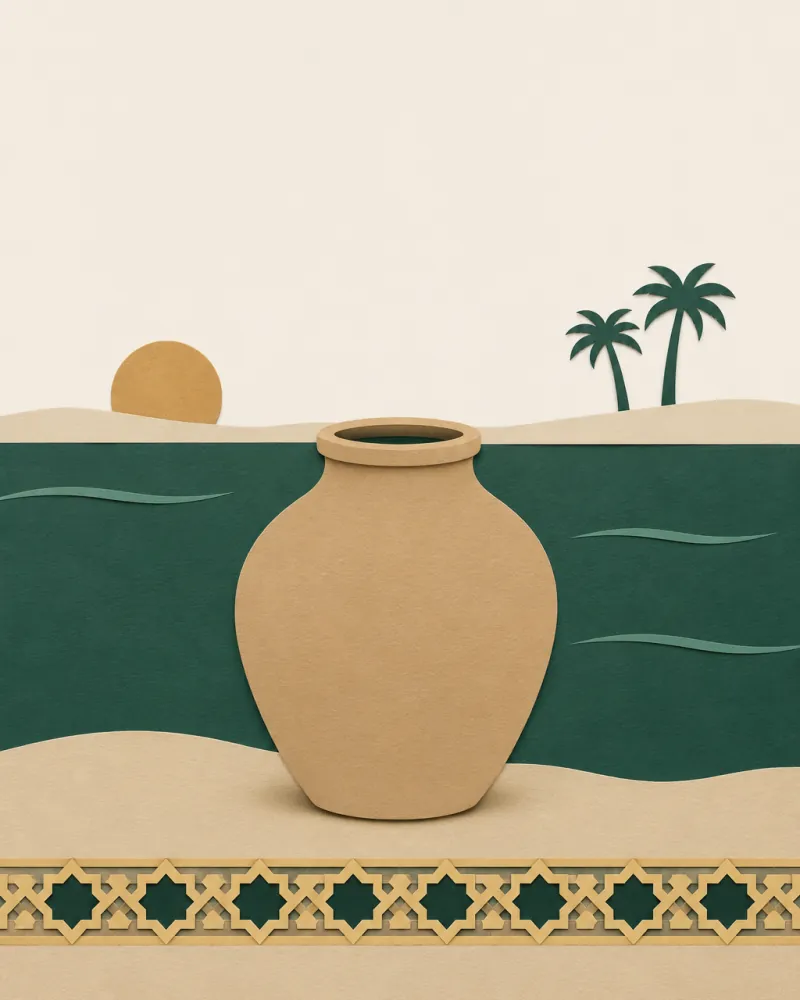
The writing on the board is the Qur’an, so the water that washes it away is treated with respect. In the Djenné schools Mommersteeg described, the rinse water was collected in a jar and later poured into the Bani River, once or twice a year.
In the villages, he wrote, boards were washed at the spot where the night fire burns, “because nobody ever walks on that spot.”
To the end of the Qur’an
This is slow work. Mommersteeg wrote that a student needed at least four years to finish the Qur’an in Djenné, though most left before finishing. Some students carry it all the way to the end of the Qur’an. In Djenné, a student who finished read the end of al-Baqarah, was blessed by a visiting teacher, and walked through town with the board while people gave small gifts.
Mommersteeg was describing one town, and the details differ across the region. In Mauritania, the maḥẓara, a school that historically moved with nomadic camps, taught the Qur’an and the Islamic sciences, and it is still widespread there today. Students tended the shaykh’s cows and camels, and families gave livestock, food and paper. Benaouda Bensaid and Tarek Ladjal trace its roots to the Almoravid period, and note that under French rule the maḥẓara shaykhs resisted the colonial schools.
The historian Rudolph Ware, writing about roughly a thousand years of Qur’an schooling in Senegambia, describes the board, the memorization and the discipline as meant to make the student a living copy of the Qur’an. He called his book The Walking Qur’an. He also records how reformists of the late nineteenth and twentieth centuries attacked these methods.
The board is less common than it was. Andrea Brigaglia and Dahir Lawan Muʿāz note that the tablet was still the main tool of Qur’an schooling in the Maghreb in the mid-twentieth century. It is “certainly less ubiquitous today,” they write, yet it “continues to show a surprising resilience.”
The writing is washed away when the lesson is learned. The board is ready for the next passage. The Qur’an goes on, carried in people. Most of us will never hold a lawḥ. Your board can be a screen, a printed page or a muṣḥaf on a stand. The order of the Djenné schools still works: read the passage until it stays, say it to someone who can hear you, and only then move on.
Sources
Every fact in this story comes from these. Where they disagree, the story says so.
- Mommersteeg, Geert. “Learning the Word of God.” Aramco World 42, no. 5 (September/October 1991). Read the article ↗︎ (opens another site)
- Ware, Rudolph T., III. The Walking Qur’an: Islamic Education, Embodied Knowledge, and History in West Africa. Chapel Hill: University of North Carolina Press, 2014. Publisher’s page ↗︎ (opens another site)
- Bensaid, Benaouda, and Tarek Ladjal. “The Struggle of Traditional Religious Education in West Africa: The Case of Mahdara in Mauritania.” Journal of Ethnic and Cultural Studies 6, no. 1 (2019): 152–161. PDF ↗︎ (opens another site)
- Brigaglia, Andrea, and Dahir Lawan Muʿāz. “Transient Texts: Erasable Writing on Wood, Sand, and Metal in Northern Nigerian Islam.” Berlin: De Gruyter, 2025 (open access). doi:10.1515/9783111682983-015 ↗︎ (opens another site)
Image credits
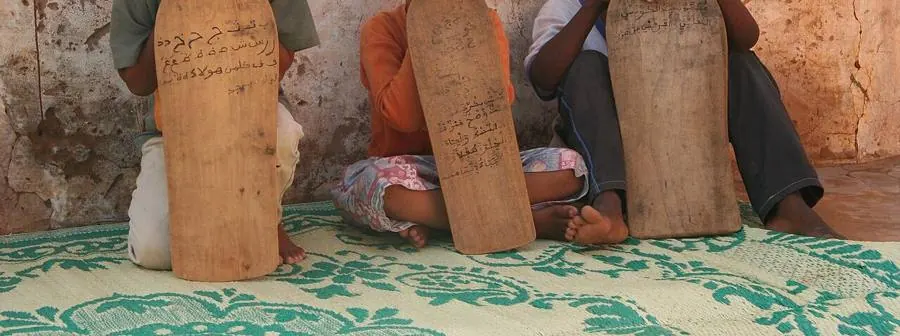
- Qur’an pupils in Mauritania, 2006 (top). Photo: Ferdinand Reus, CC BY-SA 2.0 ↗︎ (opens another site), via Wikimedia Commons ↗︎ (opens another site), cropped to the boards and hands. Our cropped version is shared under the same license. The photo is from Mauritania, not Djenné.
- The board and ink pot; the jar by the river. Art: Inheriting Qur’an cut-paper illustration.
Start reading
Carry it yourself. Start from the first letter.
The Qāʿidah course on this site begins at the first Arabic letter and assumes nothing. It is free, with no account.
More from Carried