
BackThe app

A guide for adults

You are not late. You are starting.

Many people reach adulthood without being taught to read the Qur’an — converts, people who grew up Muslim but missed it, parents who want to read before they teach. This page is the practical part: what to expect, how to practice, and who can help.

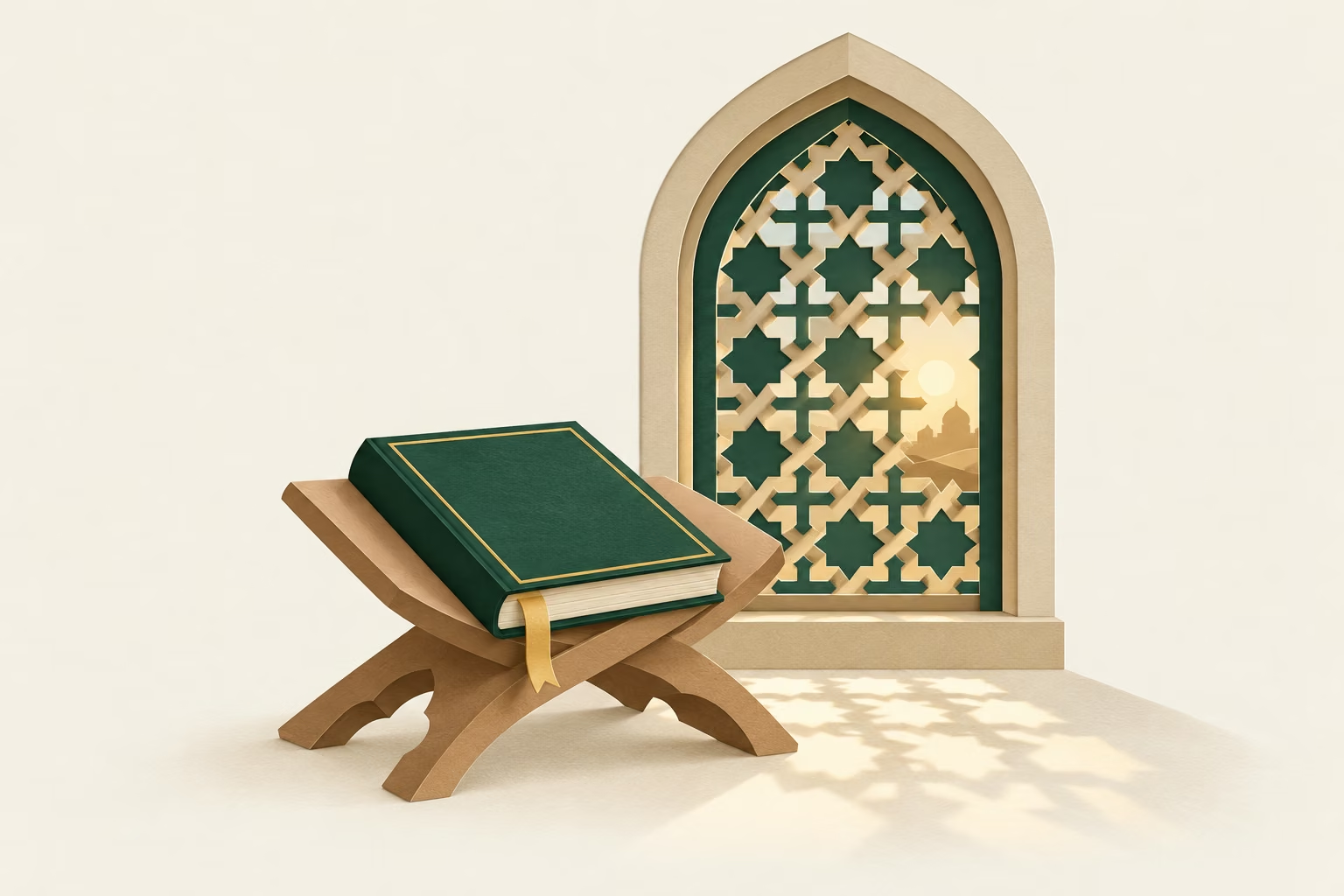
Paper-cut illustration: a closed green book with a ribbon marker rests on a wooden reading stand beside an arched lattice window, morning light falling across the floor.Paper-cut illustration: a closed green book with a ribbon marker rests on a wooden reading stand beside an arched lattice window, morning light falling across the floor.
A place for daily reading

How long it takes

An honest answer: it depends on you, and that is good news.

Anyone who gives you a number before hearing you read is guessing, and the books refuse to. What changes the pace is how often you practice, whether someone hears you, and where you start. What we can show you is the shape of the road.

Lessons 1–6

Sounds and shapes. Most of a beginner’s first weeks are spent here, on the mouth and the eye. It is the part everyone underestimates.

Lessons 7–17

Letters become reading: hamzah, tanwīn, the long vowels, sukūn, shaddah. The part people most often rush.

Lessons 18–20

The muṣḥaf’s last conventions, stopping, and the finish line: reading a page you have never seen.

Then

Tajwīd for Juz ʿAmma, and, if you want it, carrying the juz in memory. Each book has its own finish line.

Nothing in the books is timed and nothing is a score. Each gate is either true yet or not true yet.

Practicing daily

Short, and every day. That is the whole method.

A little every day does more than a long sitting once a week, because the mouth learns by repetition and the ear by comparison. Here is a rhythm that holds up on a busy week.

  1. 01

    Fix a time you already keep

    Tie it to something that happens every day anyway — after a particular prayer, before work, after the children sleep. Same place, the book open, the phone ready to record.

  2. 02

    Fifteen or twenty minutes is plenty

    Read the lesson’s teaching page once, then spend the time on the drill, aloud. Stop while it is still going well; you want to come back tomorrow.

  3. 03

    Record, then listen

    Record yourself reading the drill. Listen back beside a trusted recitation and go again where they differ. A recording is more honest than your ear in the moment.

  4. 04

    Move on at the gate, not the calendar

    A lesson is finished when its drill is easy, not when its teaching page is understood. If you are unsure whether a gate is true, it is not true yet. Stay another few days.

  5. 05

    Missed a day? Begin again

    There is nothing to catch up. Open the book where you left it and do today’s fifteen minutes. Consistency is built from restarts.

Someone to listen

A book cannot hear you. A person can.

The books never assume you have anyone, and every gate can be checked on a recording. But when you can, read to someone who reads well. Ten minutes a week is enough to catch what your own ear misses.

Who to ask

  • The imam, or someone who leads the prayer, at your local masjid.
  • A friend, relative or neighbor whose reading you trust.
  • A Qur’an teacher near you, if you want regular lessons.
  • Anyone you are comfortable sitting with. It does not need to be formal.

How to ask

“I’m learning to read the Qur’an from a free book. Could you listen to me read one page for ten minutes, once a week, and tell me what you hear?”

Bring the book open at your page, and the lesson’s gate so they know what you are working on. Ask them to stop you at the first mistake, not the last.

No one yet? Keep recording and comparing. That is how every gate is designed to be checked, and it is real progress.

Masājid and teachers can use our free kit to run a reading circle with these books. See the kit

Using the books

Three books, read in order.

Open the booksOpen the glossary

  1. 01

    Start where the reading check puts you

    Most adults start at lesson one of the qāʿidah, even if they know some sūrahs by heart. Memory happily pretends to read; the drills are built so it cannot.

  2. 02

    Cover the transliteration

    The Latin letters are on teaching pages only, as scaffolding. Cover them as soon as you can; the drill pages have none on purpose.

  3. 03

    Use a Madinah muṣḥaf

    The books follow the Madinah (ʿUthmānī) muṣḥaf in the recitation of Ḥafṣ from ʿĀṣim. If your copy has the thicker South Asian lettering, find a Madinah copy while you learn: the marks differ.

  4. 04

    Print only the page you are on

    A printed drill sheet on the table beats a PDF on a phone. Keep the glossary open for any word the book uses that you have forgotten.

The assessments

Optional, and only when you are ready.

An assessment is a live, one-to-one video call with Hamza. You recite; he listens against the finish line printed in the free book for that stage. You leave with a numbered certificate, or with written notes on exactly what to work on next.

They are paid and entirely optional: everything you need to learn is free. They are not lessons, and the certificate is not an ijāzah.

For new Muslims

Welcome. Go gently.

New to Islam? You have your own page, with a different starting point: where to begin with the Qur’an as a new Muslim.

Questions

What people ask before they begin.

Am I too old to start?

No. These books do not talk down to anyone. Adults bring patience and a reason to learn; those matter more than age.

How long will it take me to read?

Nobody can honestly say before hearing you read. It depends on how often you practice, whether someone listens to you, and where you start. Expect the first six lessons to take the most time.

How much should I practice each day?

Fifteen or twenty minutes, every day, is a good start. Short and daily does more than long and occasional.

I already know some sūrahs by heart. Do I still start at the beginning?

Probably, yes. Knowing a sūrah is not the same as reading it, and memory fills gaps without telling you. Take the two-minute reading check; it will tell you where to start.

Can I learn with transliteration?

Use it as scaffolding on the teaching pages, then cover it. A reader who needs the Latin underneath has not yet learned to read, which is why the drill pages leave it out.

Do you offer lessons with a teacher?

No. This site teaches through the free books and lessons. For regular lessons, look for a teacher near you. The assessments are the one one-to-one sitting we offer, and they are not lessons.

What does it cost?

The books, the lessons, the reading check and everything on these resource pages are free, with no account. Only the optional assessments are paid.

Is the certificate an ijāzah?

No. It records that you met the standard printed in one book on one day. It is not an ijāzah, not a license to teach, and confers no title.

I have been on one lesson for weeks. Is something wrong?

Probably not. Some letters take weeks — the qāʿidah says so plainly about ḍād. Keep recording, compare, and if you can, let someone who reads well hear you. Staying on a gate until it is true is the method working.

A moment with the Qur’an

For the days it feels slow.

A beginning can be gentle.

فَإِنَّ مَعَ ٱلۡعُسۡرِ يُسۡرًا

“For indeed, with hardship [will be] ease.”

Translation of the meanings · Complete verse · 94:5 · Saheeh International

Our reflectionStarting again can feel difficult. Let this be a place to name what you need, without comparing your pace with someone else’s.

One step to carry with youNotice one part you can already do and one question to bring to a teacher.

Context and source notes

Complete verse. The surah addresses the Prophet, recalling Allah’s favors and affirming ease alongside hardship. It closes with an invitation to effort and turning toward the Lord.

Sūrah Ash-Sharh · 8 āyāt

Report a mistake

A wrong example, a typo, something broken? Say exactly what, and it gets checked and fixed.

What kind of mistake?

Only if you would like a reply. If you are under 13, ask a parent first.

Anonymous: no name, no account. How feedback is handled