BackThe app

Free books · print and share

Open a book.
Keep learning.

A small library for learning to read, practicing tajwīd, and memorizing Juz ʿAmma. Free editions to download, print, and share with your students.

Written by Hamza Abdul-Tawwaab
Three course books · Free editions

Three books and a companion

Find the book for your next step.

They are meant to be read in sequence — the tajwīd book assumes you can already decode a line, and the ḥifẓ book assumes you can already recite one correctly. Each holds to the standard of the stage it belongs to.

Free editions

Written by Hamza Abdul-Tawwaab. Keep the author’s name when sharing, and send corrections to Hamza.

PDF previews open in this tab. Use your browser’s Back button to return; download a copy to read offline. Forgot a term? The glossary.

01 · Begin here · no reading prerequisite

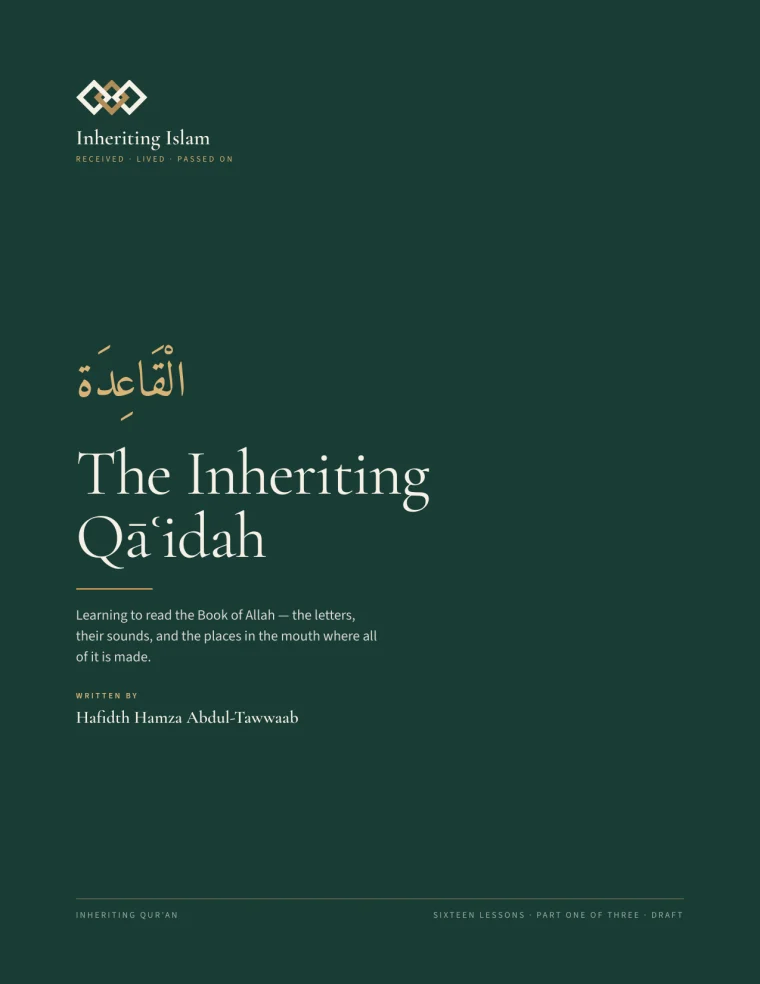
The Inheriting Qāʿidah

For your first steps in reading Arabic. Open lesson one and practice its letters before moving on to joining and fluency.

87 pages20 lessonsPDF · 1.9 MB
How to practice with this material

Work through one row at a time. Identify each letter before reading the practice words; these are invented drills, not Qur’anic verses. Mark an unfamiliar shape and ask a teacher to check it before moving on.
Or work through it on screen: the Qāʿidah course

Next: try the letter explorer.

02 · Once you can decode a line

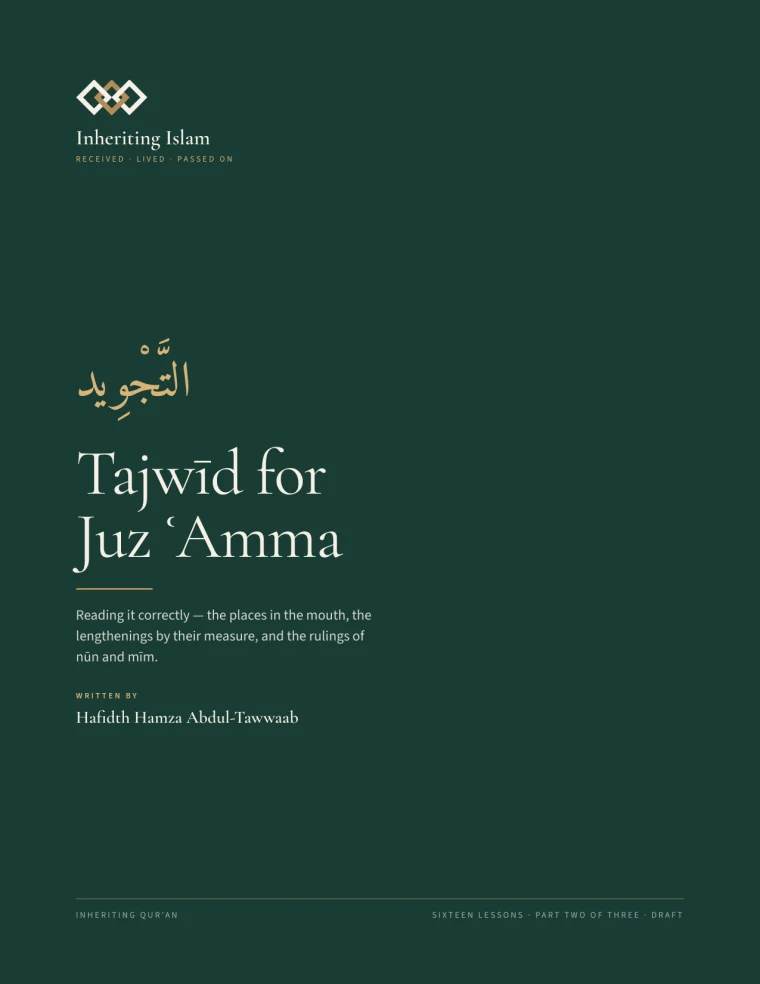
Tajwīd for Juz ʿAmma

For readers who can already decode a line. Preview one rule and practice it with the examples from Juz ʿAmma.

52 pages16 lessonsPDF · 0.6 MB
How to practice with this material

Choose one rule and find its marks in the examples. Read a short passage with that rule in mind, then ask a teacher to hear it. The book uses the marks in the muṣḥaf rather than relying on color coding.

Study it online, rule by rule: the tajwīd course

Next: begin memorizing with the ḥifẓ book.

03 · Once you can recite correctly

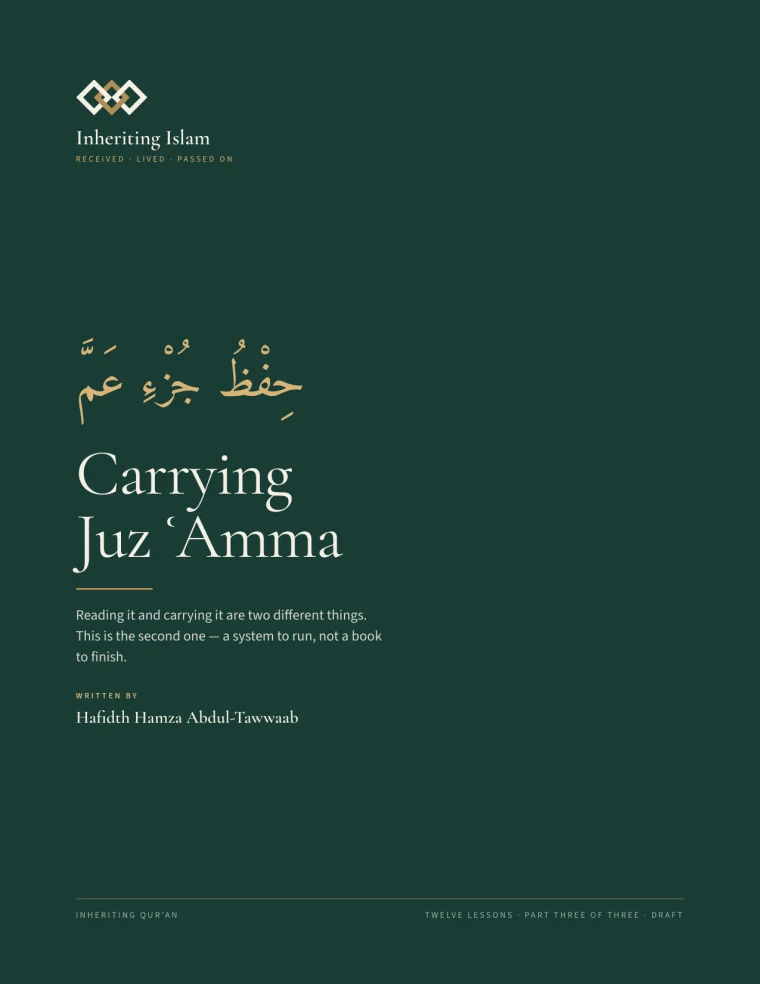
Carrying Juz ʿAmma

For learners who can recite correctly and want a steady memorization routine. Begin with the opening lesson and choose a manageable daily portion.

49 pages12 lessonsPDF · 0.9 MB
How to practice with this material

Read the opening guidance, then agree a manageable portion with your teacher. Keep revision beside new memorization. The final source notes distinguish established practice, research, and the author’s judgment.

Practice on the site: the Juz ʿAmma pages

Next: use the companion tracker to plan your revision.

04 · A companion to book three

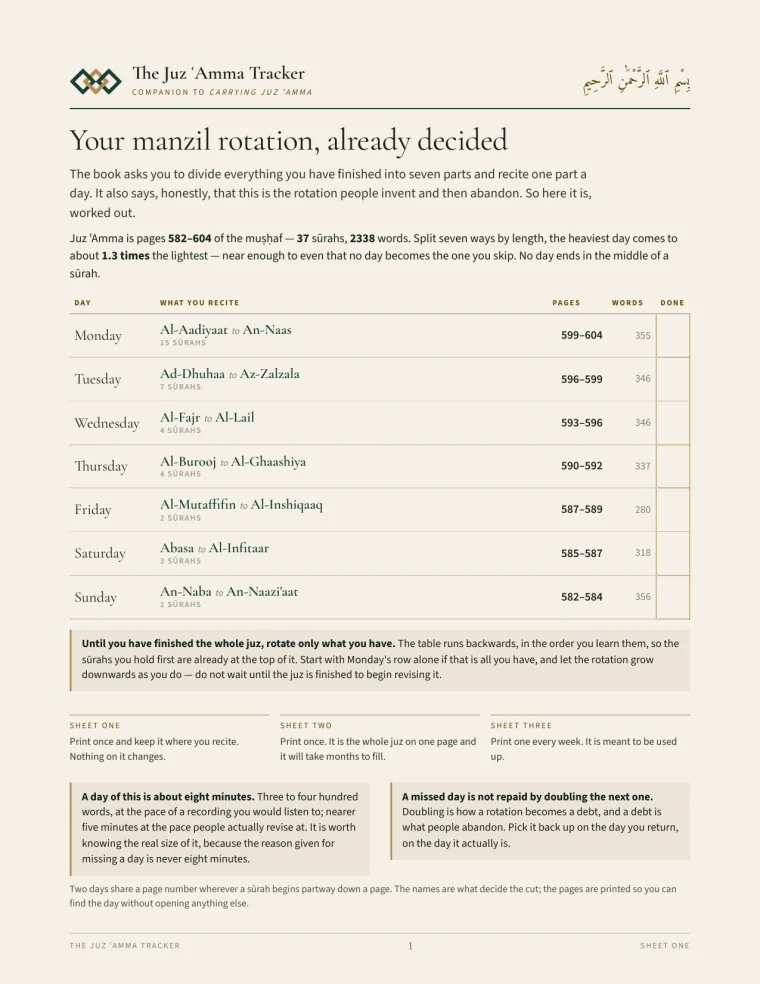
The Juz ʿAmma Tracker

For learners revising Juz ʿAmma. Preview the three sheets, then print the weekly sheet and mark your first revision session.

3 sheetsPrint & writePDF · 0.1 MB
How to practice with this material

Print the sheet that fits your routine and keep it beside your muṣḥaf. Record what you actually revised; leave unfinished work for your next session. Use a fresh weekly sheet when you begin a new week.

Or print the 14-day revision log

Next: read the memorization guide for the routine behind these sheets.

How they were checked

How the books are reviewed.

We wanted materials written for this teaching sequence that families and teachers could print and share freely. Hamza wrote these books for that purpose, with the permissions stated clearly. The books set out the full learning sequence, lesson by lesson, with a clear standard for moving to the next step.

Paper-cut illustration: a bookbinding bench with blank pages, thread and bound notebooks.Paper-cut illustration: a bookbinding bench with blank pages, thread and bound notebooks.
Learning materials, made and cared for.
01

Arabic checked against its source

Qur’anic words are checked against the source text. Any deliberate presentation change is explained in the book.

How this is checked

No Qurʾānic word is written into these books by hand. Every one is referenced by sūrah, āyah and word, and pulled from the Uthmani text at build time — so what is printed is byte for byte what the source says, or the build stops. The qāʿidah drops one mark and says on its own pages which one and why; nothing else is altered anywhere.

02

Each lesson builds on the last

Exercises are checked so students encounter the marks and forms already introduced in their lessons.

How this is checked

A drill in lesson six cannot contain a mark taught in lesson nine. That rule is code, not care — the first time it ran it found six places where the book was quietly asking a student to read something it had not taught yet.

03

Files checked for clear Arabic

The PDFs are checked for the intended embedded fonts, so Arabic characters can display as designed.

How this is checked

Arabic that silently falls back to a system font still looks correct — that is what makes it dangerous. Every character is checked against the fonts actually embedded, and the finished file is checked again for any face that should not be in it.

Free, and that is not a launch offer

These stay free. Print them at home, run them off at the masjid, hand them to anyone who needs them. If you teach from them and they help, that is the whole return — the ajr for it is worth more to this house than a price would be.

© Inheriting Islam LLC. Licensed CC BY-NC-ND 4.0: you may copy and share these books unchanged and free of charge, with credit. Qur'anic text is from Tanzil under its own terms; other sources keep theirs.

These books are still being improved. They have been checked against the text and read end to end.

If you find an error, in the Arabic or in the teaching, write to Hamza and it will be fixed in the next build. Corrections are wanted, not merely tolerated.

A book cannot hear you read.

That is the one thing on this page that has to be said plainly. These will teach you the shapes, the rules and the method — but nothing on paper can tell you that your ḍād is actually a dāl. For that you need somebody listening: a teacher at your masjid, or anyone who reads well and will hear you out.

A moment with the sources

Room to keep learning.

رَّبِّ زِدۡنِى عِلۡمࣰا

“My Lord, increase me in knowledge.”

Translation of the meanings · Excerpt · 20:114 · Saheeh International

Our reflectionBring the question you have, even if it feels small. A useful book leaves room to learn, practice, and ask again.

Context and source notes

Verse excerpt: the closing supplication. The full verse exalts Allah as the true King and addresses the Prophet ﷺ about receiving revelation without haste. It ends with this supplication for knowledge.

Sūrah Taha · 135 āyāt

Report a mistake

A wrong example, a typo, something broken? Say exactly what, and it gets checked and fixed.

What kind of mistake?

Only if you would like a reply. If you are under 13, ask a parent first.

Anonymous: no name, no account. How feedback is handled