BackThe app

Optional · one to one · by video

Recite to someone
who is listening.

An assessment is a live, one-to-one video call. You recite; Hamza listens against the standard printed in the free book for that stage. You leave with a numbered certificate, or with written notes on exactly what to work on next.

Every course, book and lesson on this site is free. This assessment is separate and optional: you don’t need it to finish a course or to keep learning.

Bookings open soon, in shā’ Allāh. You can send a request now, and you will be told when times are ready.

Can’t afford the fee? Ask for a sponsored place

The three stages

Three assessments, one for each book.

Each standard is quoted from the last page of its book. Take them in the order of the books: the ḥifẓ book asks for tajwīd first.

Stage 1

Qāʿidah

The Inheriting Qāʿidah

Read unseen text aloud, with no prompting.

The standard, word for word
The standard: “You read unseen text aloud to a teacher you trust: joining the letters, sounding them from their places, stopping correctly, and reading without prompting.”

$60once · one retake included

About 30 min
Free book · Course

Request a placeBookings open soon
Stage 2

Tajwīd

Tajwīd for Juz ʿAmma

All of Juz ʿAmma, read with the rules applied.

The standard, word for word
The standard: “The whole of Juz ʿAmma, read aloud to a teacher you trust, with the rules applied throughout.”

$100once · one retake included

About 60 min, can be split in two
Free book · Course

Request a placeBookings open soon
Stage 3

Ḥifẓ

Carrying Juz ʿAmma

Juz ʿAmma from memory, tajwīd held throughout.

The standard, word for word
The standard: “The juz recited from memory with the rules of tajwīd held throughout.”

$120once · one retake included

About 60–75 min, can be split in two
Free book · Juz ʿAmma pages

Request a placeBookings open soon

Can’t afford the fee? Ask for a sponsored place. No explanation needed.

For learners aged 13 and over. When bookings open, booking means agreeing to the terms below: retakes, cancellations, refunds and recording.

Not sure you are ready for the Qāʿidah assessment? The free reading check gives you a fair idea first.

Not sure you are ready for a stage? Take the self-check: one honest list per assessment.

How each stage is scored

All stages

  • A prompt is when Hamza supplies a letter, vowel, word or the opening of an āyah, or says “check that”. “Take your time” is not a prompt.
  • A significant error changes a letter, a vowel or a word, adds or drops something, or stops in a way that changes the meaning. A minor error is a rule applied imperfectly with the word intact, such as a short ghunnah or a madd off by a count.
  • Speed never counts: slow and correct passes. A mistake you fix at once, with no cue, counts for less. The same mistake three or more times is “not yet”, whatever the totals.

Qāʿidah — reading

  • About 15 lines from three pages outside Juz ʿAmma, drawn just before the session and shown on screen.
  • No prompts at all: the standard is reading without prompting.
  • Joined reading, not letter by letter; correct stops; only a few significant errors, never two of the same kind.
  • Memory aids: no transliteration and no audio to read along with.

Tajwīd — Juz ʿAmma

  • The whole of Juz ʿAmma, from your own muṣḥaf, straight through.
  • A small number of prompts and errors is allowed across the juz; the lāzim madd (six counts) must be right at every place.
  • Every rule in the book is listened for: makhārij, heavy and light letters, ghunnah, nūn and mīm sākinah, the madds, qalqalah, and stopping and starting.

Ḥifẓ — Juz ʿAmma

  • Every sūrah, in an order given on the day, then six random starting points.
  • Any memory aid (a muṣḥaf, notes, text on screen, someone mouthing the words) ends the sitting as “not yet”. You show your desk and screen on camera at the start.
  • An uncorrected skipped āyah, or crossing into a similar āyah, is a significant error. Tajwīd is held to the same bar as the tajwīd assessment.

The exact error limits for each stage are confirmed and published here before bookings open, and they do not change between learners.

What an assessment is

One listener, one standard, one sitting.

A book can teach you the shapes and the rules, but it cannot hear you read. This is the part a book cannot do.

Live

One to one, by video

A video call between you and Hamza. No group and no audience. For a learner under 18, a parent or guardian is present throughout.

Published

Against a standard you can read

You are heard against the finish line printed in the free book for that stage, word for word as it appears below, and scored on the criteria published with it. Nothing is held back for the day.

In writing

A clear answer

Brief written feedback for everyone, and a numbered certificate if you meet the standard. If not yet, the feedback names exactly what to fix, and one full retake is included.

How it works

From choosing a stage to a result in writing.

  1. 01

    Choose a stage

    Read the three standards and pick the one you are ready for. If you are unsure, start with the earlier stage.

  2. 02

    Pay the fee

    On a secure Stripe page, where the terms are shown again. A sponsored place skips this step: send a request instead.

  3. 03

    Book a time

    After paying you are taken to the booking calendar. Choose the time that suits you; times are shown in your own time zone.

  4. 04

    The session

    Join the video call from a quiet place. Hamza names the passages, you recite, and he listens to the end without interrupting more than he must.

  5. 05

    Your result, within 7 days

    Everyone receives brief written feedback. If you met the standard, a numbered certificate comes with it. If not yet, the feedback names exactly what to fix, and you have one full retake at the same stage within 60 days of that result.

The certificate

What the certificate is, and what it is not.

  1. 01

    Certificate of assessed achievement

    Each names its stage and says one thing: the learner met the published standard in a live assessment. It says nothing more than that.

  2. 02

    Numbered, and checkable

    Each one carries a number such as IQ-Q-1448-014.

  3. 03

    Signed by the assessor

    Assessed by Hamza Abdul-Tawwaab, ḥāfiẓ, who served as a masjid imam and leads tarāwīḥ every Ramadan.

  4. 04

    Not an ijāzah

    It does not place you in a chain of transmission, and every certificate says so on its face.

  5. 05

    Not a license to teach

    It is not permission to teach or to transmit the Qur’an, and it should never be presented as one.

  6. 06

    No title is conferred

    Passing the ḥifẓ assessment for Juz ʿAmma is a real achievement, but it does not make anyone a ḥāfiẓ, and the certificate never says so.

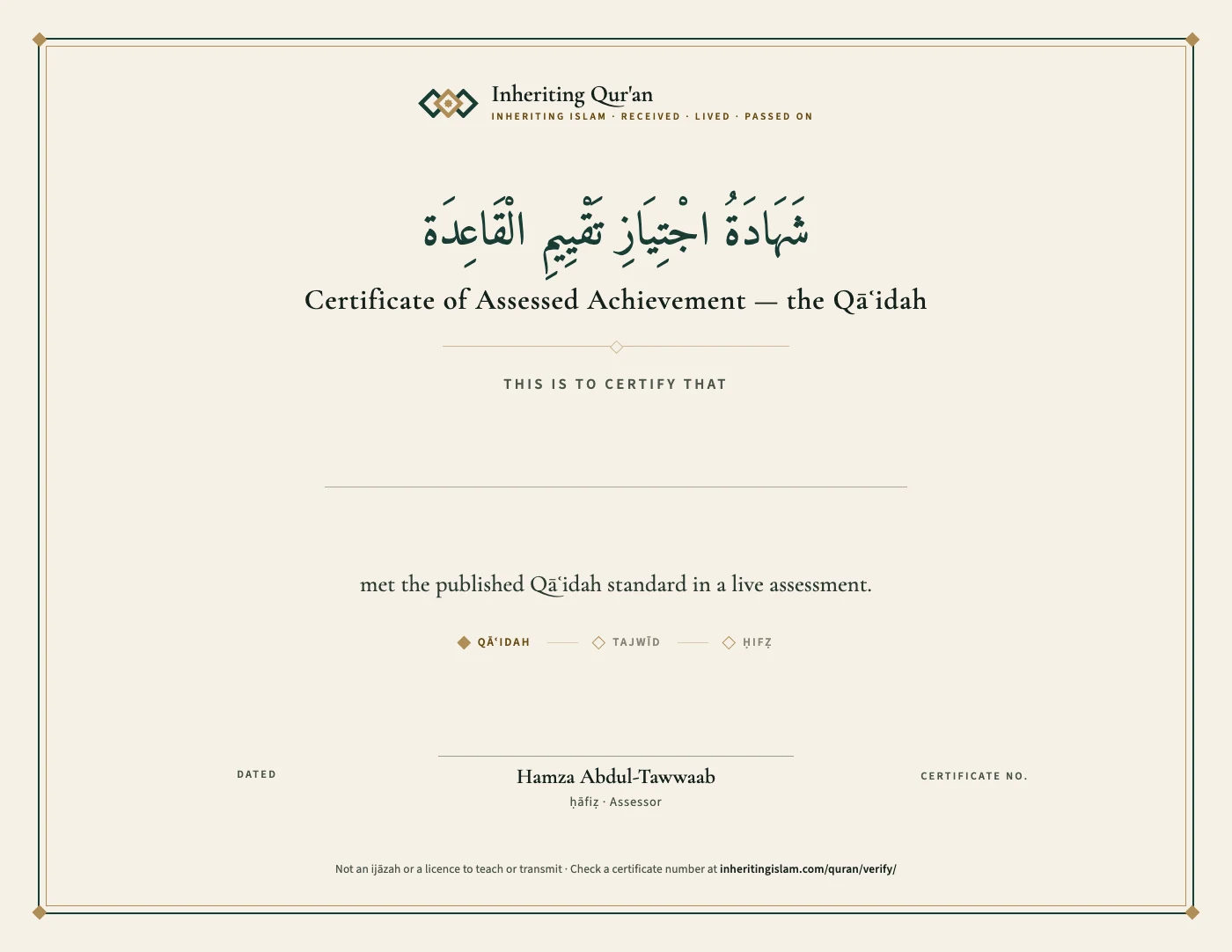
A blank landscape certificate on ivory with a pine and gold double border, the learner’s name, date and number left empty. Titled “Certificate of Assessed Achievement — the Qāʿidah”, with the Arabic title above. It reads: “met the published Qāʿidah standard in a live assessment”, with the first of three stage markers filled. Below: Hamza Abdul-Tawwaab, ḥāfiẓ · Assessor, and the footer “Not an ijāzah or a licence to teach or transmit · Check a certificate number at inheritingislam.com/quran/verify/”.
Blank specimen · no learner name · Qāʿidah — reading Full size (opens in a new tab)
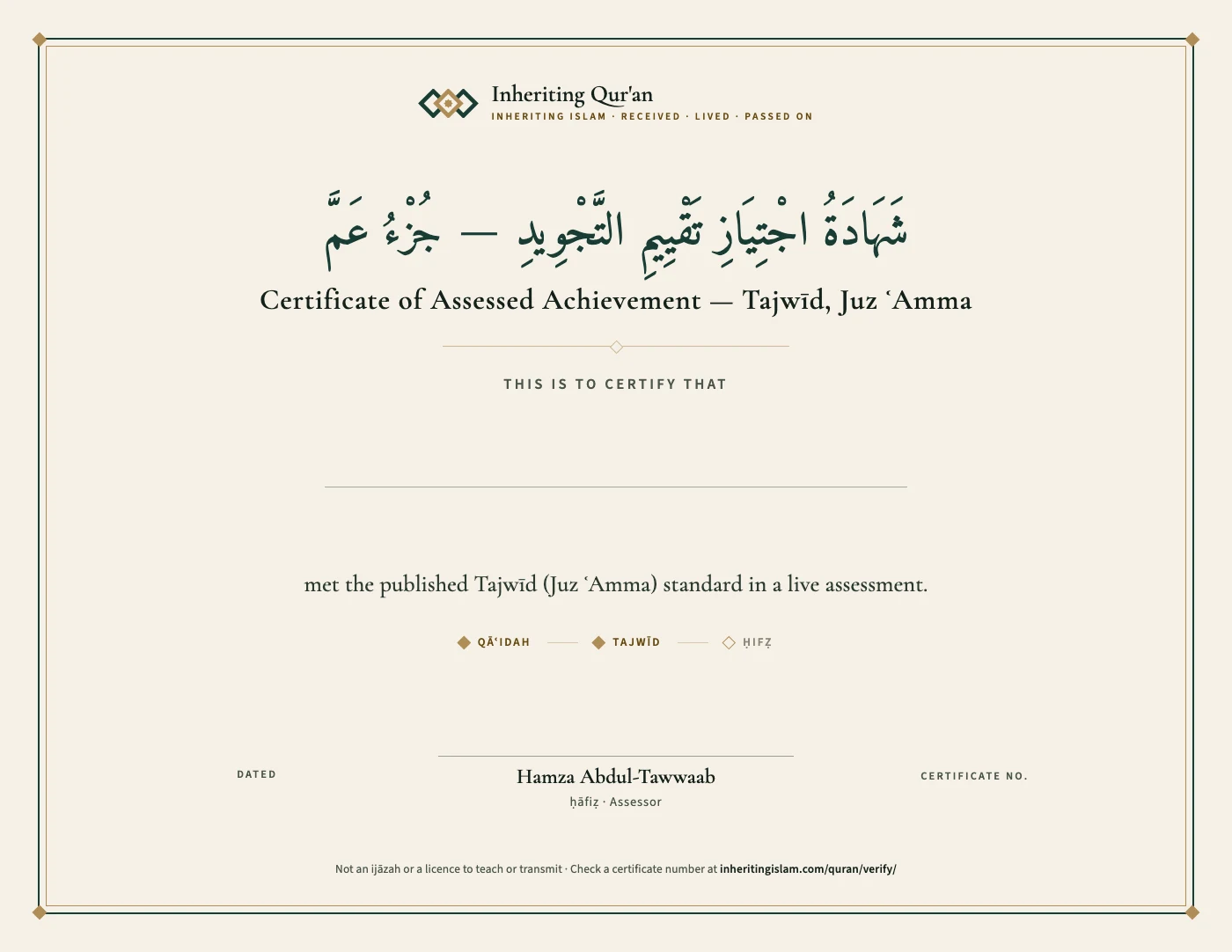
A blank landscape certificate on ivory with a pine and gold double border, the learner’s name, date and number left empty. Titled “Certificate of Assessed Achievement — Tajwīd, Juz ʿAmma”, with the Arabic title above. It reads: “met the published Tajwīd (Juz ʿAmma) standard in a live assessment”, with two of the three stage markers filled. Below: Hamza Abdul-Tawwaab, ḥāfiẓ · Assessor, and the footer “Not an ijāzah or a licence to teach or transmit · Check a certificate number at inheritingislam.com/quran/verify/”.
Blank specimen · no learner name · Tajwīd — Juz ʿAmma Full size (opens in a new tab)
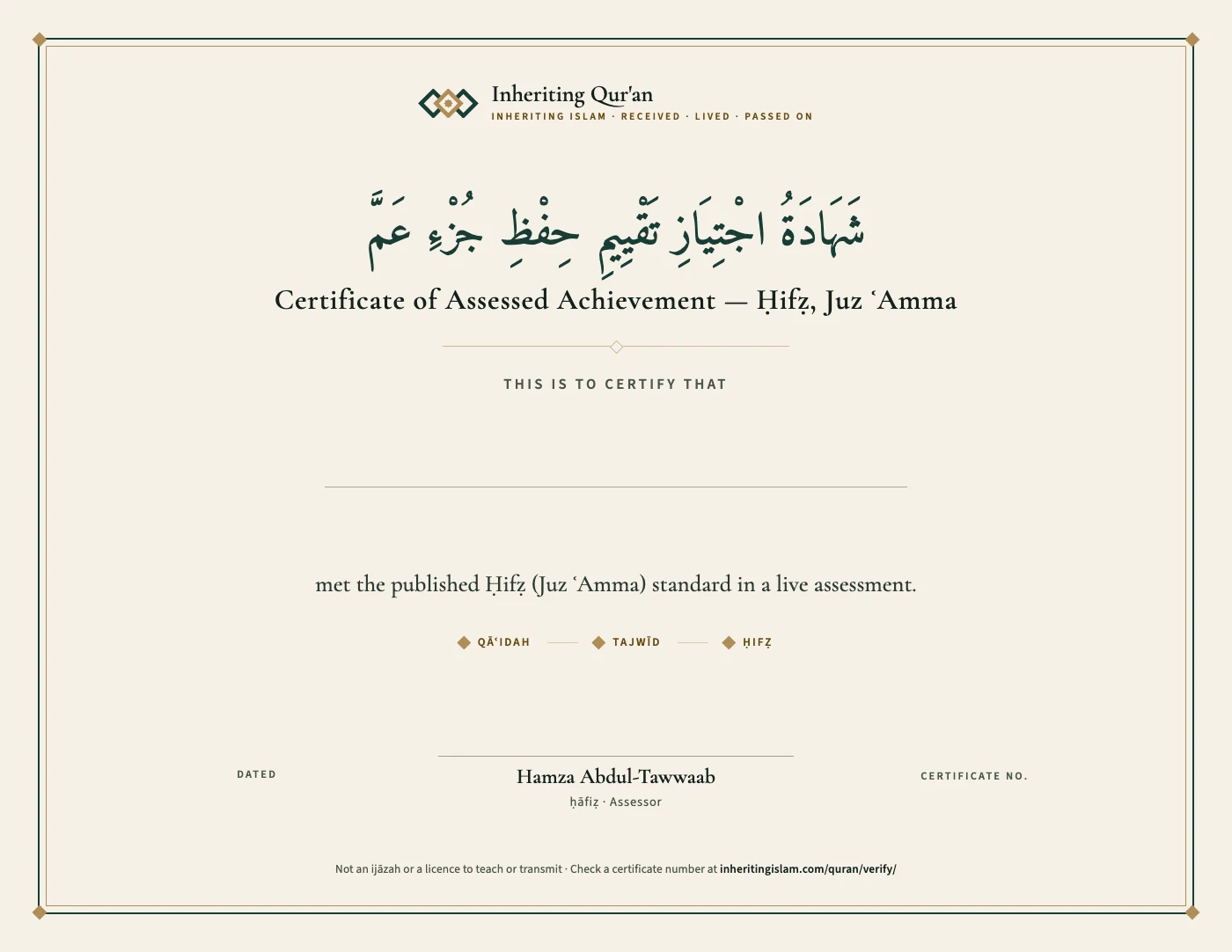
A blank landscape certificate on ivory with a pine and gold double border, the learner’s name, date and number left empty. Titled “Certificate of Assessed Achievement — Ḥifẓ, Juz ʿAmma”, with the Arabic title above. It reads: “met the published Ḥifẓ (Juz ʿAmma) standard in a live assessment”, with all three stage markers filled. Below: Hamza Abdul-Tawwaab, ḥāfiẓ · Assessor, and the footer “Not an ijāzah or a licence to teach or transmit · Check a certificate number at inheritingislam.com/quran/verify/”.
Blank specimen · no learner name · Ḥifẓ — Juz ʿAmma Full size (opens in a new tab)

Terms

The plain terms.

These are shown again before you pay and in your confirmation email.

  1. 01

    Who can book

    Learners aged 13 and over. Assessments for younger children are planned; parents can ask to be told when they open.

  2. 02

    Learners under 18

    A parent or guardian books, receives every email, and stays in the room and on camera for the whole session; if they leave, the session pauses until they return. Never recorded, and no transcription or AI note-taking.

  3. 03

    Recording, for adults

    Off by default. Recorded only with your consent in advance, confirmed again at the start; saying no never affects your assessment.
    You can withdraw consent at any time: the recording stops and is deleted.
    Used only to review that assessment, never for marketing, clips or AI, and permanently deleted within 30 days.

  4. 04

    The included retake

    One full assessment at the same stage, within 60 days of a written “not yet” result; the whole juz again for the Juz ʿAmma stages. Extended if the assessor’s availability prevents it. There is no third free attempt.

  5. 05

    Two-part assessments

    A Juz ʿAmma assessment may be split into two parts, booked together and completed within 14 days. The result follows within 7 days of the final part.

  6. 06

    Canceling

    24+ hours before your first appointment: full refund, started within 7 days.
    Two-part assessment, 24+ hours before part two: 50% refund (paid assessments only).
    No refund for a “not yet” result: the fee pays for the assessment and feedback, not a pass.

  7. 07

    Moving your time

    One free reschedule per package, with at least 24 hours’ notice.

  8. 08

    Late cancellations and missed sessions

    Under 24 hours’ notice, or not joining within 10 minutes, forfeits that sitting.
    A replacement sitting costs the stage fee, or 50% of it for one part of a two-part assessment.
    A missed sitting is not a “not yet” and does not use up your retake, but a missed retake sitting forfeits the retake.

  9. 09

    If we cancel, or the connection fails

    The assessment is resumed or replaced at no cost, and it does not use your retake. If the assessor cannot complete it, you receive a full refund.

  10. 10

    If no time suits

    If no mutually suitable appointment can be arranged within 14 days of payment, you receive a full refund.

  11. 11

    Asking for a review

    If you think a result is wrong, ask for a review within 14 days. You will have an answer within 7 days.

  12. 12

    Sponsored places

    A sponsored learner has the same assessment, feedback, retake and review rights as anyone else. Donors are not told who is helped.

Questions

Before you ask.

Why is there a fee when the books are free?

Many scholars permit payment for Qur’an teaching. Our fee pays for the assessor’s time: careful listening on the call, and the written feedback after it. A certificate is issued only when the published standard is met. The books remain free, and sponsored places are available.

Do I need to have learned from these books?

No. You may have learned at your masjid, from a family member, or on your own. You are heard against the standard, not against where you learned it.

Which assessment should I take first?

The one whose standard you can already meet. Most people begin with the Qāʿidah. The ḥifẓ assessment expects the tajwīd to hold while you recite from memory, so it usually comes last.

What do I need for the call?

A phone, tablet or computer with a camera and microphone, a steady connection, and a quiet room. For the Qāʿidah, the unseen text is shown on screen. For tajwīd, read from the muṣḥaf you normally use. For ḥifẓ, nothing is open in front of you.

What if I am nervous?

Most people are. Take a moment before you begin; a pause to breathe is not a mistake. And if it is not yet, the feedback tells you what to work on and one full retake is included.

Is the certificate an ijāzah?

No. It records that you met one published standard in a live assessment. It is not an ijāzah, not a license to teach, and it confers no title; see what the certificate is, and is not.

When do bookings open?

Soon, in shā’ Allāh. Send a request below and you will be told when they do. A request does not commit you to anything.

Request an assessment

Request an assessment, or be told when bookings open.

Prepare your message below, review it, then open your email app to send it to Hamza. He will reply with the next step.

If the learner is under 18, a parent or guardian should send this request. Learners aged 13 and over only, for now.

Prepare a draft below, review it, then open your email app to send. Nothing is sent by this website.

What happens next

Hamza replies by email. For a sponsored place, the reply carries a booking link when funding and a time are available. Nothing about your request is published, and a sponsored request is never shared with sponsors or anyone else.

Or write directly

Report a mistake

A wrong example, a typo, something broken? Say exactly what, and it gets checked and fixed.

What kind of mistake?

Only if you would like a reply. If you are under 13, ask a parent first.

Anonymous: no name, no account. How feedback is handled