Carried · Maryland and London
Three copies of the Qur’an, written from memory, Bluett says.
Thomas Bluett wrote that Ayuba copied the Qur’an from memory three times, in England, in 1733–34. Here is what we know of the man, and how we know it.
From Bundu
In his own country his name was Ayyūb ibn Sulaymān ibn Ibrāhīm. Thomas Bluett, who came to know him in England, wrote it down as “Hyuba, Boon Salumena, Boon Hibrahema.” The English called him Job, the son of Solomon. He came from Bundu, in West Africa, and he was a learned Muslim.
Bluett records that Ayuba’s father sent him to sell two enslaved people and to buy paper, and that on that journey, after he crossed the Gambia River, he was captured himself. His story belongs to a complicated history, and we tell it with that in view.
Timeline
- 1730 · Captured near the Gambia River (Bluett gives 27 February 1730 for his sale)
- 1731 · Enslaved in Maryland, by later scholarship’s dating
- 1733 · Sails for England; reaches London and gains his freedom
- 1733–34 · Writes out three copies of the Qur’an, Bluett says
- 1734 · Returns home to Africa
Maryland

He was captured near the Gambia River around 1730. Bluett gives the date of his sale as 27 February 1730, to Captain Pike, whose ship was in the service of Captain Henry Hunt; some later scholarship dates his enslavement in Maryland to 1731. He was taken to Annapolis, Maryland, and sold to a Mr. Tolsey on Kent Island.
Bluett says that, while enslaved in Maryland, Ayuba withdrew into the woods to pray. He ran away, was caught, and was put in jail. The title of Bluett’s book sums up those years in one line: Ayuba “was a Slave About Two Years in Maryland.”
A letter in Arabic
Ayuba wrote a letter in Arabic to his father, and the letter reached England. James Oglethorpe saw it and pledged payment: in Bluett’s words, he “gave his Bond to Mr. Hunt.”
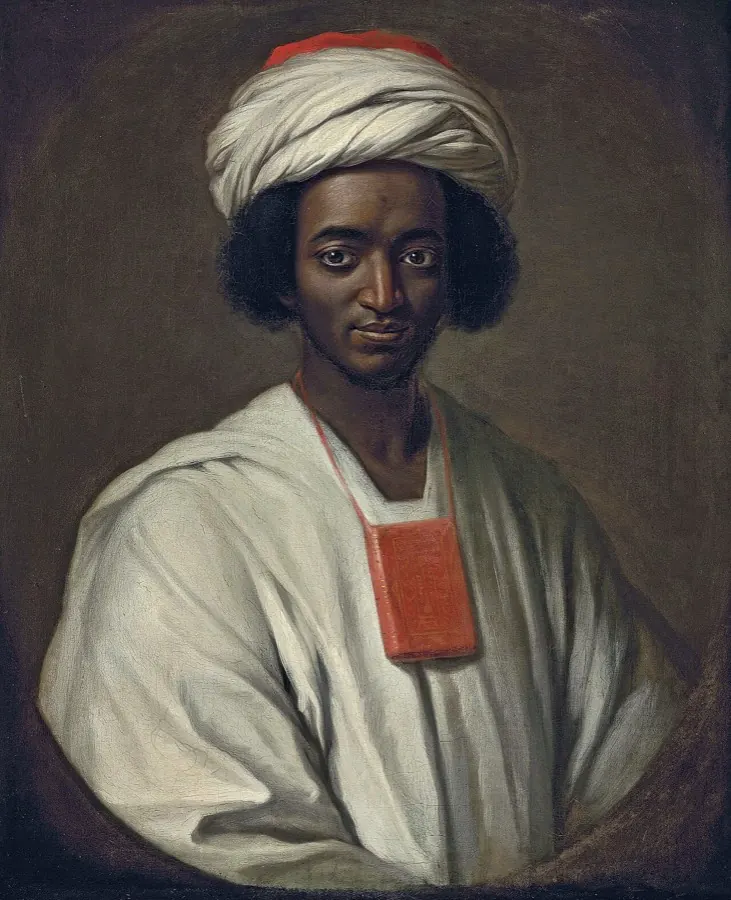
In March 1733 Ayuba sailed for England on the William, arriving, Bluett says, at “the latter End of April.” He reached London in 1733, and there he gained his freedom with help from several people. That same year William Hoare of Bath painted the portrait at the top of this page.
Three copies
His contemporary Thomas Bluett wrote that Ayuba knew the whole Qur’an by heart at fifteen, and that in England he wrote it out three times:
…he wrote three Copies of it without the Assistance of any other Copy, and without so much as looking to one of those three when he wrote the others.
Bluett knew Ayuba personally. Maurice Johnson named three recipients in a 1750 account, but whether the surviving manuscript was written entirely without consulting another copy remains uncertain.
A Qur’an manuscript dated 1733 is attributed to Ayuba and believed to be one of those copies. It is written in Arabic, in a personal, cursive hand, on European paper. The attribution rests partly on an old English note in the volume, probably from the eighteenth century. The manuscript was sold at auction in London in 2013, and the British Library showed it in its 2015–16 exhibition West Africa: Word, Symbol, Song, beside two of his letters. It is now in the El-Nimer Collection in Beirut. Scholars still ask whether it was written entirely without a copy to hand.
Home
In 1734 he went home to Africa, and Bluett published his account in London the same year. British Library scholars now read Ayuba’s own letters, written before, during and after his time in London, alongside the Qur’ans he is said to have written there.
They took his freedom. They couldn’t take what he carried in his heart. We hold that beside everything else Bluett tells us, including the errand Ayuba was on when he was captured: a true story does not have to be a simple one. What stays with us is the Qur’an itself, kept in one man’s memory across an ocean and written out again far from home. What are you carrying?
Sources
Every fact in this story comes from these. Where they disagree, the story says so.
- Bluett, Thomas. Some Memoirs of the Life of Job, the Son of Solomon, the High Priest of Boonda in Africa; Who was a Slave About Two Years in Maryland; and Afterwards Being Brought to England, was Set Free, and Sent to His Native Land in the Year 1734. London: Richard Ford, 1734. Transcription ↗︎ (opens another site) · Documenting the American South ↗︎ (opens another site)
- Naylor, Paul, and Marion Wallace. “Author of His Own Fate? The Eighteenth-Century Writings of Ayuba Sulayman Diallo.” Journal of African History 60, no. 3 (2019): 343–377. doi:10.1017/S0021853719000732 ↗︎ (opens another site)
- Bonhams, London. Sale 21359, lot 137, 8 October 2013: the Qur’an manuscript dated 1733 and attributed to Ayuba. Lot record ↗︎ (opens another site)
- LSE Africa blog. “West African history and culture unveiled in British Library exhibition.” 30 January 2016 (interview with curator Marion Wallace). Read the interview ↗︎ (opens another site)
- Dar El-Nimer, Beirut. “Diallo’s Journey,” a talk by Ian Foster. Event page ↗︎ (opens another site)
Image credits
- Portrait of Ayuba: William Hoare of Bath, Ayuba Suleiman Diallo, 1733, Qatar Museums. Public domain, via Wikimedia Commons ↗︎ (opens another site).
- The woods at dusk; the letter crossing the sea. Art: Inheriting Qur’an cut-paper illustration.
Start reading
Carry it yourself. Start from the first letter.
The Qāʿidah course on this site begins at the first Arabic letter and assumes nothing. It is free, with no account.
More from Carried