Part 2 · The nose · Lesson 6 of 16
The muṣḥaf tells you the rule
How to read the ruling for a sākin nūn straight off the page, instead of remembering four lists.
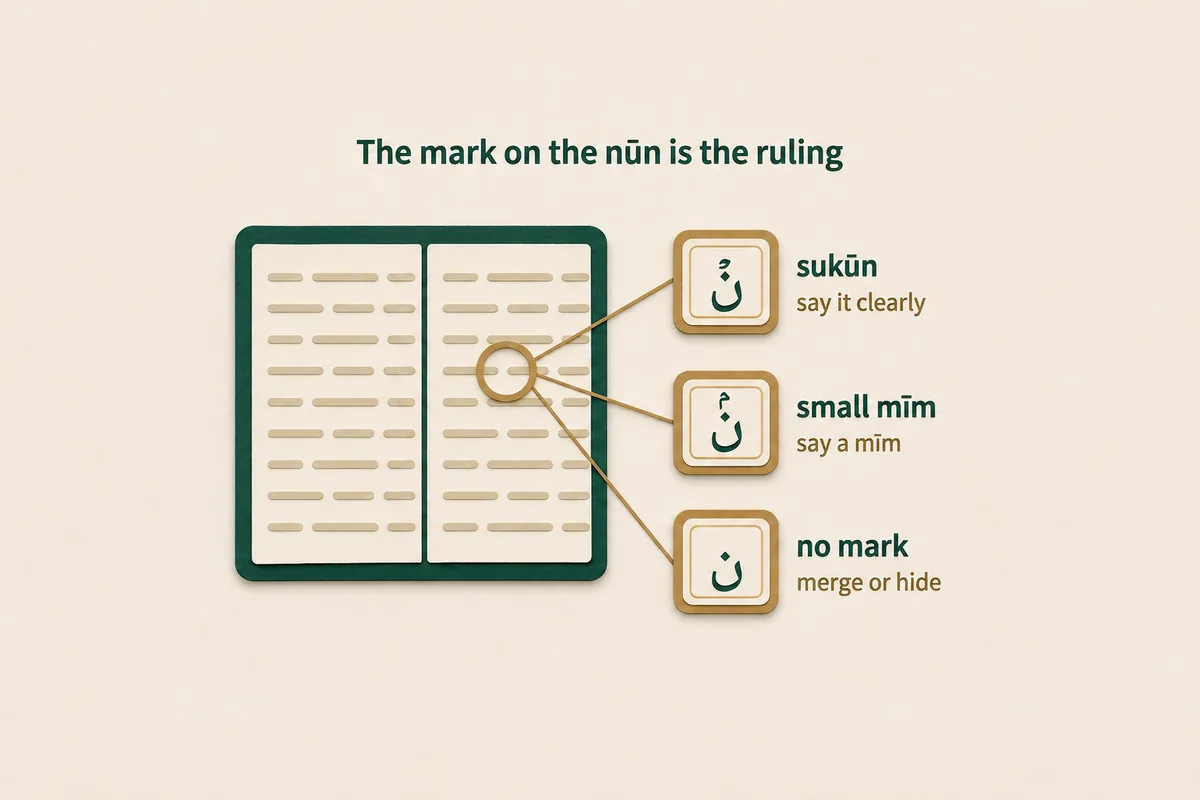
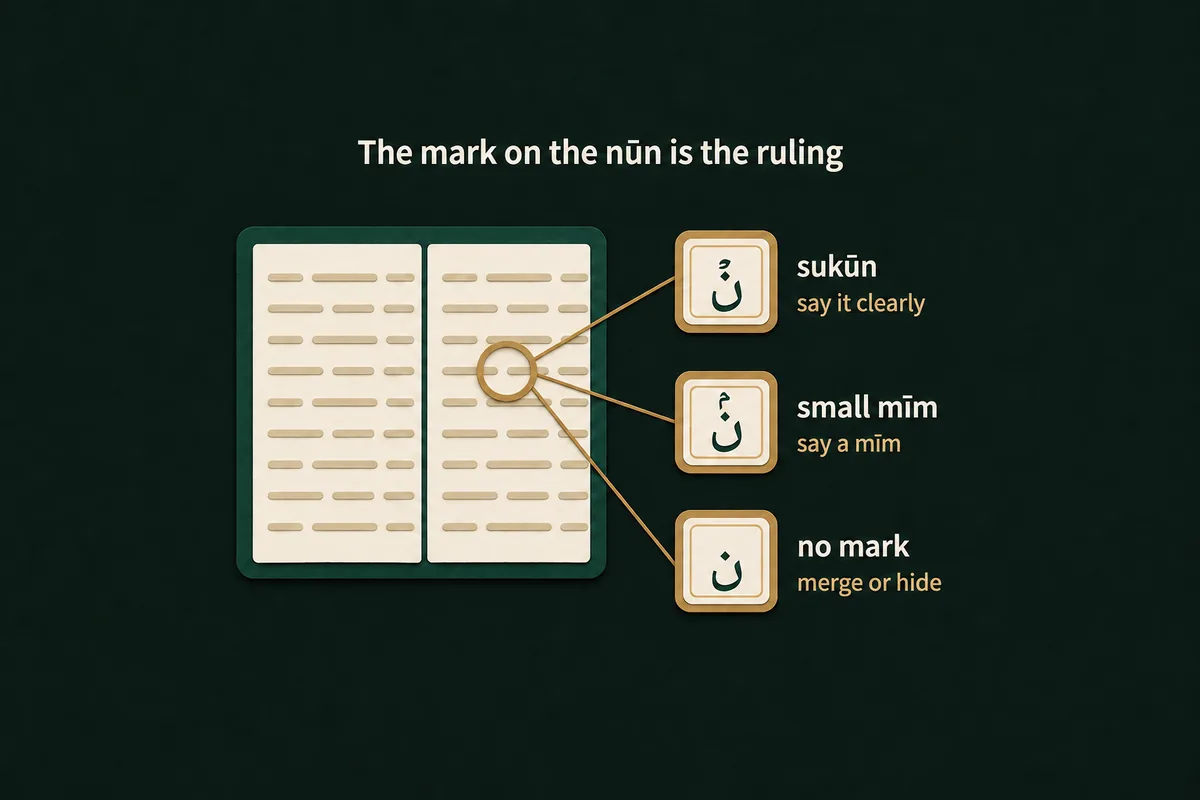
The rule
This is the spine of this part. The next four lessons each teach one ruling in detail, but if you only ever learn this page you will get them right anyway.
Taught as lists, a sākin nūn is twenty-eight facts to memorize — and students routinely learn them, pass the test, and cannot apply them at speed. The Uthmani text does not write a sākin nūn the same way in all four cases. The mark on the nūn is the ruling.
| What is printed | What you do | Its name |
|---|---|---|
| a sukūn is written | say the nūn clearly | Iẓhār |
| a small mīm replaces the sukūn | say a mīm instead | Iqlāb |
| bare, and the next letter has a shaddah | the nūn is gone — double the next letter | Idghām, complete |
| bare, and the next letter is ي or و | the place goes, the ghunnah stays | Idghām, incomplete |
| bare, anything else | hide it, keep the ghunnah | Ikhfāʾ |
Nothing above is an aid added to the text. It is how the muṣḥaf has been written for centuries. Learn it once and every muṣḥaf you pick up is annotated — including the plain one in the masjid, which is the one a color-coded student cannot read.
Examples from Juz ʿAmma only
In Juz ʿAmma
The book’s own examples, in muṣḥaf order. Nothing is colored: the marks that decide the ruling are already printed in the words. Choose one to see it in its āyah.
The book’s own examples, in muṣḥaf order. Nothing is colored: the marks that decide the ruling are already printed in the words.
Lesson six has no drill of its own in the book. These are the first examples from the drills of lessons seven to ten, one ruling at a time.
Iẓhār
4 of 68 in the juz- وَجَنَّٰتٍ أَلۡفَافًا78:16
- شَىۡءٍ أَحۡصَيۡنَٰهُ78:29
- عَطَآءً حِسَابࣰا78:36
- مِنۡهُ78:37
The example is underlined.
Idghām, complete
4 of 67 in the juz- فَلَن نَّزِيدَكُمۡ78:30
- جَزَآءࣰ مِّن78:36
- مِّن رَّبِّكَ78:36
- عِظَٰمࣰا نَّخِرَةࣰ79:11
The example is underlined.
Idghām, incomplete
4 of 46 in the juz- سِرَاجࣰا وَهَّاجࣰا78:13
- حَبࣰّا وَنَبَاتࣰا78:15
- بَرۡدࣰا وَلَا78:24
- حَمِيمࣰا وَغَسَّاقࣰا78:25
The example is underlined.
Iqlāb
4 of 12 in the juz- كِرَامِۭ بَرَرَةࣲ80:16
- فَأَنۢبَتۡنَا80:27
- ذَنۢبࣲ81:9
- مِنۢ بَيۡنِ86:7
The example is underlined.
Ikhfāʾ
4 of 128 in the juz- سَبۡعࣰا شِدَادࣰا78:12
- وَأَنزَلۡنَا78:14
- مَآءࣰ ثَجَّاجࣰا78:14
- يُنفَخُ78:18
The example is underlined.
5-question check
Spot the rule
A short self-check, using only the book’s examples. Choose an answer to see why. Nothing is saved or sent.
Question 1 of 5
Read the ruling off the page. Which is it?
زَجۡرَةࣱ وَٰحِدَةࣱSūrat an-Nāziʿāt 79:13- Iẓhār
- Idghām, complete
- Idghām, incomplete
- Iqlāb
- Ikhfāʾ
Show the answer
Answer: Idghām, incomplete. A yāʾ or wāw follows with no shaddah written: the nūn’s place goes, its ghunnah stays.
Question 2 of 5
Read the ruling off the page. Which is it?
ٱلۡأَنۡهَٰرُSūrat al-Burūj 85:11- Iẓhār
- Idghām, complete
- Idghām, incomplete
- Iqlāb
- Ikhfāʾ
Show the answer
Answer: Iẓhār. A throat letter follows the nūn or tanwīn, so the nūn is said clearly, with no ghunnah added.
Question 3 of 5
Read the ruling off the page. Which is it?
مَنۢ بَخِلَSūrat al-Layl 92:8- Iẓhār
- Idghām, complete
- Idghām, incomplete
- Iqlāb
- Ikhfāʾ
Show the answer
Answer: Iqlāb. A bāʾ follows, and the small mīm says so: the nūn becomes a hidden mīm with its ghunnah held.
Question 4 of 5
Read the ruling off the page. Which is it?
مِن ذِكۡرَىٰهَآSūrat an-Nāziʿāt 79:43- Iẓhār
- Idghām, complete
- Idghām, incomplete
- Iqlāb
- Ikhfāʾ
Show the answer
Answer: Ikhfāʾ. One of the fifteen follows, and the nūn is left bare: hide it and keep the ghunnah.
Question 5 of 5
Read the ruling off the page. Which is it?
ضَاحِكَةࣱ مُّسۡتَبۡشِرَةࣱSūrat ʿAbasa 80:39- Iẓhār
- Idghām, complete
- Idghām, incomplete
- Iqlāb
- Ikhfāʾ
Show the answer
Answer: Idghām, complete. The next letter carries a shaddah: the nūn is gone into it.
Lesson 6
The gate
The book ends every lesson with a gate. Move on when this is true of you:
Given any sākin nūn in unseen text, you name its ruling from what is printed — without reciting a list of letters to get there.
Each gate has two halves: you must make the sound, and you must hear it when it is missing. Ask someone who reads well to listen to you.
Ticking it marks the lesson done in this browser only. Nothing is sent anywhere.
Lesson 6 is done. On to the next one when you are ready.
Next: lesson 7 · IẓhārThis course is free, with no ads. Monthly supporters help keep it that way. Support from $10 a month
Help shape this lesson
How was this lesson?
One tap. It goes straight to Hamza, and it is how the next version of this lesson gets better.
Received. Jazāk Allāhu khayran. Hamza reads every one.
Anonymous: no name, no account. How feedback is handled
From Tajwīd for Juz ʿAmma, lesson 6 — the free book by Hamza Abdul-Tawwaab. Āyāt from the Uthmani text the book uses.
Qur’anic text: Tanzil Quran Text (Uthmani), via alquran.cloud. Marks are normalized for display (the sukūn and staggered tanwīn as the muṣḥaf prints them); the letters are unchanged.