Part 2 · The nose · Lesson 7 of 16
Iẓhār
The sākin nūn said plainly, and the six letters that require it.
The rule
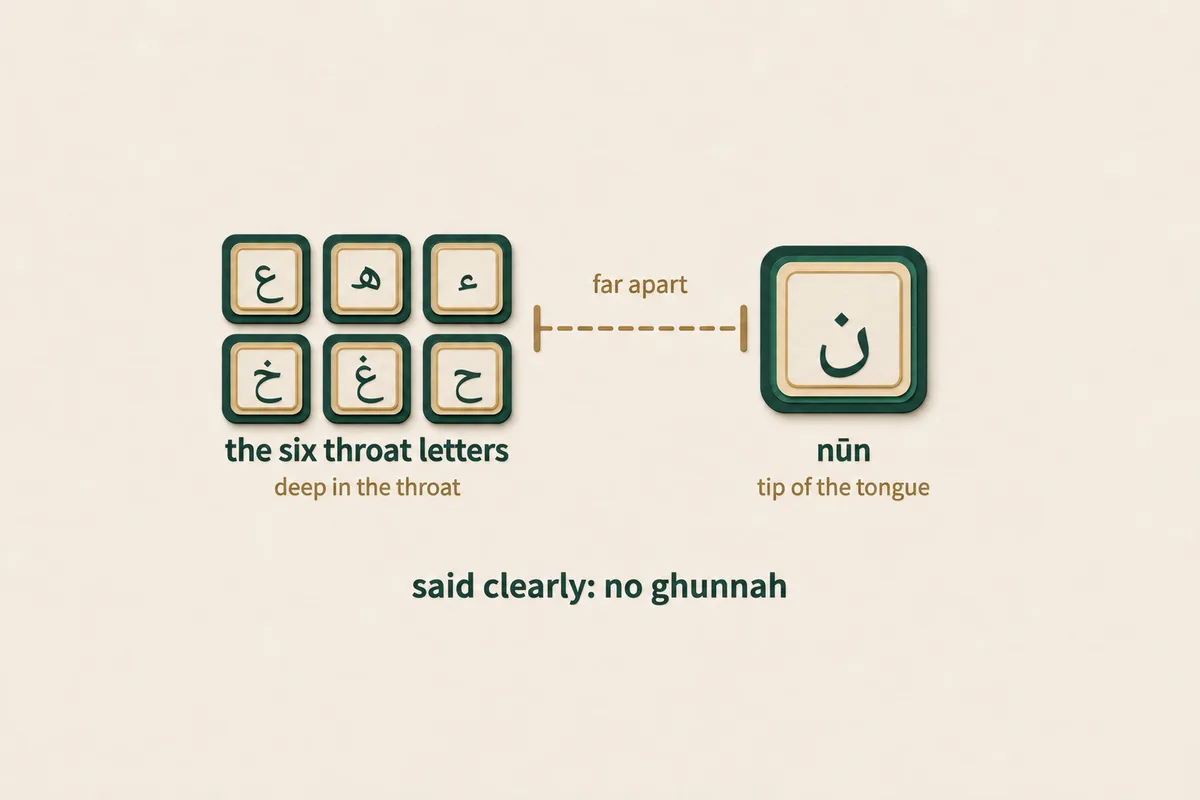
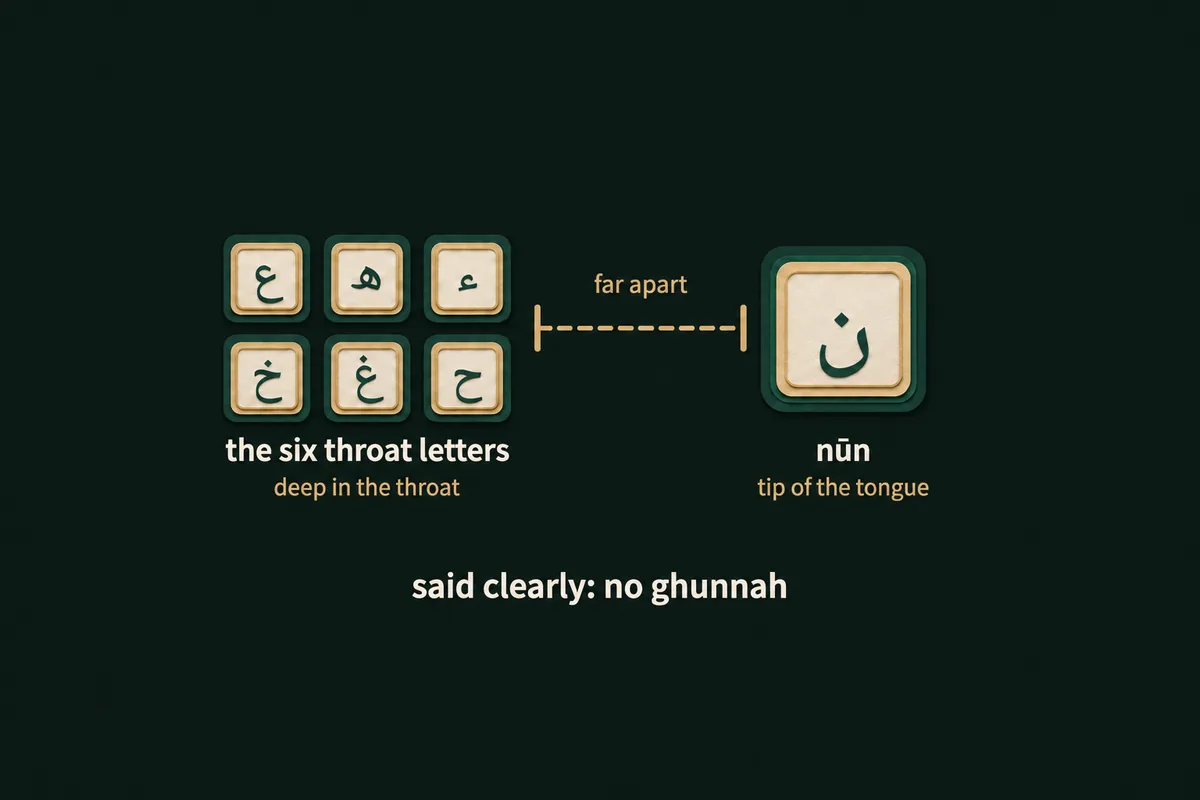
Iẓhār means making clear: the nūn is pronounced as itself, with no ghunnah added and nothing merged into what follows. It happens before the six throat letters: ء ه ع ح غ خ.
The reason is mechanical, not arbitrary. The nūn is made at the tip of the tongue and these six are made in the throat — too far apart for one to lean into the other. Every other letter is near enough that something happens.
The error to listen for is adding, not dropping. A student who has just learned ghunnah tends to put one everywhere, including here. Iẓhār is the ruling where the nose does nothing at all.
Examples from Juz ʿAmma only
In Juz ʿAmma
The book’s own examples, in muṣḥaf order. Nothing is colored: the marks that decide the ruling are already printed in the words. Choose one to see it in its āyah.
The book’s own examples, in muṣḥaf order. Nothing is colored: the marks that decide the ruling are already printed in the words.
Every case in Juz ʿAmma, listed by sūrah: Iẓhār — said clearly
Iẓhār
30 of 68 in the juzThe nose does nothing.
- وَجَنَّٰتٍ أَلۡفَافًا78:16
- شَىۡءٍ أَحۡصَيۡنَٰهُ78:29
- عَطَآءً حِسَابࣰا78:36
- مِنۡهُ78:37
- مَنۡ أَذِنَ78:38
- كَرَّةٌ خَاسِرَةࣱ79:12
- خَلۡقًا أَمِ79:27
- مِنۡهَا79:31
- وَلِأَنۡعَٰمِكُمۡ79:33
- عَشِيَّةً أَوۡ79:46
- عَنۡهُ80:10
- مِنۡ أَىِّ80:18
- نُّطۡفَةٍ خَلَقَهُۥ80:19
- مِّنۡهُمۡ80:37
- يَوۡمَئِذٍ عَلَيۡهَا80:40
- قُوَّةٍ عِندَ81:20
- إِنۡ هُوَ81:27
- عَنۡهَا82:16
- لِيَوۡمٍ عَظِيمࣲ83:5
- مُعۡتَدٍ أَثِيمٍ83:12
- كَادِحٌ إِلَىٰ84:6
- طَبَقًا عَن84:19
- بِعَذَابٍ أَلِيمٍ84:24
- أَجۡرٌ غَيۡرُ84:25
- مِنۡهُمۡ85:8
- ٱلۡأَنۡهَٰرُ85:11
- غُثَآءً أَحۡوَىٰ87:5
- نَارًا حَامِيَةࣰ88:4
- عَيۡنٍ ءَانِيَةࣲ88:5
- طَعَامٌ إِلَّا88:6
The example is underlined.
4-question check
Spot the rule
A short self-check, using only the book’s examples. Choose an answer to see why. Nothing is saved or sent.
Question 1 of 4
Which of these is iẓhār?
- خَلۡقًا أَمِ 79:27
- مُنذِرُ 79:45
- زَجۡرَةࣱ وَٰحِدَةࣱ 79:13
- سِرَاجࣰا وَهَّاجࣰا 78:13
Show the answer
Answer: خَلۡقًا أَمِ (79:27). A throat letter follows the nūn or tanwīn, so the nūn is said clearly, with no ghunnah added.
Question 2 of 4
Which of these is iẓhār?
- صُورَةࣲ مَّا 82:8
- ٱنتَثَرَتۡ 82:2
- لِمَن شَآءَ 81:28
- طَعَامٌ إِلَّا 88:6
Show the answer
Answer: طَعَامٌ إِلَّا (88:6). A throat letter follows the nūn or tanwīn, so the nūn is said clearly, with no ghunnah added.
Question 3 of 4
Which of these is iẓhār?
- ءَأَنتُمۡ 79:27
- فَمَن شَآءَ 78:39
- ٱلۡأَنۡهَٰرُ 85:11
- لِمَن يَرَىٰ 79:36
Show the answer
Answer: ٱلۡأَنۡهَٰرُ (85:11). A throat letter follows the nūn or tanwīn, so the nūn is said clearly, with no ghunnah added.
Question 4 of 4
Which of these is iẓhār?
- كَرَّةٌ خَاسِرَةࣱ 79:12
- مَآءࣰ ثَجَّاجࣰا 78:14
- وَكَأۡسࣰا دِهَاقࣰا 78:34
- أَنشَرَهُۥ 80:22
Show the answer
Answer: كَرَّةٌ خَاسِرَةࣱ (79:12). A throat letter follows the nūn or tanwīn, so the nūn is said clearly, with no ghunnah added.
All four rules side by side: the noon sākinah and tanwīn chart.
Lesson 7
The gate
The book ends every lesson with a gate. Move on when this is true of you:
You read a sākin nūn before all six throat letters clearly, with no ghunnah leaking in — and you hear it when someone else adds one.
Each gate has two halves: you must make the sound, and you must hear it when it is missing. Ask someone who reads well to listen to you.
Ticking it marks the lesson done in this browser only. Nothing is sent anywhere.
Lesson 7 is done. On to the next one when you are ready.
Next: lesson 8 · IdghāmThis course is free, with no ads. Monthly supporters help keep it that way. Support from $10 a month
Help shape this lesson
How was this lesson?
One tap. It goes straight to Hamza, and it is how the next version of this lesson gets better.
Received. Jazāk Allāhu khayran. Hamza reads every one.
Anonymous: no name, no account. How feedback is handled
From Tajwīd for Juz ʿAmma, lesson 7 — the free book by Hamza Abdul-Tawwaab. Āyāt from the Uthmani text the book uses.
Qur’anic text: Tanzil Quran Text (Uthmani), via alquran.cloud. Marks are normalized for display (the sukūn and staggered tanwīn as the muṣḥaf prints them); the letters are unchanged.