Part 2 · The nose · Lesson 5 of 16
Ghunnah
The held nasal sound, on its own, before any ruling uses it.
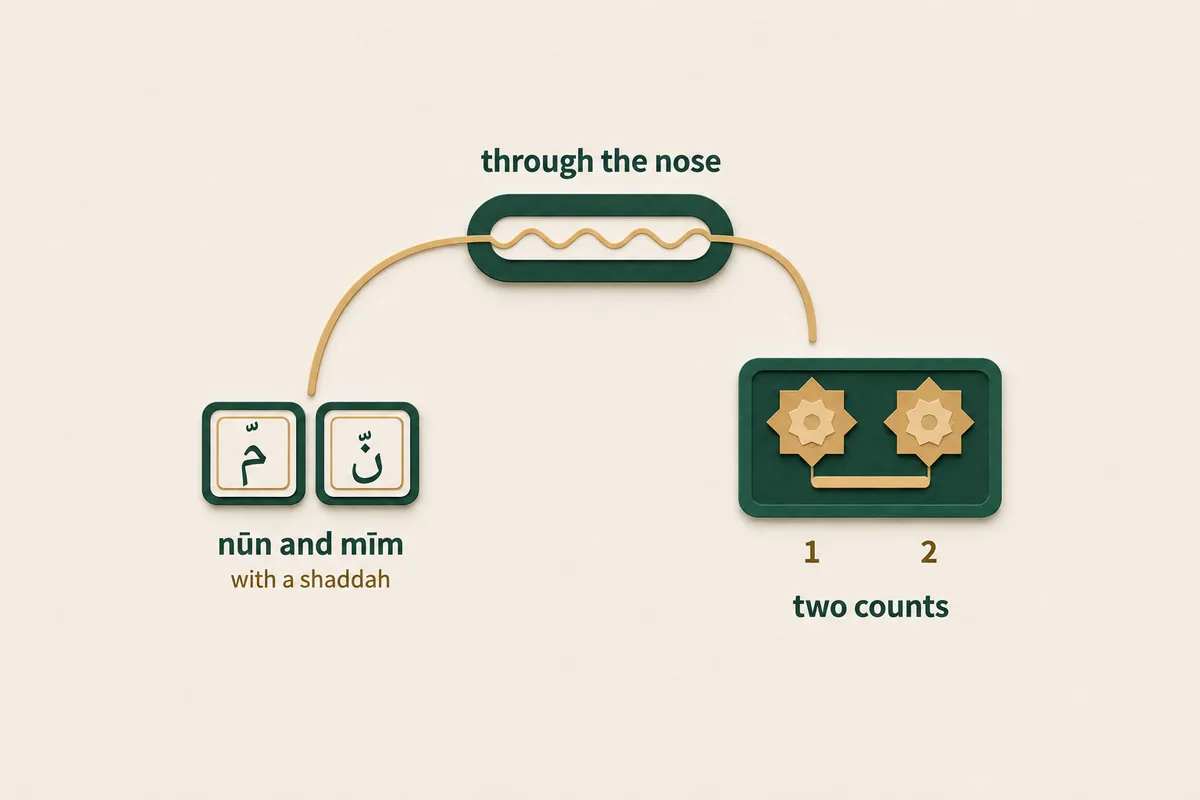
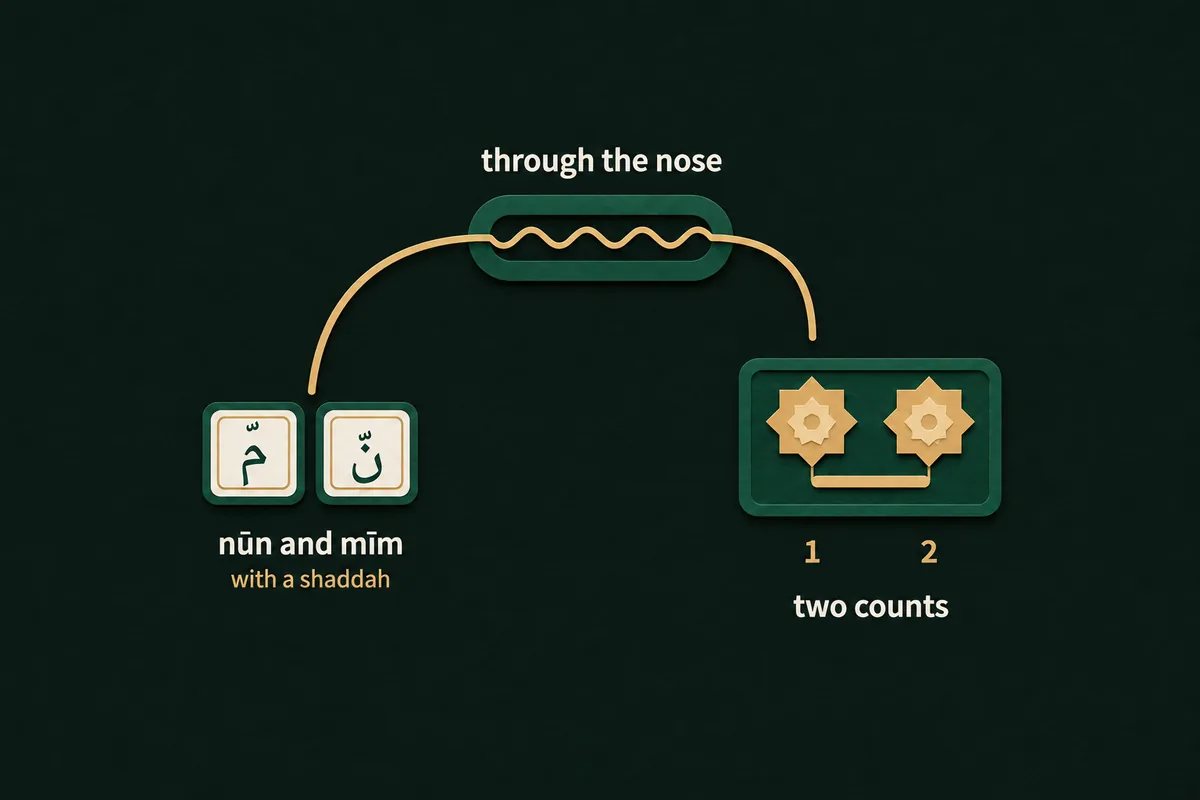
The rule
Every ruling in this part is a question about one sound, so learn the sound first and the rulings become bookkeeping. A ghunnah is made in the nose — the zone with no letters of its own. It belongs permanently to ن and م, and is fullest when either carries a shaddah.
The test that settles it. Pinch your nose and say إِنَّ. If the sound cannot come out, you made a ghunnah. If nothing changes, you did not, and the nūn is going through your mouth where it does not belong.
Two counts — the same two you hold a madd ṭabīʿī for. Not a flick, and not a hum you settle into. Every doubled nūn and mīm in the juz gets the same measure, and there are 209 of them waiting.
Examples from Juz ʿAmma only
In Juz ʿAmma
The book’s own examples, in muṣḥaf order. Nothing is colored: the marks that decide the ruling are already printed in the words. Choose one to see it in its āyah.
The book’s own examples, in muṣḥaf order. Nothing is colored: the marks that decide the ruling are already printed in the words.
Every case in Juz ʿAmma, listed by sūrah: Ghunnah — the nasal hold
Doubled nūn and mīm
36 of 209 in the juzPinch, release, pinch — until you stop needing to test.
- عَمَّ78:1
- ٱلنَّبَإِ78:2
- ثُمَّ78:5
- ٱلنَّهَارَ78:11
- وَجَنَّٰتٍ78:16
- إِنَّ78:17
- جَهَنَّمَ78:21
- إِنَّهُمۡ78:27
- نَّزِيدَكُمۡ78:30
- مِّن78:36
- إِنَّآ78:40
- وَٱلنَّٰزِعَٰتِ79:1
- وَٱلنَّٰشِطَٰتِ79:2
- أَءِنَّا79:10
- كُنَّا79:11
- نَّخِرَةࣰ79:11
- فَإِنَّمَا79:13
- إِنَّهُۥ79:17
- ٱلطَّآمَّةُ79:34
- فَأَمَّا79:37
- فَإِنَّ79:39
- وَأَمَّا79:40
- ٱلنَّفۡسَ79:40
- ٱلۡجَنَّةَ79:41
- إِنَّمَآ79:45
- كَأَنَّهُمۡ79:46
- أَمَّا80:5
- إِنَّهَا80:11
- مُّكَرَّمَةࣲ80:13
- مَّرۡفُوعَةࣲ80:14
- مُّطَهَّرَةِۭ80:14
- نُّطۡفَةٍ80:19
- لَمَّا80:23
- أَنَّا80:25
- مَّتَٰعࣰا80:32
- وَأُمِّهِۦ80:35
The example is underlined.
4-question check
Spot the rule
A short self-check, using only the book’s examples. Choose an answer to see why. Nothing is saved or sent.
Question 1 of 4
Which of these has a doubled nūn or mīm?
- أُقۡسِمُ 81:15
- وَأُمِّهِۦ 80:35
- لَغۡوࣰا 78:35
- وَغَسَّاقࣰا 78:25
Show the answer
Answer: وَأُمِّهِۦ (80:35). A shaddah on a nūn or mīm: a full ghunnah, held for two counts.
Question 2 of 4
Which of these has a doubled nūn or mīm?
- سَبۡحࣰا 79:3
- حَدَآئِقَ 78:32
- ٱلۡأَرۡضَ 78:6
- إِنَّآ 78:40
Show the answer
Answer: إِنَّآ (78:40). A shaddah on a nūn or mīm: a full ghunnah, held for two counts.
Question 3 of 4
Which of these has a doubled nūn or mīm?
- مِرۡصَادࣰا 78:21
- نَّزِيدَكُمۡ 78:30
- وِفَاقًا 78:26
- بِمَجۡنُونࣲ 81:22
Show the answer
Answer: نَّزِيدَكُمۡ (78:30). A shaddah on a nūn or mīm: a full ghunnah, held for two counts.
Question 4 of 4
Which of these has a doubled nūn or mīm?
- فَإِنَّمَا 79:13
- وَٱلصُّبۡحِ 81:18
- وَخَلَقۡنَٰكُمۡ 78:8
- مُخۡتَلِفُونَ 78:3
Show the answer
Answer: فَإِنَّمَا (79:13). A shaddah on a nūn or mīm: a full ghunnah, held for two counts.
Lesson 5
The gate
The book ends every lesson with a gate. Move on when this is true of you:
Every doubled nūn and mīm passes the pinched-nose test, held to a steady two counts — the same length each time, not longer when you are concentrating.
Each gate has two halves: you must make the sound, and you must hear it when it is missing. Ask someone who reads well to listen to you.
Ticking it marks the lesson done in this browser only. Nothing is sent anywhere.
Lesson 5 is done. On to the next one when you are ready.
Next: lesson 6 · The muṣḥaf tells you the ruleThis course is free, with no ads. Monthly supporters help keep it that way. Support from $10 a month
Help shape this lesson
How was this lesson?
One tap. It goes straight to Hamza, and it is how the next version of this lesson gets better.
Received. Jazāk Allāhu khayran. Hamza reads every one.
Anonymous: no name, no account. How feedback is handled
From Tajwīd for Juz ʿAmma, lesson 5 — the free book by Hamza Abdul-Tawwaab. Āyāt from the Uthmani text the book uses.
Qur’anic text: Tanzil Quran Text (Uthmani), via alquran.cloud. Marks are normalized for display (the sukūn and staggered tanwīn as the muṣḥaf prints them); the letters are unchanged.