Part 1 · The mouth · Lesson 4 of 16
Rāʾ
The one letter with two weights, and a rule for choosing between them.
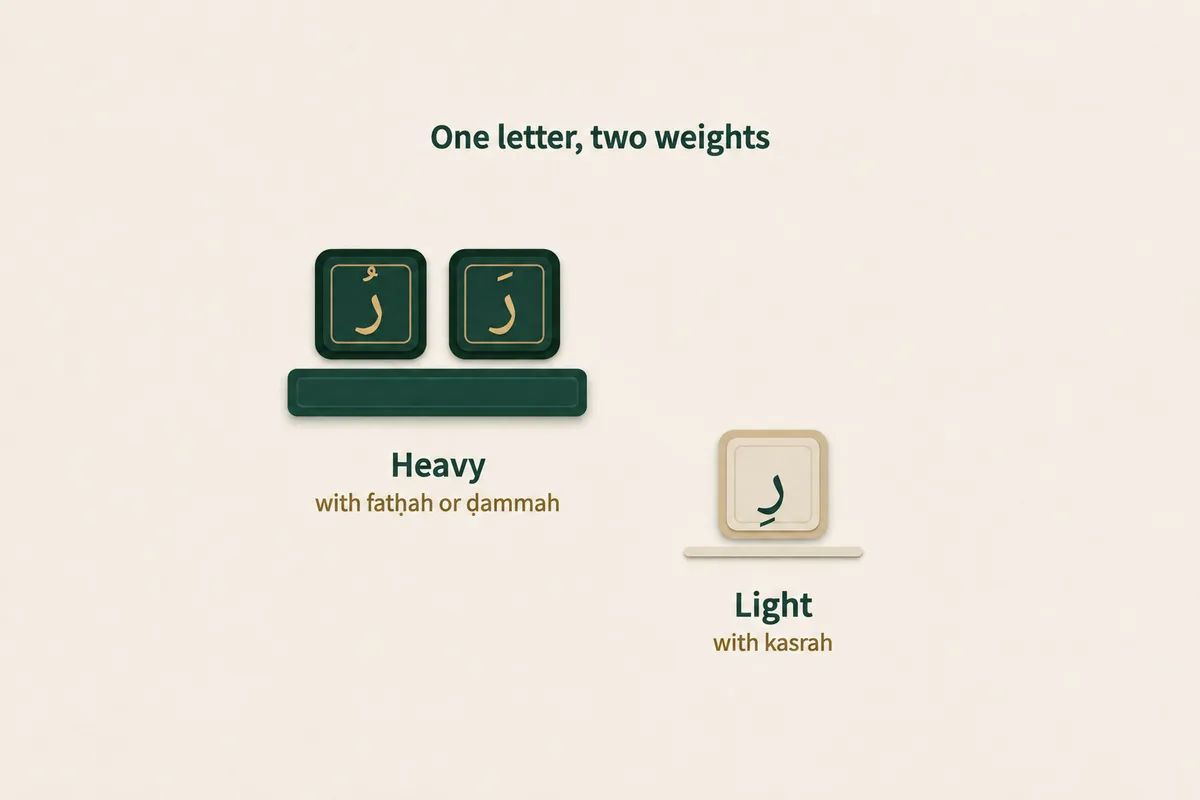
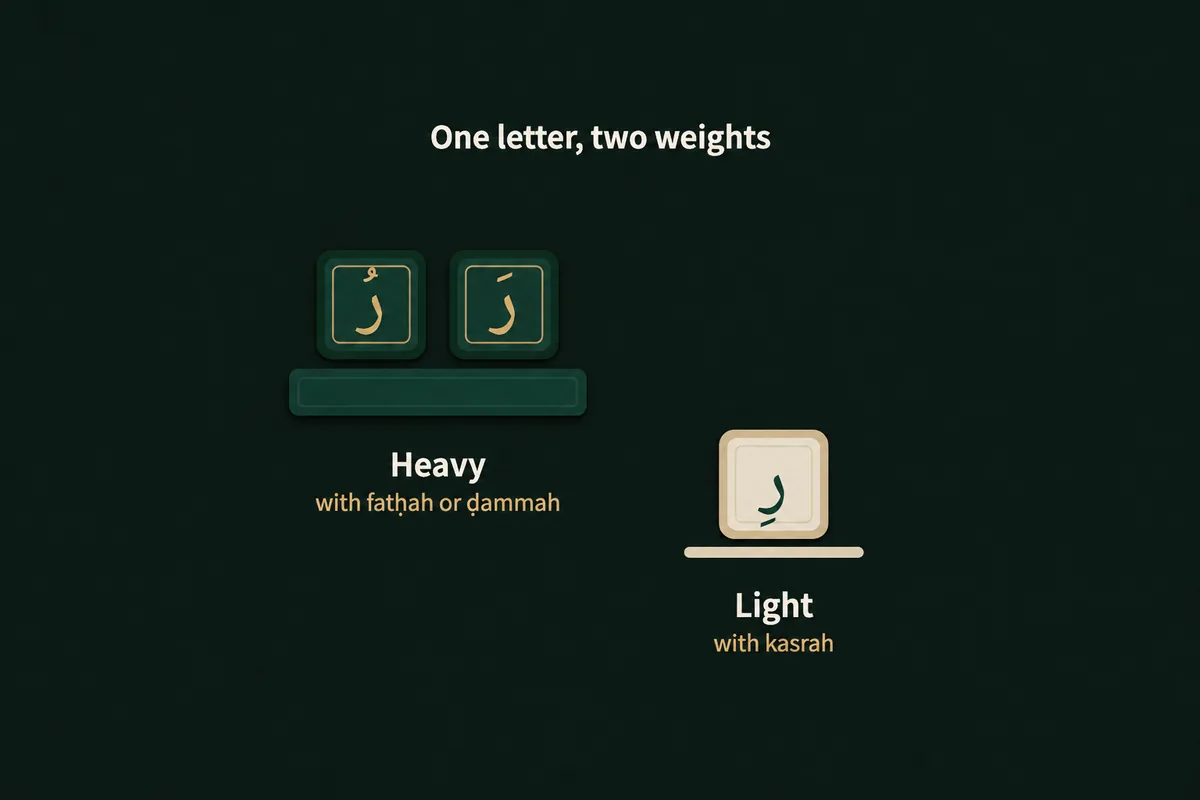
The rule
Rāʾ is neither in the seven nor safely outside them. It is heavy sometimes and light at others, and it gets its own lesson because it is the commonest correction a teacher makes after the throat letters.
The rule, in the order you check it
Heavy when the rāʾ carries a fatḥah or a ḍammah. Light when it carries a kasrah. When the rāʾ is sākin, look at the letter before it: a fatḥah or ḍammah before it keeps it heavy; a kasrah before it makes it light.
Where students actually go wrong is stopping. Stopping takes away the vowel the rāʾ was carrying, so a rāʾ that was light while you read through can change when you stop on it. The last section of this lesson shows what decides it.
Three words in this juz where that rule gives the wrong answer
Not three kinds of word — three words. Inside this juz, the rule above is right everywhere except here. Learn these three as words.
| مِرۡصَادࣰا | Sūrat an-Nabaʾ 78:21 | A kasrah before the rāʾ, but a heavy ص straight after it inside the same word. The heavy letter wins. | Heavy |
| لَبِٱلۡمِرۡصَادِ | Sūrat al-Fajr 89:14 | The same word again, carrying the article. | Heavy |
| ٱرۡجِعِىٓ | Sūrat al-Fajr 89:28 | The kasrah you say is only borrowed to get the word started. It is not part of the word, so it lightens nothing. | Heavy |
Rāʾ at a stop
When you stop, the rāʾ has no vowel of its own left to decide by, so look one step back. These are the words the āyāt of this juz actually end on.
| What comes before the rāʾ | In this juz | Weight |
|---|---|---|
| A fatḥah or ḍammah | ٱلۡكَوۡثَرَ108:1ٱلتَّكَاثُرُ102:1 | Heavy |
| A kasrah | لَقَادِرࣱ86:8ٱلۡمَقَابِرَ102:2 | Light |
| A sākin letter, with a fatḥah or ḍammah before that | ٱلۡقَدۡرِ97:1وَٱلۡعَصۡرِ103:1خُسۡرٍ103:2ٱلۡقُبُورِ100:9 | Heavy |
| A sākin letter, with a kasrah before that | حِجۡرٍ89:5 | Light |
| A sākin ي | ٱلۡكَبِيرُ85:11لَّخَبِيرُۢ100:11 | Light |
One word has two permitted ways. Stop on يَسۡرِ (89:4) and it may be read heavy or light.
3-question check
Spot the rule
A short self-check, using only the book’s examples. Choose an answer to see why. Nothing is saved or sent.
Question 1 of 3
Heavy or light? Read the rāʾ in this word.
مِرۡصَادࣰاSūrat an-Nabaʾ 78:21- Heavy
- Light
Show the answer
Answer: Heavy. A kasrah before the rāʾ, but a heavy ص straight after it inside the same word. The heavy letter wins.
Question 2 of 3
Heavy or light? Read the rāʾ in this word.
لَبِٱلۡمِرۡصَادِSūrat al-Fajr 89:14- Heavy
- Light
Show the answer
Answer: Heavy. The same word again, carrying the article.
Question 3 of 3
Heavy or light? Read the rāʾ in this word.
ٱرۡجِعِىٓSūrat al-Fajr 89:28- Heavy
- Light
Show the answer
Answer: Heavy. The kasrah you say is only borrowed to get the word started. It is not part of the word, so it lightens nothing.
Lesson 4
The gate
The book ends every lesson with a gate. Move on when this is true of you:
You choose correctly on an unseen rāʾ, reading through, without pausing to work it out — and when you get one wrong you can say which part you missed.
Each gate has two halves: you must make the sound, and you must hear it when it is missing. Ask someone who reads well to listen to you.
Ticking it marks the lesson done in this browser only. Nothing is sent anywhere.
Lesson 4 is done. On to the next one when you are ready.
Next: lesson 5 · GhunnahThis course is free, with no ads. Monthly supporters help keep it that way. Support from $10 a month
Help shape this lesson
How was this lesson?
One tap. It goes straight to Hamza, and it is how the next version of this lesson gets better.
Received. Jazāk Allāhu khayran. Hamza reads every one.
Anonymous: no name, no account. How feedback is handled
From Tajwīd for Juz ʿAmma, lesson 4 — the free book by Hamza Abdul-Tawwaab. Āyāt from the Uthmani text the book uses.
Qur’anic text: Tanzil Quran Text (Uthmani), via alquran.cloud. Marks are normalized for display (the sukūn and staggered tanwīn as the muṣḥaf prints them); the letters are unchanged.