Part 1 · The mouth · Lesson 3 of 16
Heavy and light
The seven letters that raise the back of the tongue, and what they do to the vowel after them.
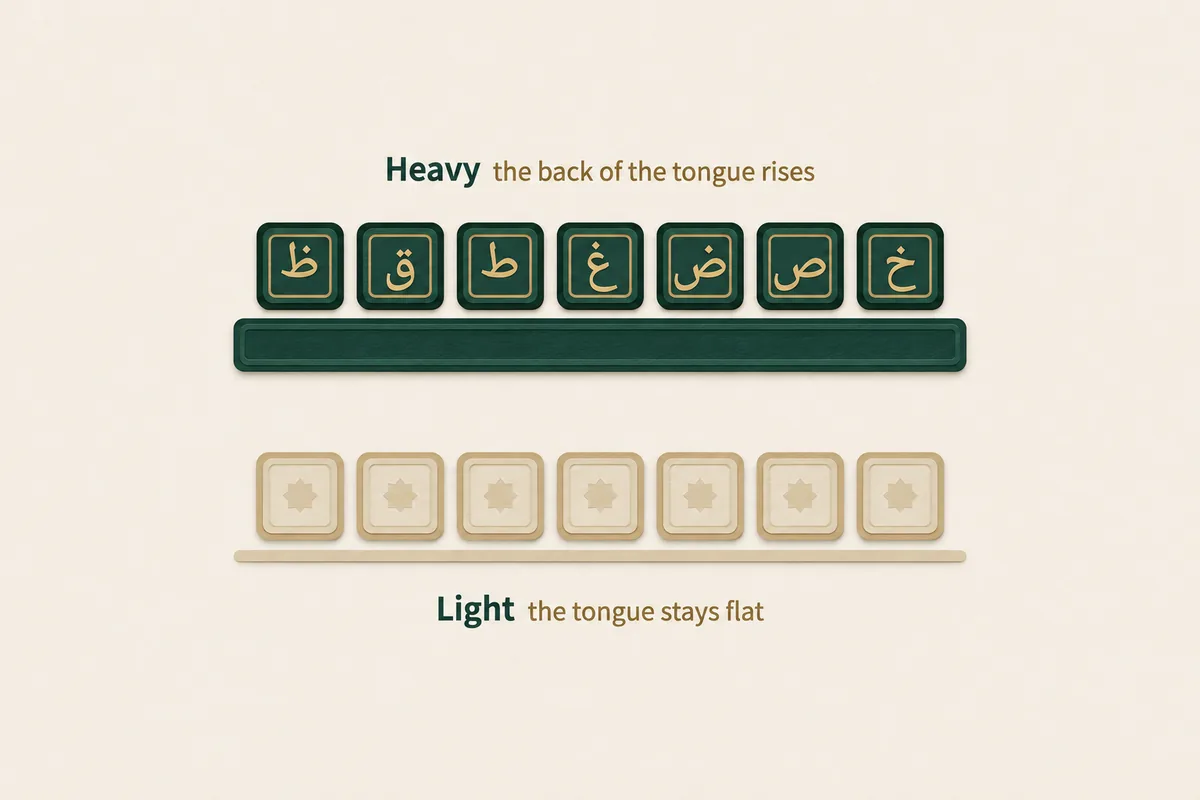
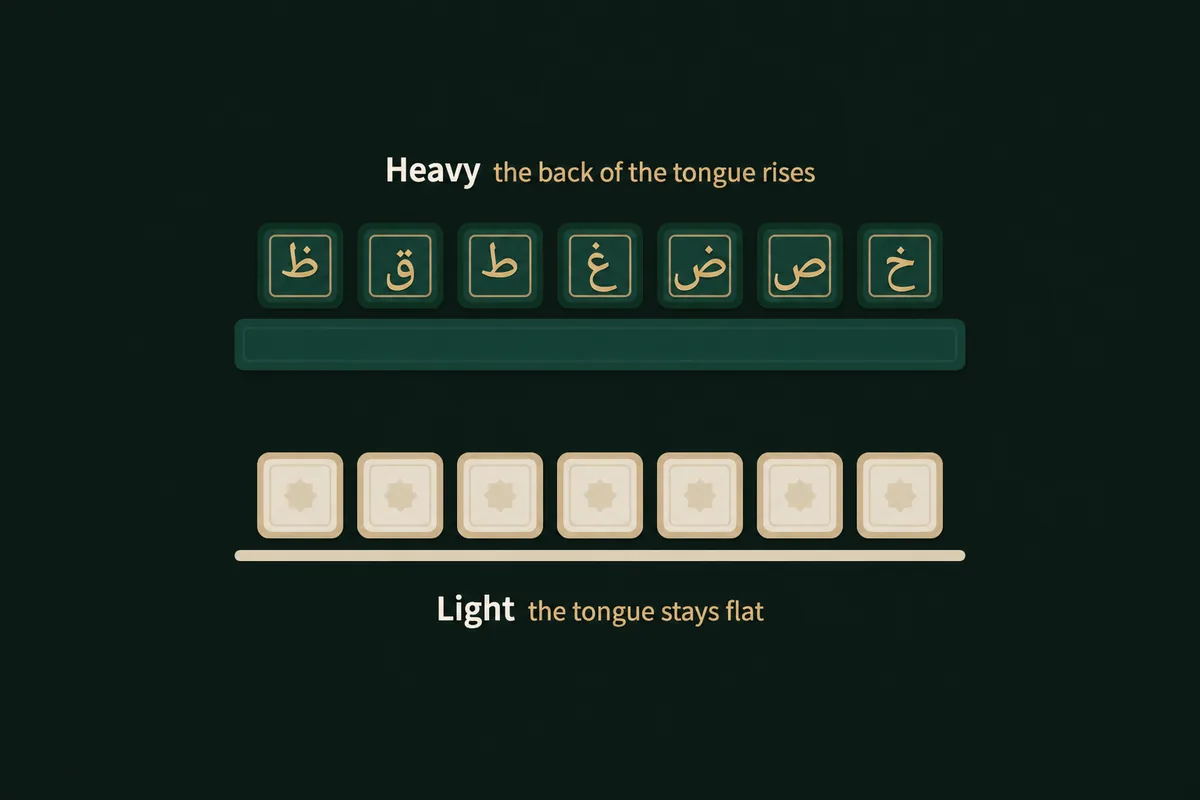
The rule
Some letters are made with the tongue flat; some with the back of the tongue raised toward the roof of the mouth, which darkens the sound and the vowel after it. Arabic calls the raising istiʿlāʾ. The seven are خ ص ض غ ط ق ظ.
You do not thicken the vowel deliberately. You raise the tongue for the letter, and the vowel thickens because it has nowhere else to go — which is why the fatḥah after a heavy letter comes out closer to the a of father.
The lām in the name of Allah
One letter changes weight by what comes before it, in the most recited word in the language. It is heavy after a fatḥah or ḍammah, light after a kasrah.
| نَصۡرُ ٱللَّهِ | ḍammah before it — heavy | Sūrat an-Naṣr 110:1 |
| بِسۡمِ ٱللَّهِ | kasrah before it — light | the basmalah |
Examples from Juz ʿAmma only
In Juz ʿAmma
The book’s own examples, in muṣḥaf order. Nothing is colored: the marks that decide the ruling are already printed in the words. Choose one to see it in its āyah.
The book’s own examples, in muṣḥaf order. Nothing is colored: the marks that decide the ruling are already printed in the words.
Every case in Juz ʿAmma, listed by sūrah: Heavy letters
The seven heavy letters, in the juz
24 of 456 in the juzEvery word holds at least one of the seven. Raise the tongue for it, and leave the rest light.
- ٱلۡعَظِيمِ78:2
- مُخۡتَلِفُونَ78:3
- ٱلۡأَرۡضَ78:6
- وَخَلَقۡنَٰكُمۡ78:8
- فَوۡقَكُمۡ78:12
- ٱلۡمُعۡصِرَٰتِ78:14
- لِّنُخۡرِجَ78:15
- ٱلۡفَصۡلِ78:17
- مِيقَٰتࣰا78:17
- يُنفَخُ78:18
- ٱلصُّورِ78:18
- مِرۡصَادࣰا78:21
- لِّلطَّٰغِينَ78:22
- أَحۡقَابࣰا78:23
- يَذُوقُونَ78:24
- وَغَسَّاقࣰا78:25
- وِفَاقًا78:26
- أَحۡصَيۡنَٰهُ78:29
- فَذُوقُوا۟78:30
- لِلۡمُتَّقِينَ78:31
- حَدَآئِقَ78:32
- دِهَاقࣰا78:34
- لَغۡوࣰا78:35
- عَطَآءً78:36
The example is underlined.
4-question check
Spot the rule
A short self-check, using only the book’s examples. Choose an answer to see why. Nothing is saved or sent.
Question 1 of 4
Which of these holds one of the seven heavy letters?
- أَحۡقَابࣰا 78:23
- ثُمَّ 78:5
- وَوُجُوهࣱ يَوۡمَئِذٍ 80:40
- عَيۡنࣰا يَشۡرَبُ 83:28
Show the answer
Answer: أَحۡقَابࣰا (78:23). It holds one of the seven heavy letters: خ ص ض غ ط ق ظ.
Question 2 of 4
Which of these holds one of the seven heavy letters?
- إِنَّهُمۡ 78:27
- عَيۡنٍ ءَانِيَةࣲ 88:5
- لَمَّا 80:23
- عَطَآءً 78:36
Show the answer
Answer: عَطَآءً (78:36). It holds one of the seven heavy letters: خ ص ض غ ط ق ظ.
Question 3 of 4
Which of these holds one of the seven heavy letters?
- إِنَّهَا 80:11
- وَيۡلࣱ يَوۡمَئِذࣲ 83:10
- لِّنُخۡرِجَ 78:15
- إِنَّآ 78:40
Show the answer
Answer: لِّنُخۡرِجَ (78:15). It holds one of the seven heavy letters: خ ص ض غ ط ق ظ.
Question 4 of 4
Which of these holds one of the seven heavy letters?
- بَرۡدࣰا وَلَا 78:24
- لِلۡمُتَّقِينَ 78:31
- مِّنۡهُمۡ 80:37
- عَنۡهُ 80:10
Show the answer
Answer: لِلۡمُتَّقِينَ (78:31). It holds one of the seven heavy letters: خ ص ض غ ط ق ظ.
Lesson 3
The gate
The book ends every lesson with a gate. Move on when this is true of you:
You keep the seven heavy through a whole sūrah without thickening anything else, and you get the lām of the name right in both directions unprompted.
Each gate has two halves: you must make the sound, and you must hear it when it is missing. Ask someone who reads well to listen to you.
Ticking it marks the lesson done in this browser only. Nothing is sent anywhere.
Lesson 3 is done. On to the next one when you are ready.
Next: lesson 4 · RāʾThis course is free, with no ads. Monthly supporters help keep it that way. Support from $10 a month
Help shape this lesson
How was this lesson?
One tap. It goes straight to Hamza, and it is how the next version of this lesson gets better.
Received. Jazāk Allāhu khayran. Hamza reads every one.
Anonymous: no name, no account. How feedback is handled
From Tajwīd for Juz ʿAmma, lesson 3 — the free book by Hamza Abdul-Tawwaab. Āyāt from the Uthmani text the book uses.
Qur’anic text: Tanzil Quran Text (Uthmani), via alquran.cloud. Marks are normalized for display (the sukūn and staggered tanwīn as the muṣḥaf prints them); the letters are unchanged.