Part 2 · The nose · Lesson 11 of 16
Mīm sākinah
Three rulings for the sākin mīm, one of which is missed constantly.
The rule
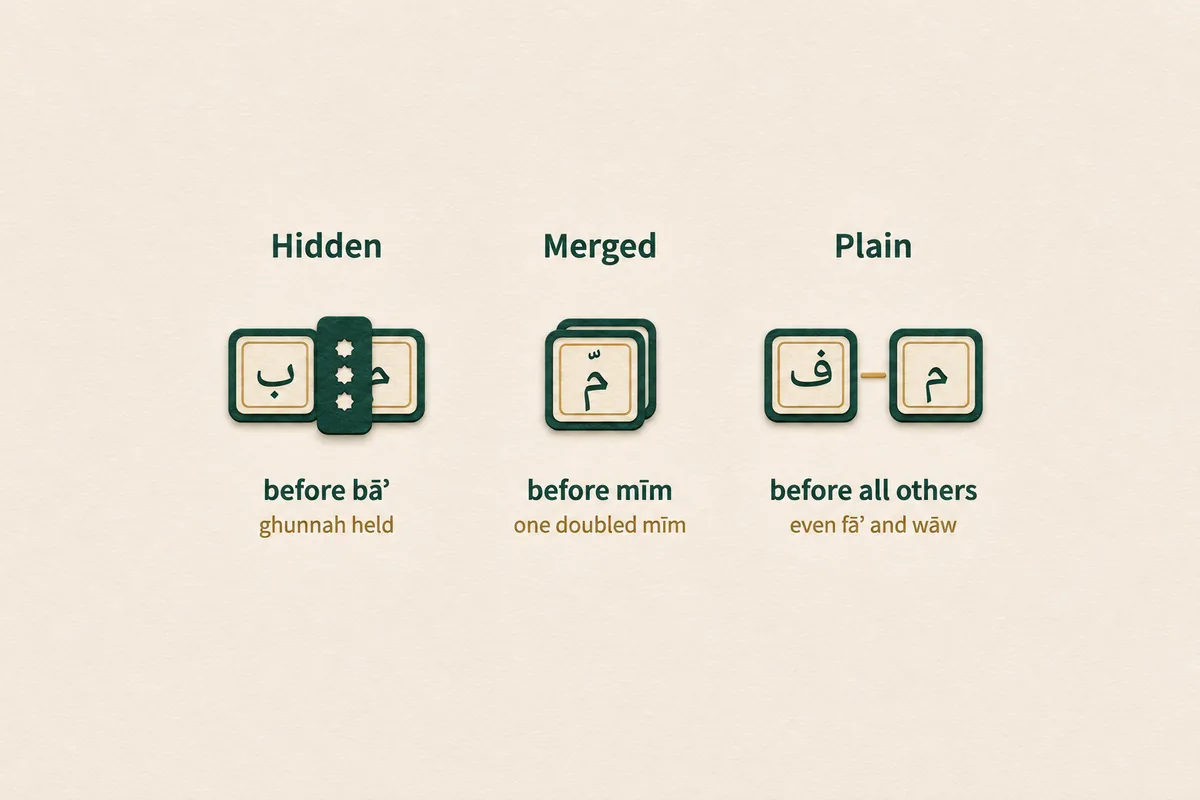
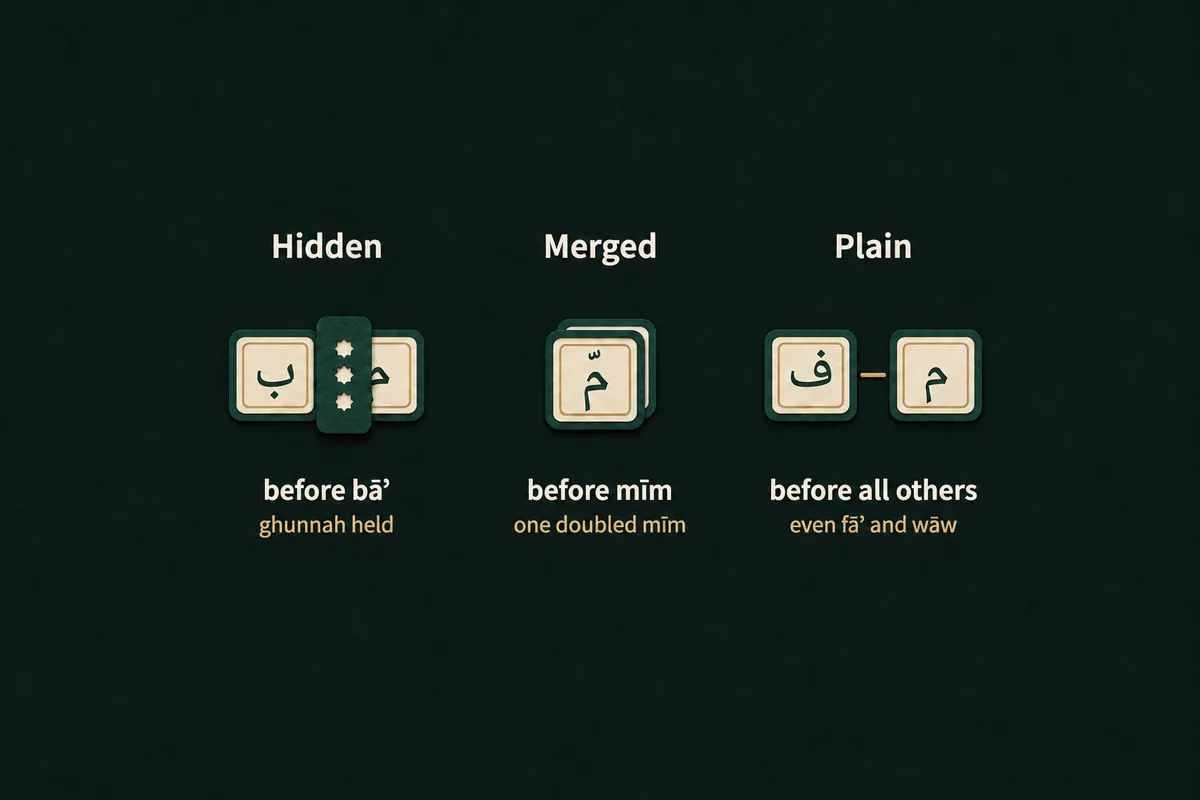
The sākin mīm is simpler than the nūn: three rulings, and the letter that follows decides. Before ب it is hidden — ikhfāʾ shafawī, 9 sites. Before another م the two become one doubled mīm — idghām shafawī, 7 sites. Before everything else it is said plainly, with no ghunnah added — iẓhār shafawī, and at 79 sites that is the commonest of the three by a distance.
The two to watch are ف and و, and this is the miss that gives everyone away. They are made at or near the lips, so a sākin mīm before them wants to blur — but the ruling is iẓhār. The mīm must be closed and released cleanly before the next letter starts. Nothing hidden, nothing held.
Examples from Juz ʿAmma only
In Juz ʿAmma
The book’s own examples, in muṣḥaf order. Nothing is colored: the marks that decide the ruling are already printed in the words. Choose one to see it in its āyah.
The book’s own examples, in muṣḥaf order. Nothing is colored: the marks that decide the ruling are already printed in the words.
Every case in Juz ʿAmma, listed by sūrah: The sākin mīm
Hidden — before bāʾ
all 9 in the juzHidden, with its ghunnah.
- هُم بِٱلسَّاهِرَةِ79:14
- صَاحِبُكُم بِمَجۡنُونࣲ81:22
- كُنتُم بِهِۦ83:17
- فَبَشِّرۡهُم بِعَذَابٍ84:24
- عَلَيۡهِم بِمُصَيۡطِرٍ88:22
- رَبُّهُم بِذَنۢبِهِمۡ91:14
- يَعۡلَم بِأَنَّ96:14
- رَبَّهُم بِهِمۡ100:11
- تَرۡمِيهِم بِحِجَارَةࣲ105:4
The example is underlined.
Merged — before another mīm
all 7 in the juzThe two become one doubled mīm.
- أَنَّهُم مَّبۡعُوثُونَ83:4
- قُلُوبِهِم مَّا83:14
- وَرَآئِهِم مُّحِيطُۢ85:20
- رَبِّهِم مِّن97:4
- عَلَيۡهِم مُّؤۡصَدَةࣱ104:8
- أَطۡعَمَهُم مِّن106:4
- وَءَامَنَهُم مِّنۡ106:4
The example is underlined.
Plain — before everything else
24 of 79 in the juzThe commonest, and the one that blurs.
- هُمۡ فِيهِ78:3
- أَلَمۡ نَجۡعَلِ78:6
- وَخَلَقۡنَٰكُمۡ أَزۡوَٰجࣰا78:8
- نَوۡمَكُمۡ سُبَاتࣰا78:9
- فَوۡقَكُمۡ سَبۡعࣰا78:12
- إِنَّهُمۡ كَانُوا۟78:27
- نَّزِيدَكُمۡ إِلَّا78:30
- أَنذَرۡنَٰكُمۡ عَذَابࣰا78:40
- ءَأَنتُمۡ أَشَدُّ79:27
- لَّكُمۡ وَلِأَنۡعَٰمِكُمۡ79:33
- كَأَنَّهُمۡ يَوۡمَ79:46
- لَمۡ يَلۡبَثُوٓا۟79:46
- مِّنۡهُمۡ يَوۡمَئِذࣲ80:37
- مِنكُمۡ أَن81:28
- عَلَيۡكُمۡ لَحَٰفِظِينَ82:10
- كَالُوهُمۡ أَو83:3
- وَّزَنُوهُمۡ يُخۡسِرُونَ83:3
- رَّبِّهِمۡ يَوۡمَئِذࣲ83:15
- وُجُوهِهِمۡ نَضۡرَةَ83:24
- بِهِمۡ يَتَغَامَزُونَ83:30
- رَأَوۡهُمۡ قَالُوٓا۟83:32
- عَلَيۡهِمۡ حَٰفِظِينَ83:33
- لَهُمۡ لَا84:20
- وَهُمۡ عَلَىٰ85:7
The example is underlined.
6-question check
Spot the rule
A short self-check, using only the book’s examples. Choose an answer to see why. Nothing is saved or sent.
Question 1 of 6
Which ruling is this?
هُم بِٱلسَّاهِرَةِSūrat an-Nāziʿāt 79:14- Ikhfāʾ shafawī
- Idghām shafawī
- Iẓhār shafawī
Show the answer
Answer: Ikhfāʾ shafawī. A sākin mīm before a bāʾ: hidden, with its ghunnah.
Question 2 of 6
Which ruling is this?
رَبِّهِم مِّنSūrat al-Qadr 97:4- Ikhfāʾ shafawī
- Idghām shafawī
- Iẓhār shafawī
Show the answer
Answer: Idghām shafawī. A sākin mīm before another mīm: the two become one doubled mīm.
Question 3 of 6
Which ruling is this?
بِهِمۡ يَتَغَامَزُونَSūrat al-Muṭaffifīn 83:30- Ikhfāʾ shafawī
- Idghām shafawī
- Iẓhār shafawī
Show the answer
Answer: Iẓhār shafawī. A sākin mīm before anything other than bāʾ or mīm: said plainly, nothing hidden, nothing held.
Question 4 of 6
Which ruling is this?
عَلَيۡهِم مُّؤۡصَدَةࣱSūrat al-Humazah 104:8- Ikhfāʾ shafawī
- Idghām shafawī
- Iẓhār shafawī
Show the answer
Answer: Idghām shafawī. A sākin mīm before another mīm: the two become one doubled mīm.
Question 5 of 6
Which ruling is this?
عَلَيۡهِمۡ حَٰفِظِينَSūrat al-Muṭaffifīn 83:33- Ikhfāʾ shafawī
- Idghām shafawī
- Iẓhār shafawī
Show the answer
Answer: Iẓhār shafawī. A sākin mīm before anything other than bāʾ or mīm: said plainly, nothing hidden, nothing held.
Question 6 of 6
Which ruling is this?
قُلُوبِهِم مَّاSūrat al-Muṭaffifīn 83:14- Ikhfāʾ shafawī
- Idghām shafawī
- Iẓhār shafawī
Show the answer
Answer: Idghām shafawī. A sākin mīm before another mīm: the two become one doubled mīm.
Lesson 11
The gate
The book ends every lesson with a gate. Move on when this is true of you:
You distinguish all three in one passage — and the sākin mīm before ف and و is clean, with no ghunnah and no blur.
Each gate has two halves: you must make the sound, and you must hear it when it is missing. Ask someone who reads well to listen to you.
Ticking it marks the lesson done in this browser only. Nothing is sent anywhere.
Lesson 11 is done. On to the next one when you are ready.
Next: lesson 12 · Two counts, measuredThis course is free, with no ads. Monthly supporters help keep it that way. Support from $10 a month
Help shape this lesson
How was this lesson?
One tap. It goes straight to Hamza, and it is how the next version of this lesson gets better.
Received. Jazāk Allāhu khayran. Hamza reads every one.
Anonymous: no name, no account. How feedback is handled
From Tajwīd for Juz ʿAmma, lesson 11 — the free book by Hamza Abdul-Tawwaab. Āyāt from the Uthmani text the book uses.
Qur’anic text: Tanzil Quran Text (Uthmani), via alquran.cloud. Marks are normalized for display (the sukūn and staggered tanwīn as the muṣḥaf prints them); the letters are unchanged.