Part 2 · The nose · Lesson 10 of 16
Ikhfāʾ
The sākin nūn hidden — the commonest ruling in the juz, and the one with fifteen letters.
The rule
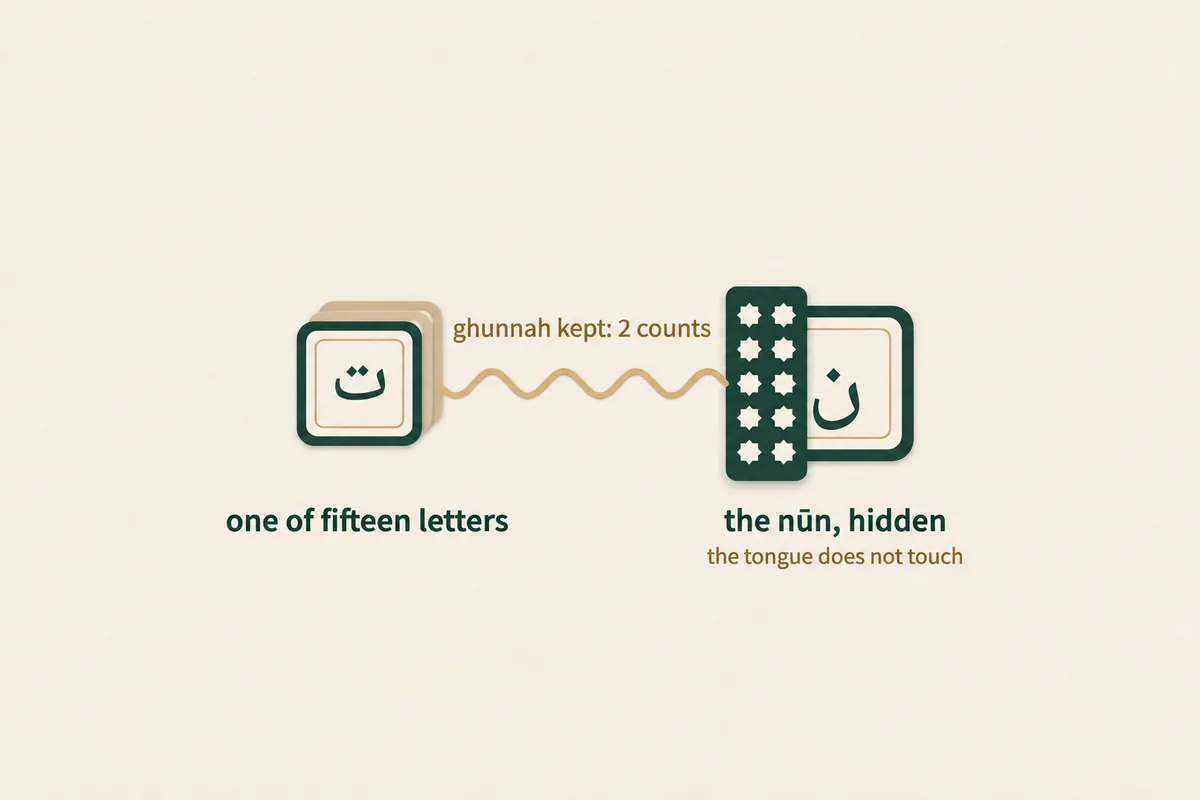
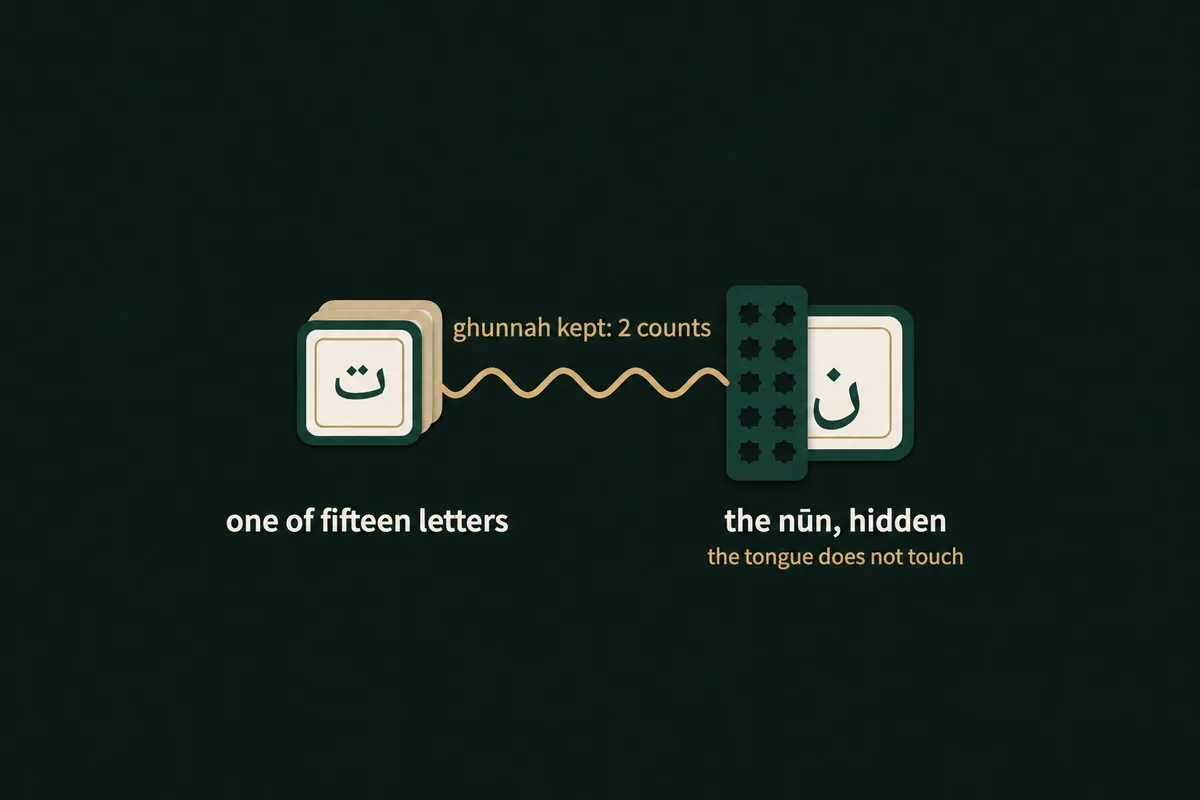
Ikhfāʾ means hiding. The nūn is neither said clearly nor merged away: its place is abandoned — the tongue does not touch the gum ridge — but its ghunnah is held for two counts while the mouth gets ready for what follows. It applies to the fifteen letters left once you remove the six of iẓhār, the six of idghām and the one of iqlāb: ت ث ج د ذ ز س ش ص ض ط ظ ف ق ك.
128 sites — the commonest of the four rulings by a wide margin. ت and س alone account for 43 of them; ض occurs once in the entire juz, so do not spend a lesson drilling it.
The ghunnah takes the weight of the letter coming. Before ص ض ط ظ ق it goes heavy; before the other ten it stays light. You do not do this deliberately — your mouth is already moving toward the next letter and the ghunnah picks up its color on the way. If it does not, you are holding the nūn too long before releasing it.
Examples from Juz ʿAmma only
In Juz ʿAmma
The book’s own examples, in muṣḥaf order. Nothing is colored: the marks that decide the ruling are already printed in the words. Choose one to see it in its āyah.
The book’s own examples, in muṣḥaf order. Nothing is colored: the marks that decide the ruling are already printed in the words.
Every case in Juz ʿAmma, listed by sūrah: Ikhfāʾ — hidden
Ikhfāʾ
39 of 128 in the juzThe densest of the four in this juz.
- سَبۡعࣰا شِدَادࣰا78:12
- وَأَنزَلۡنَا78:14
- مَآءࣰ ثَجَّاجࣰا78:14
- يُنفَخُ78:18
- وَكَأۡسࣰا دِهَاقࣰا78:34
- فَمَن شَآءَ78:39
- أَنذَرۡنَٰكُمۡ78:40
- عَذَابࣰا قَرِيبࣰا78:40
- يَنظُرُ78:40
- كُنتُ78:40
- إِذࣰا كَرَّةٌ79:12
- أَن تَزَكَّىٰ79:18
- ءَأَنتُمۡ79:27
- ٱلۡإِنسَٰنُ79:35
- مَن طَغَىٰ79:37
- أَنتَ79:43
- مِن ذِكۡرَىٰهَآ79:43
- مُنتَهَىٰهَآ79:44
- مُنذِرُ79:45
- فَتَنفَعَهُ80:4
- فَأَنتَ80:6
- أَنشَرَهُۥ80:22
- فَلۡيَنظُرِ80:24
- يَوۡمَئِذࣲ شَأۡنࣱ80:37
- ٱنكَدَرَتۡ81:2
- ذَنۢبࣲ قُتِلَتۡ81:9
- رَسُولࣲ كَرِيمࣲ81:19
- عِندَ81:20
- مُّطَاعࣲ ثَمَّ81:21
- لِمَن شَآءَ81:28
- مِنكُمۡ81:28
- ٱنفَطَرَتۡ82:1
- ٱنتَثَرَتۡ82:2
- كِرَامࣰا كَٰتِبِينَ82:11
- لِّنَفۡسࣲ شَيۡـࣰٔا82:19
- كُنتُم83:17
- يَنظُرُونَ83:23
- ٱنقَلَبُوٓا۟83:31
- ٱنقَلَبُوا۟83:31
The example is underlined.
4-question check
Spot the rule
A short self-check, using only the book’s examples. Choose an answer to see why. Nothing is saved or sent.
Question 1 of 4
Which of these is ikhfāʾ?
- رَّحِيقࣲ مَّخۡتُومٍ 83:25
- وَزَيۡتُونࣰا وَنَخۡلࣰا 80:29
- يَوۡمَئِذࣲ مُّسۡفِرَةࣱ 80:38
- مُّطَاعࣲ ثَمَّ 81:21
Show the answer
Answer: مُّطَاعࣲ ثَمَّ (81:21). One of the fifteen follows, and the nūn is left bare: hide it and keep the ghunnah.
Question 2 of 4
Which of these is ikhfāʾ?
- مِنكُمۡ 81:28
- شَيۡطَٰنࣲ رَّجِيمࣲ 81:25
- مِّنۡهُمۡ 80:37
- لِمَن يَرَىٰ 79:36
Show the answer
Answer: مِنكُمۡ (81:28). One of the fifteen follows, and the nūn is left bare: hide it and keep the ghunnah.
Question 3 of 4
Which of these is ikhfāʾ?
- قُرۡءَانࣱ مَّجِيدࣱ 85:21
- ٱلۡأَنۡهَٰرُ 85:11
- أَجۡرٌ غَيۡرُ 84:25
- لِّنَفۡسࣲ شَيۡـࣰٔا 82:19
Show the answer
Answer: لِّنَفۡسࣲ شَيۡـࣰٔا (82:19). One of the fifteen follows, and the nūn is left bare: hide it and keep the ghunnah.
Question 4 of 4
Which of these is ikhfāʾ?
- وَلِأَنۡعَٰمِكُمۡ 79:33
- وَفَٰكِهَةࣰ وَأَبࣰّا 80:31
- أَنذَرۡنَٰكُمۡ 78:40
- حِسَابࣰا يَسِيرࣰا 84:8
Show the answer
Answer: أَنذَرۡنَٰكُمۡ (78:40). One of the fifteen follows, and the nūn is left bare: hide it and keep the ghunnah.
All four rules side by side: the noon sākinah and tanwīn chart.
Lesson 10
The gate
The book ends every lesson with a gate. Move on when this is true of you:
You hide the nūn without losing the ghunnah, and the ghunnah goes heavy before the five heavy letters and light before the rest — at reading speed.
Each gate has two halves: you must make the sound, and you must hear it when it is missing. Ask someone who reads well to listen to you.
Ticking it marks the lesson done in this browser only. Nothing is sent anywhere.
Lesson 10 is done. On to the next one when you are ready.
Next: lesson 11 · Mīm sākinahThis course is free, with no ads. Monthly supporters help keep it that way. Support from $10 a month
Help shape this lesson
How was this lesson?
One tap. It goes straight to Hamza, and it is how the next version of this lesson gets better.
Received. Jazāk Allāhu khayran. Hamza reads every one.
Anonymous: no name, no account. How feedback is handled
From Tajwīd for Juz ʿAmma, lesson 10 — the free book by Hamza Abdul-Tawwaab. Āyāt from the Uthmani text the book uses.
Qur’anic text: Tanzil Quran Text (Uthmani), via alquran.cloud. Marks are normalized for display (the sukūn and staggered tanwīn as the muṣḥaf prints them); the letters are unchanged.