Part 3 · The lengthenings · Lesson 12 of 16
Two counts, measured
Madd ṭabīʿī as a quantity rather than a feeling.
The rule
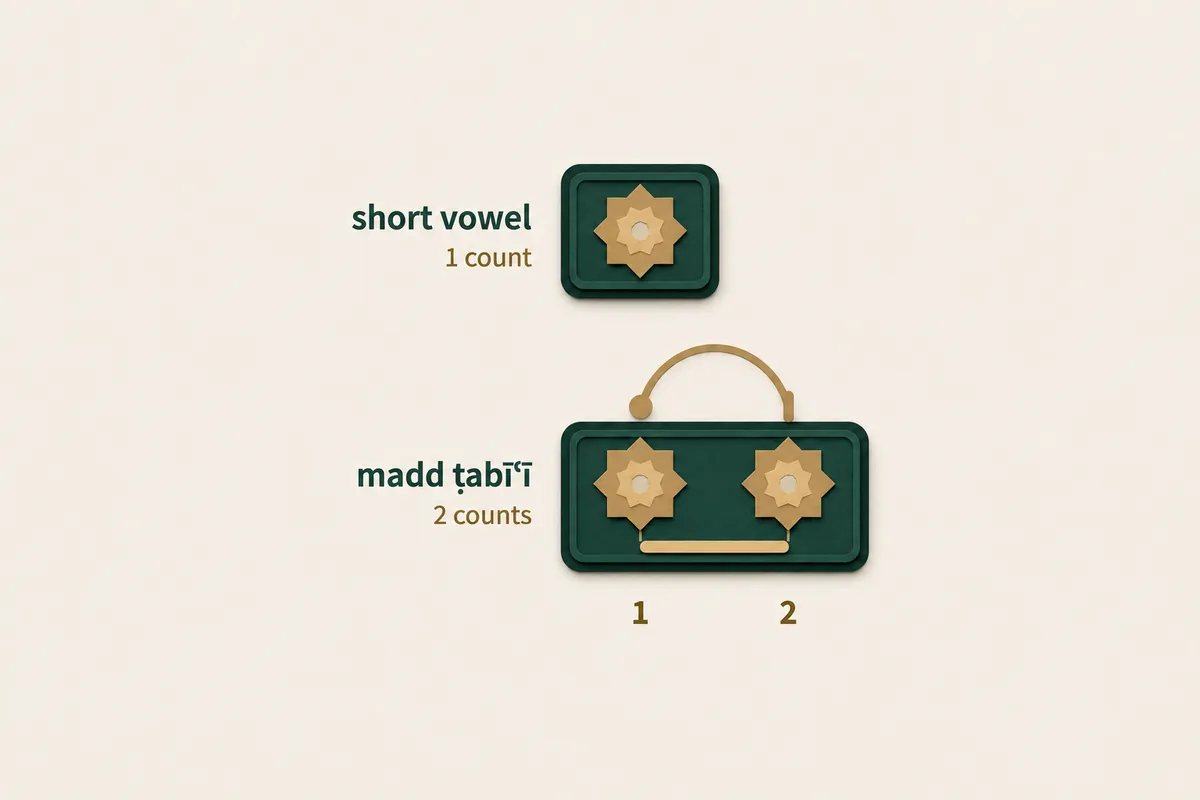
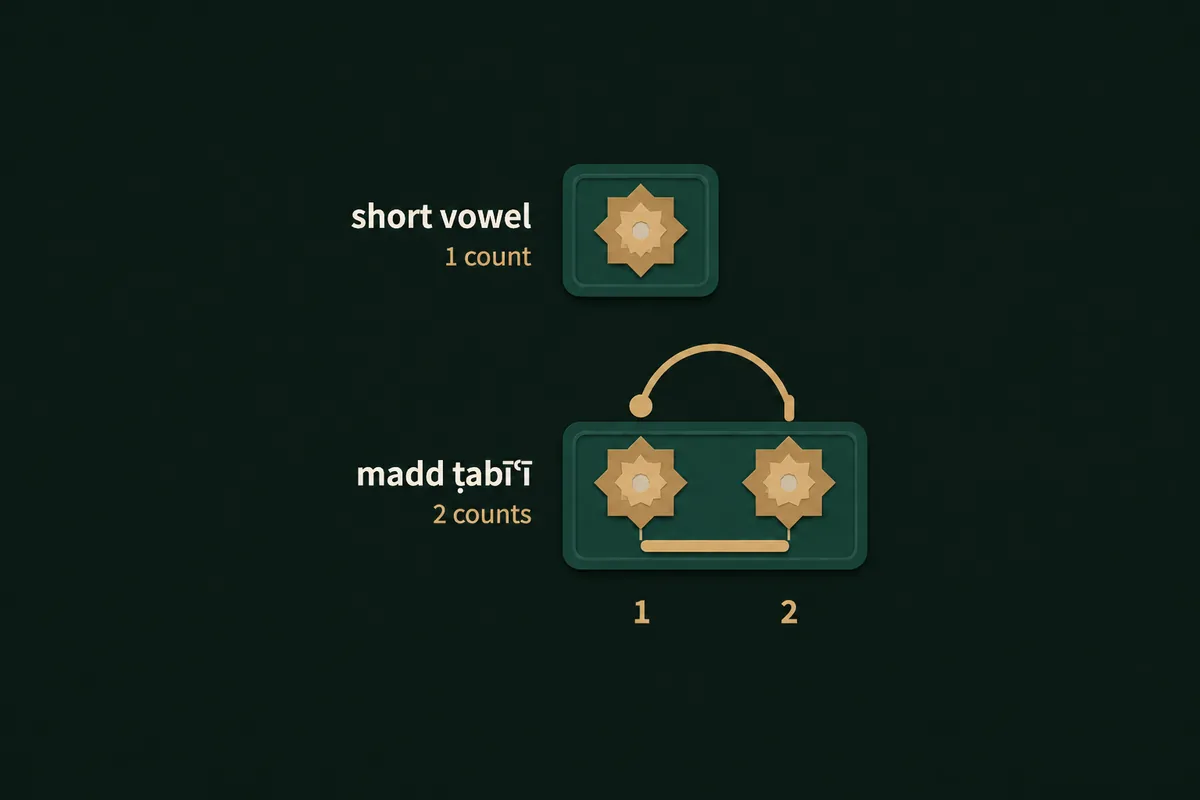
A count is not a second. It is the time it takes to say one short vowel at the pace you are reciting — relative to your own speed, which is why two people reciting at different paces can both be correct.
This is why you cannot learn lengths from a metronome and can learn them from a teacher. What has to stay constant is the ratio: your madd ṭabīʿī is always twice your short vowel, and your six-count madd is always three times your ṭabīʿī.
The fault this lesson exists to prevent is not holding too short — it is holding inconsistently. A reciter whose ṭabīʿī is two counts in one āyah and three in the next has no ratio at all, and every length above it becomes guesswork. Fix the two before you go near the four.
The lengths, stated once
Everything in this part rests on these numbers.
| Madd ṭabīʿī — the ordinary long vowel | 2counts |
| Muttaṣil and munfaṣil — a hamza after the madd | 4counts |
| ʿĀriḍ lil-sukūn and līn — at a stop | 4counts |
| Lāzim — fixed | 6counts |
Two for the natural, four for everything you choose, six for the one you do not.
3-question check
Spot the rule
A short self-check on what this lesson says. Choose an answer to see why. Nothing is saved or sent.
Question 1 of 3
How long is a madd ṭabīʿī?
- One count
- Two counts
- Four counts
Show the answer
Answer: Two counts. Two counts — twice your short vowel.
Question 2 of 3
What is a count?
- One second on a clock
- The time of one short vowel, at your own pace
Show the answer
Answer: The time of one short vowel, at your own pace. A count is relative to your own pace, which is why two people reciting at different speeds can both be right.
Question 3 of 3
What fault does this lesson exist to prevent?
- Holding too short
- Holding inconsistently
Show the answer
Answer: Holding inconsistently. Inconsistency. A ṭabīʿī of two in one āyah and three in the next leaves no ratio at all.
Lesson 12
The gate
The book ends every lesson with a gate. Move on when this is true of you:
Your madd ṭabīʿī is two counts, and it is the same two counts in the last āyah of a sūrah as in the first.
Each gate has two halves: you must make the sound, and you must hear it when it is missing. Ask someone who reads well to listen to you.
Ticking it marks the lesson done in this browser only. Nothing is sent anywhere.
Lesson 12 is done. On to the next one when you are ready.
Next: lesson 13 · Muttaṣil and munfaṣilThis course is free, with no ads. Monthly supporters help keep it that way. Support from $10 a month
All six madds and their three lengths side by side, with how to tell them apart: types of madd.
Help shape this lesson
How was this lesson?
One tap. It goes straight to Hamza, and it is how the next version of this lesson gets better.
Received. Jazāk Allāhu khayran. Hamza reads every one.
Anonymous: no name, no account. How feedback is handled
From Tajwīd for Juz ʿAmma, lesson 12 — the free book by Hamza Abdul-Tawwaab. Āyāt from the Uthmani text the book uses.
Qur’anic text: Tanzil Quran Text (Uthmani), via alquran.cloud. Marks are normalized for display (the sukūn and staggered tanwīn as the muṣḥaf prints them); the letters are unchanged.