Part 2 · The nose · Lesson 8 of 16
Idghām
The sākin nūn merged into what follows — and the fact that it merges two different amounts.
The rule
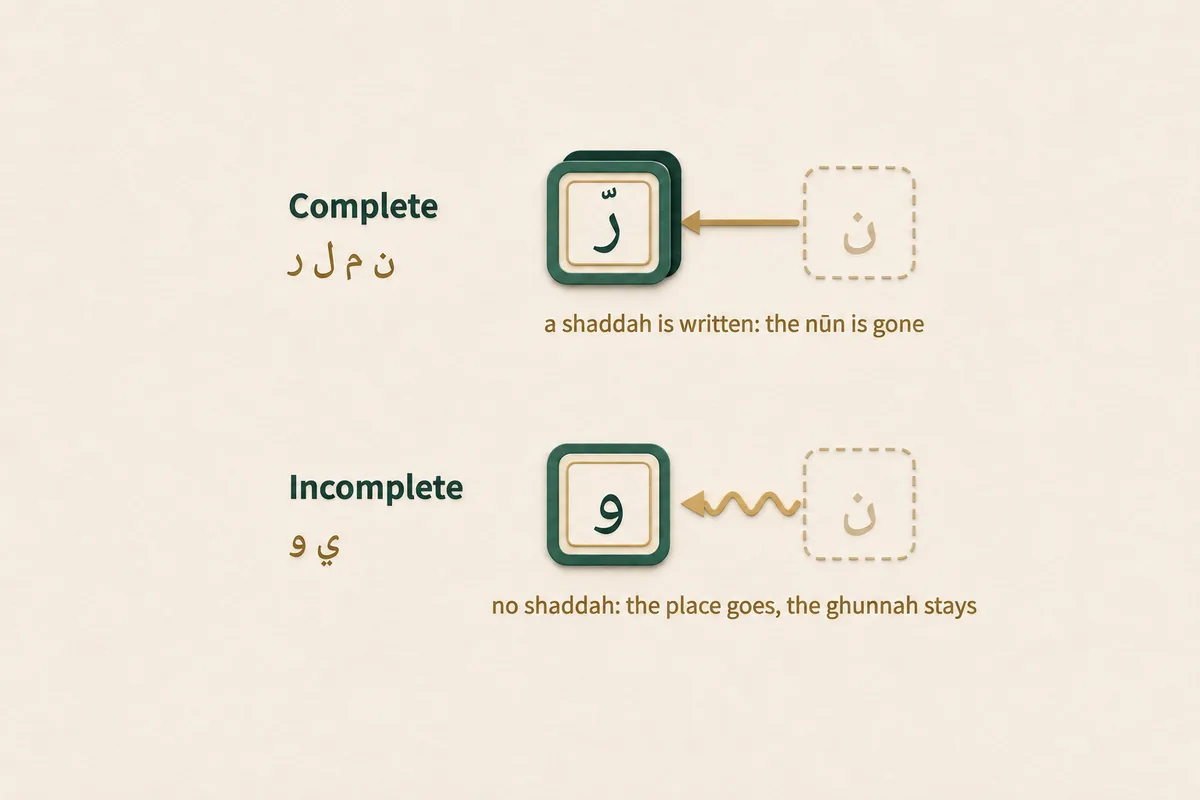
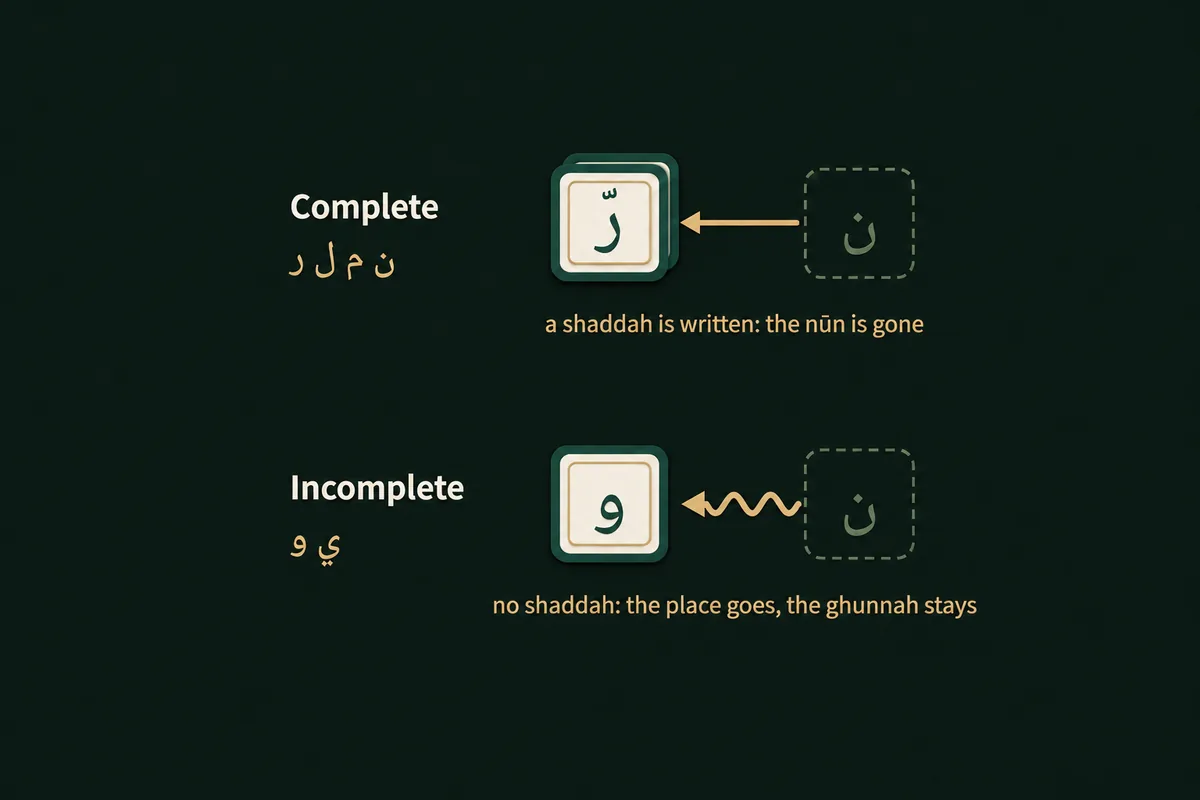
Idghām means merging: the nūn goes into the next letter. Six letters take it: ي ر م ل و ن. Most books stop there. They should not, because those six do not behave alike, and the muṣḥaf shows the difference. Idghām happens only across two words: inside one word the nūn stays clear, as in ٱلدُّنۡيَا.
Complete — ن م ل ر
The nūn disappears entirely into the next letter, which doubles. The page shows this with a shaddah. With ن and م the ghunnah continues; with ل and ر there is no ghunnah at all — the nūn is simply gone.
Incomplete — ي and و
The nūn’s place goes but its ghunnah stays. The page shows this by writing no shaddah, because nothing has fully doubled.
The check that proves it. Across the whole juz the four complete letters take a written shaddah in 67 of 67 sites; the two incomplete letters take one in 0 of 46. There is nothing to interpret — look at the next letter.
Examples from Juz ʿAmma only
In Juz ʿAmma
The book’s own examples, in muṣḥaf order. Nothing is colored: the marks that decide the ruling are already printed in the words. Choose one to see it in its āyah.
The book’s own examples, in muṣḥaf order. Nothing is colored: the marks that decide the ruling are already printed in the words.
Every case in Juz ʿAmma, listed by sūrah: Idghām — merging
Complete
24 of 67 in the juzA shaddah is written — the nūn is gone.
- فَلَن نَّزِيدَكُمۡ78:30
- جَزَآءࣰ مِّن78:36
- مِّن رَّبِّكَ78:36
- عِظَٰمࣰا نَّخِرَةࣰ79:11
- لَعِبۡرَةࣰ لِّمَن79:26
- مَتَٰعࣰا لَّكُمۡ79:33
- صُحُفࣲ مُّكَرَّمَةࣲ80:13
- مَّرۡفُوعَةࣲ مُّطَهَّرَةِۭ80:14
- مِن نُّطۡفَةٍ80:19
- مَّتَٰعࣰا لَّكُمۡ80:32
- ٱمۡرِئࣲ مِّنۡهُمۡ80:37
- يَوۡمَئِذࣲ مُّسۡفِرَةࣱ80:38
- ضَاحِكَةࣱ مُّسۡتَبۡشِرَةࣱ80:39
- نَفۡسࣱ مَّآ81:14
- شَيۡطَٰنࣲ رَّجِيمࣲ81:25
- ذِكۡرࣱ لِّلۡعَٰلَمِينَ81:27
- صُورَةࣲ مَّا82:8
- وَيۡلࣱ لِّلۡمُطَفِّفِينَ83:1
- كِتَٰبࣱ مَّرۡقُومࣱ83:9
- عَن رَّبِّهِمۡ83:15
- رَّحِيقࣲ مَّخۡتُومٍ83:25
- أَن لَّن84:14
- فَعَّالࣱ لِّمَا85:16
- قُرۡءَانࣱ مَّجِيدࣱ85:21
The example is underlined.
Incomplete
24 of 46 in the juzNo shaddah — the place goes, the ghunnah stays.
- سِرَاجࣰا وَهَّاجࣰا78:13
- حَبࣰّا وَنَبَاتࣰا78:15
- بَرۡدࣰا وَلَا78:24
- حَمِيمࣰا وَغَسَّاقࣰا78:25
- جَزَآءࣰ وِفَاقًا78:26
- لَغۡوࣰا وَلَا78:35
- قَرِيبࣰا يَوۡمَ78:40
- قُلُوبࣱ يَوۡمَئِذࣲ79:8
- يَوۡمَئِذࣲ وَاجِفَةٌ79:8
- زَجۡرَةࣱ وَٰحِدَةࣱ79:13
- لِّمَن يَخۡشَىٰٓ79:26
- لِمَن يَرَىٰ79:36
- مَن يَخۡشَىٰهَا79:45
- وَعِنَبࣰا وَقَضۡبࣰا80:28
- وَزَيۡتُونࣰا وَنَخۡلࣰا80:29
- وَفَٰكِهَةࣰ وَأَبࣰّا80:31
- شَأۡنࣱ يُغۡنِيهِ80:37
- وُجُوهࣱ يَوۡمَئِذࣲ80:38
- وَوُجُوهࣱ يَوۡمَئِذٍ80:40
- أَن يَسۡتَقِيمَ81:28
- وَيۡلࣱ يَوۡمَئِذࣲ83:10
- عَيۡنࣰا يَشۡرَبُ83:28
- حِسَابࣰا يَسِيرࣰا84:8
- لَّن يَحُورَ84:14
The example is underlined.
5-question check
Spot the rule
A short self-check, using only the book’s examples. Choose an answer to see why. Nothing is saved or sent.
Question 1 of 5
Which ruling is this?
صُورَةࣲ مَّاSūrat al-Infiṭār 82:8- Idghām, complete
- Idghām, incomplete
Show the answer
Answer: Idghām, complete. The next letter carries a shaddah: the nūn is gone into it.
Question 2 of 5
Which ruling is this?
عَيۡنࣰا يَشۡرَبُSūrat al-Muṭaffifīn 83:28- Idghām, complete
- Idghām, incomplete
Show the answer
Answer: Idghām, incomplete. A yāʾ or wāw follows with no shaddah written: the nūn’s place goes, its ghunnah stays.
Question 3 of 5
Which ruling is this?
صُحُفࣲ مُّكَرَّمَةࣲSūrat ʿAbasa 80:13- Idghām, complete
- Idghām, incomplete
Show the answer
Answer: Idghām, complete. The next letter carries a shaddah: the nūn is gone into it.
Question 4 of 5
Which ruling is this?
قُلُوبࣱ يَوۡمَئِذࣲSūrat an-Nāziʿāt 79:8- Idghām, complete
- Idghām, incomplete
Show the answer
Answer: Idghām, incomplete. A yāʾ or wāw follows with no shaddah written: the nūn’s place goes, its ghunnah stays.
Question 5 of 5
Which ruling is this?
قَرِيبࣰا يَوۡمَSūrat an-Nabaʾ 78:40- Idghām, complete
- Idghām, incomplete
Show the answer
Answer: Idghām, incomplete. A yāʾ or wāw follows with no shaddah written: the nūn’s place goes, its ghunnah stays.
All four rules side by side: the noon sākinah and tanwīn chart.
Lesson 8
The gate
The book ends every lesson with a gate. Move on when this is true of you:
You merge fully where the shaddah is written and keep the ghunnah where it is not, and you can say which of the two you just did.
Each gate has two halves: you must make the sound, and you must hear it when it is missing. Ask someone who reads well to listen to you.
Ticking it marks the lesson done in this browser only. Nothing is sent anywhere.
Lesson 8 is done. On to the next one when you are ready.
Next: lesson 9 · IqlābThis course is free, with no ads. Monthly supporters help keep it that way. Support from $10 a month
Help shape this lesson
How was this lesson?
One tap. It goes straight to Hamza, and it is how the next version of this lesson gets better.
Received. Jazāk Allāhu khayran. Hamza reads every one.
Anonymous: no name, no account. How feedback is handled
From Tajwīd for Juz ʿAmma, lesson 8 — the free book by Hamza Abdul-Tawwaab. Āyāt from the Uthmani text the book uses.
Qur’anic text: Tanzil Quran Text (Uthmani), via alquran.cloud. Marks are normalized for display (the sukūn and staggered tanwīn as the muṣḥaf prints them); the letters are unchanged.