Part 2 · The nose · Lesson 9 of 16
Iqlāb
The sākin nūn that becomes a mīm, and the mark that says so.
The rule
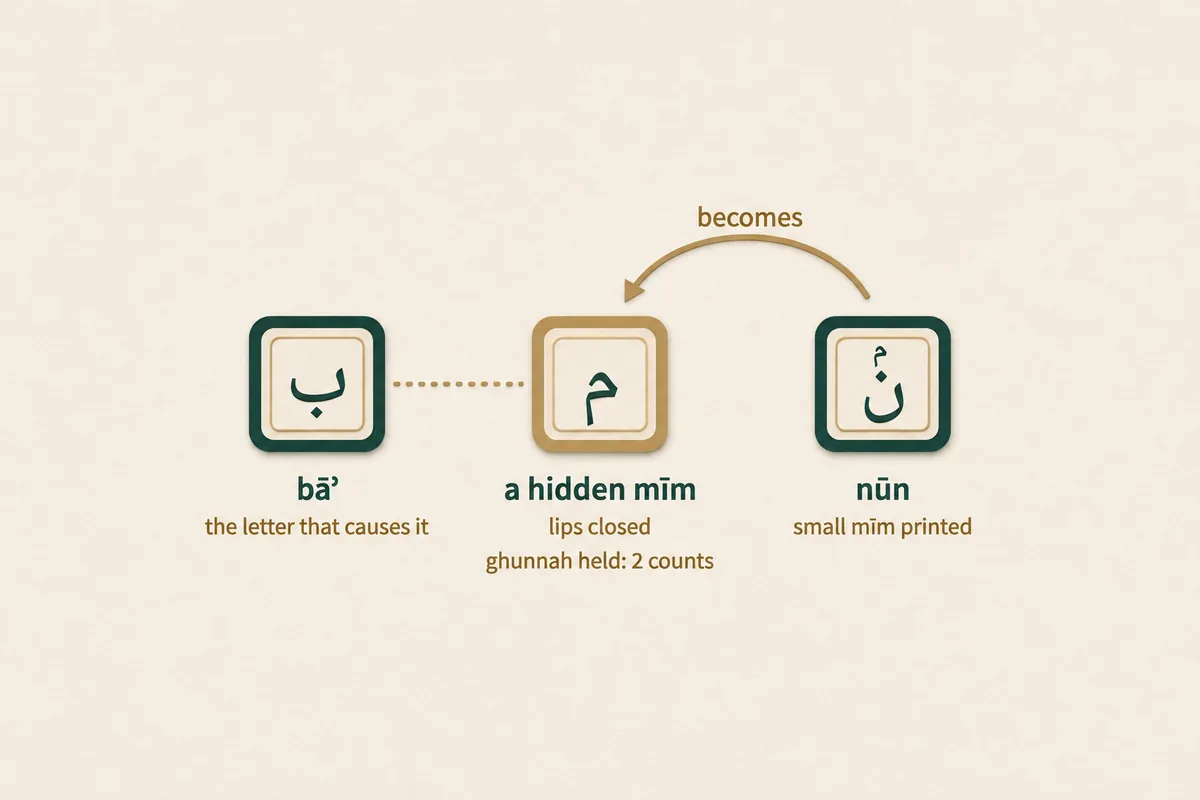
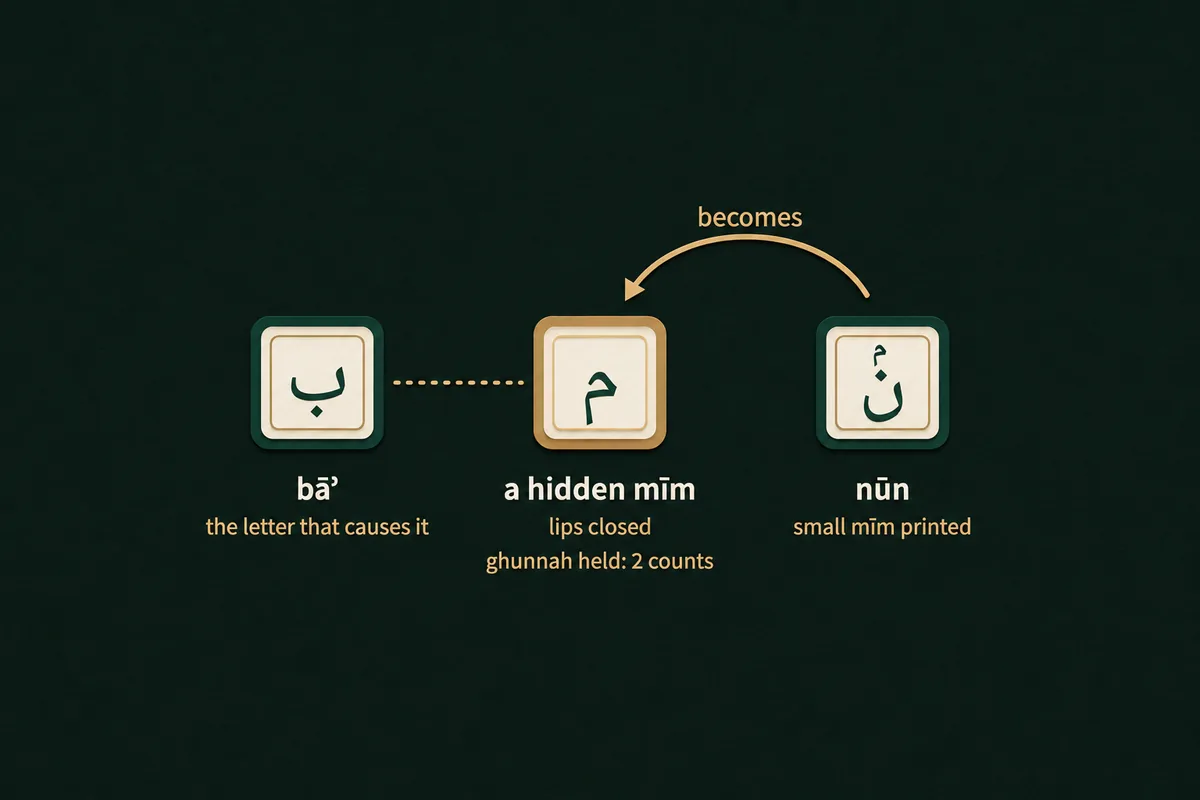
Iqlāb means turning over. Before a single letter — ب — a sākin nūn or tanwīn is not said as a nūn at all. It becomes a mīm, hidden, with its ghunnah held.
Here the mark on the nūn is a small mīm, not a sukūn. The muṣḥaf does not write a sukūn on the nūn before the bāʾ: it replaces the sukūn with a small mīm, and marks the tanwīn form with a small mīm too: above a fatḥatayn or ḍammatayn, below a kasratayn. The mark is not decoration; it is the instruction, printed inside the word.
Twelve sites in the juz — five where the bāʾ is inside the same word, and seven where it begins the next one. Your lips close and do not open: the mīm is made but not released, the way an ikhfāʾ is hidden, with the ghunnah running through it for two counts. If a listener hears a clean m followed by a b, it was released too early.
Examples from Juz ʿAmma only
In Juz ʿAmma
The book’s own examples, in muṣḥaf order. Nothing is colored: the marks that decide the ruling are already printed in the words. Choose one to see it in its āyah.
The book’s own examples, in muṣḥaf order. Nothing is colored: the marks that decide the ruling are already printed in the words.
Every case in Juz ʿAmma, listed by sūrah: Iqlāb — turned into mīm
All twelve sites in the juz
all 12 in the juzThe bāʾ is what causes it — it is always in view.
- كِرَامِۭ بَرَرَةࣲ80:16
- فَأَنۢبَتۡنَا80:27
- ذَنۢبࣲ81:9
- مِنۢ بَيۡنِ86:7
- يَوۡمَئِذِۭ بِجَهَنَّمَ89:23
- حِلُّۢ بِهَٰذَا90:2
- ٱنۢبَعَثَ91:12
- بِذَنۢبِهِمۡ91:14
- مَنۢ بَخِلَ92:8
- لَنَسۡفَعَۢا بِٱلنَّاصِيَةِ96:15
- مِنۢ بَعۡدِ98:4
- لَيُنۢبَذَنَّ104:4
The example is underlined.
4-question check
Spot the rule
A short self-check, using only the book’s examples. Choose an answer to see why. Nothing is saved or sent.
Question 1 of 4
Which of these is iqlāb?
- رَّحِيقࣲ مَّخۡتُومٍ 83:25
- عَن رَّبِّهِمۡ 83:15
- كِرَامِۭ بَرَرَةࣲ 80:16
- أَجۡرٌ غَيۡرُ 84:25
Show the answer
Answer: كِرَامِۭ بَرَرَةࣲ (80:16). A bāʾ follows, and the small mīm says so: the nūn becomes a hidden mīm with its ghunnah held.
Question 2 of 4
Which of these is iqlāb?
- عِندَ 81:20
- عَذَابࣰا قَرِيبࣰا 78:40
- لَنَسۡفَعَۢا بِٱلنَّاصِيَةِ 96:15
- وَيۡلࣱ لِّلۡمُطَفِّفِينَ 83:1
Show the answer
Answer: لَنَسۡفَعَۢا بِٱلنَّاصِيَةِ (96:15). A bāʾ follows, and the small mīm says so: the nūn becomes a hidden mīm with its ghunnah held.
Question 3 of 4
Which of these is iqlāb?
- كَرَّةٌ خَاسِرَةࣱ 79:12
- مِن ذِكۡرَىٰهَآ 79:43
- مَنۢ بَخِلَ 92:8
- طَعَامٌ إِلَّا 88:6
Show the answer
Answer: مَنۢ بَخِلَ (92:8). A bāʾ follows, and the small mīm says so: the nūn becomes a hidden mīm with its ghunnah held.
Question 4 of 4
Which of these is iqlāb?
- عَطَآءً حِسَابࣰا 78:36
- فَأَنۢبَتۡنَا 80:27
- فَلۡيَنظُرِ 80:24
- أَنتَ 79:43
Show the answer
Answer: فَأَنۢبَتۡنَا (80:27). A bāʾ follows, and the small mīm says so: the nūn becomes a hidden mīm with its ghunnah held.
All four rules side by side: the noon sākinah and tanwīn chart.
Lesson 9
The gate
The book ends every lesson with a gate. Move on when this is true of you:
The nūn is heard as a hidden mīm with its ghunnah held, and your lips do not pop between the two letters.
Each gate has two halves: you must make the sound, and you must hear it when it is missing. Ask someone who reads well to listen to you.
Ticking it marks the lesson done in this browser only. Nothing is sent anywhere.
Lesson 9 is done. On to the next one when you are ready.
Next: lesson 10 · IkhfāʾThis course is free, with no ads. Monthly supporters help keep it that way. Support from $10 a month
Help shape this lesson
How was this lesson?
One tap. It goes straight to Hamza, and it is how the next version of this lesson gets better.
Received. Jazāk Allāhu khayran. Hamza reads every one.
Anonymous: no name, no account. How feedback is handled
From Tajwīd for Juz ʿAmma, lesson 9 — the free book by Hamza Abdul-Tawwaab. Āyāt from the Uthmani text the book uses.
Qur’anic text: Tanzil Quran Text (Uthmani), via alquran.cloud. Marks are normalized for display (the sukūn and staggered tanwīn as the muṣḥaf prints them); the letters are unchanged.