Lesson 2 of 20: Where each one is made
Teaches That every letter has an address in your mouth, and roughly where.
The teaching
Before the lesson · not counted
Warm-up · from earlier lessons
Say each card aloud, then tap it to check what it reads. Nothing here is saved or counted.
Round 1 of 10
Five places in the mouth
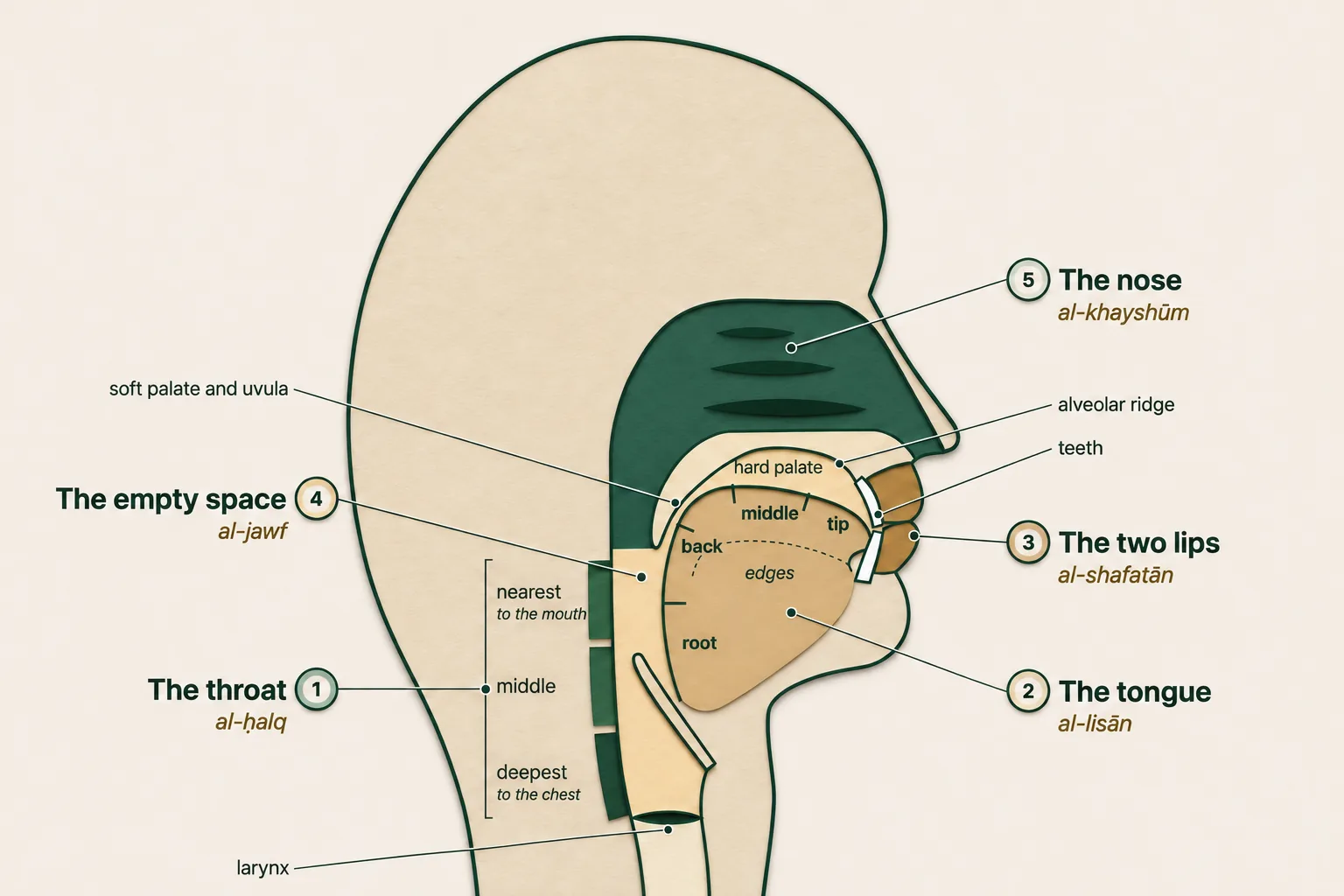
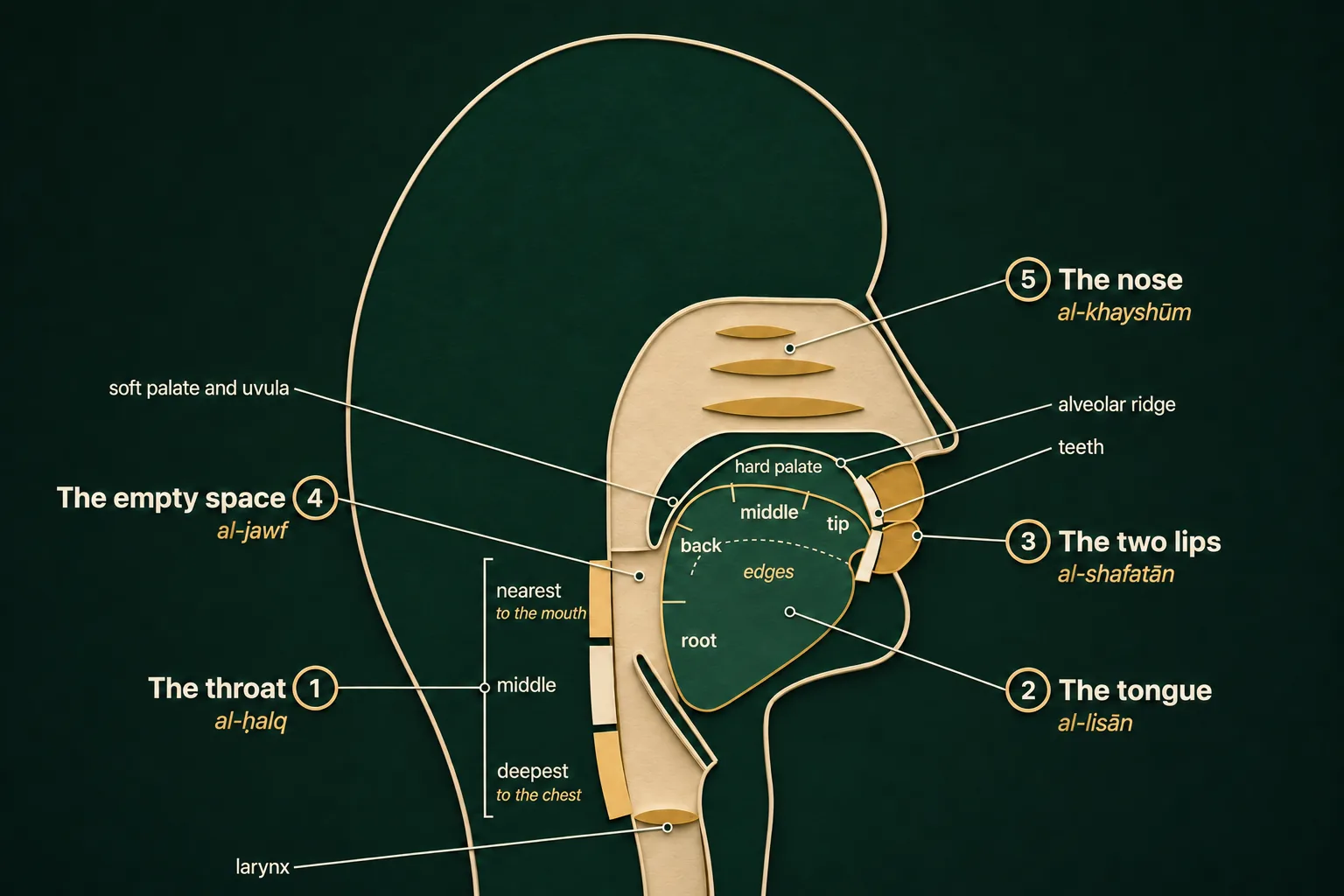
Every letter has an address in your mouth, and this lesson is a rough map of them. Listen first. Listen I say each letter's name, then sound it after a short a: bāʾ … ab, tāʾ … at. Say both after me.
Hamzah is sounded baʾ, ending in a clean catch. The letters here are in a new order — where they are made, throat to lips — so it looks shuffled. Nobody tells you where an English d is made. Here it matters: two letters can be a hand's width apart in the mouth and sound identical to an untrained ear. The classical scholars mapped seventeen points inside five zones. To begin, you only need to know that a letter has a place, and the English zone names are enough.
Round 2 of 10
The throat
الحَلۡقThree depths — deepest ء and ه, middle ع and ح, nearest the mouth غ and خ. Several of these throat sounds are new to English speakers, so this zone takes the most listening.
Try it now Say each one aloud, then tap it.
You practiced these. They count in the drill below too.
Round 3 of 10
The tongue
اللِّسانTen points and eighteen letters — the back against the soft palate, the middle against the roof, the side against the molars (the back teeth), the tip against the teeth and gums.
Round 4 of 10
The back and middle of the tongue
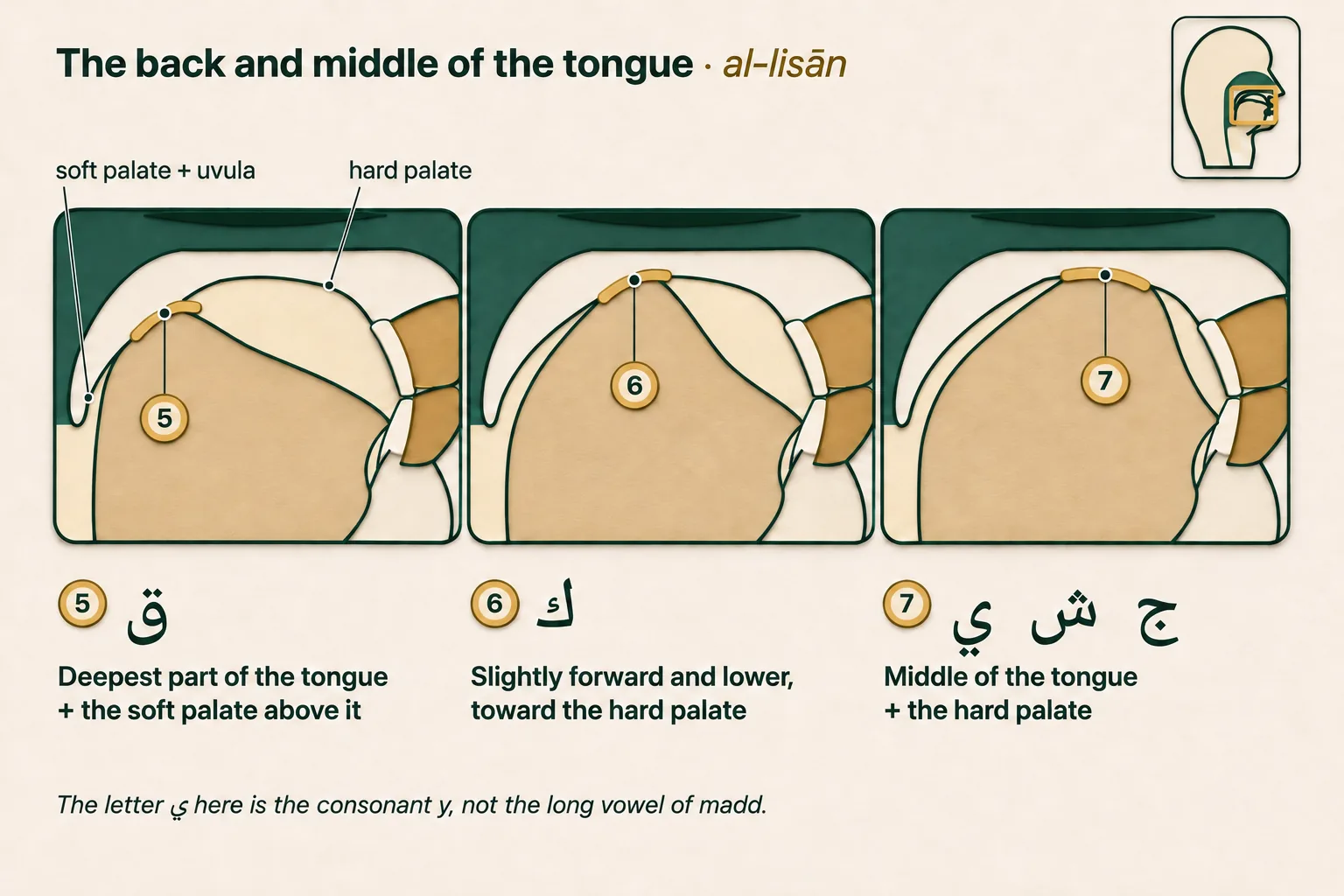
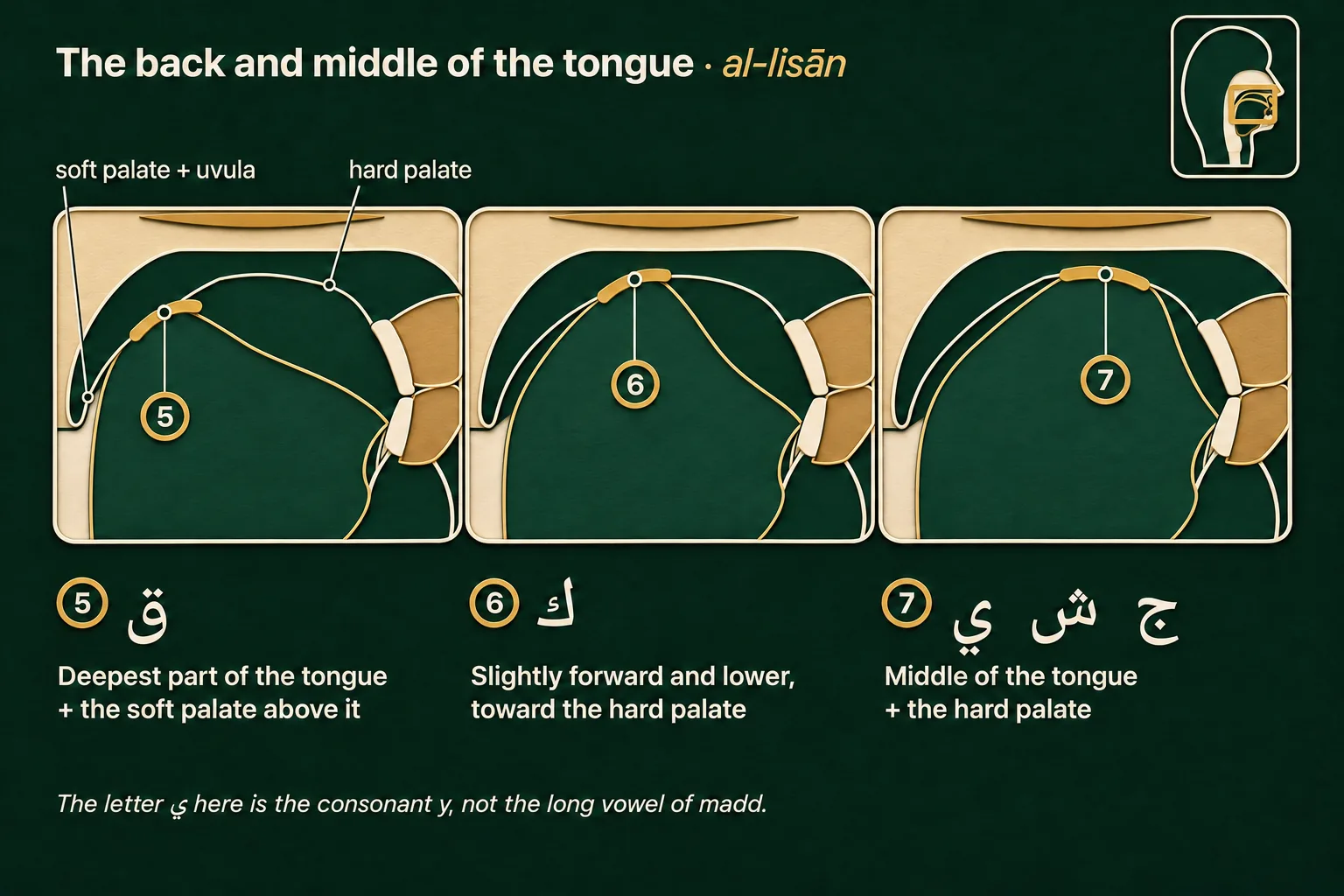
Try it now Say each one aloud, then tap it.
You practiced these. They count in the drill below too.
Round 5 of 10
The edges of the tongue
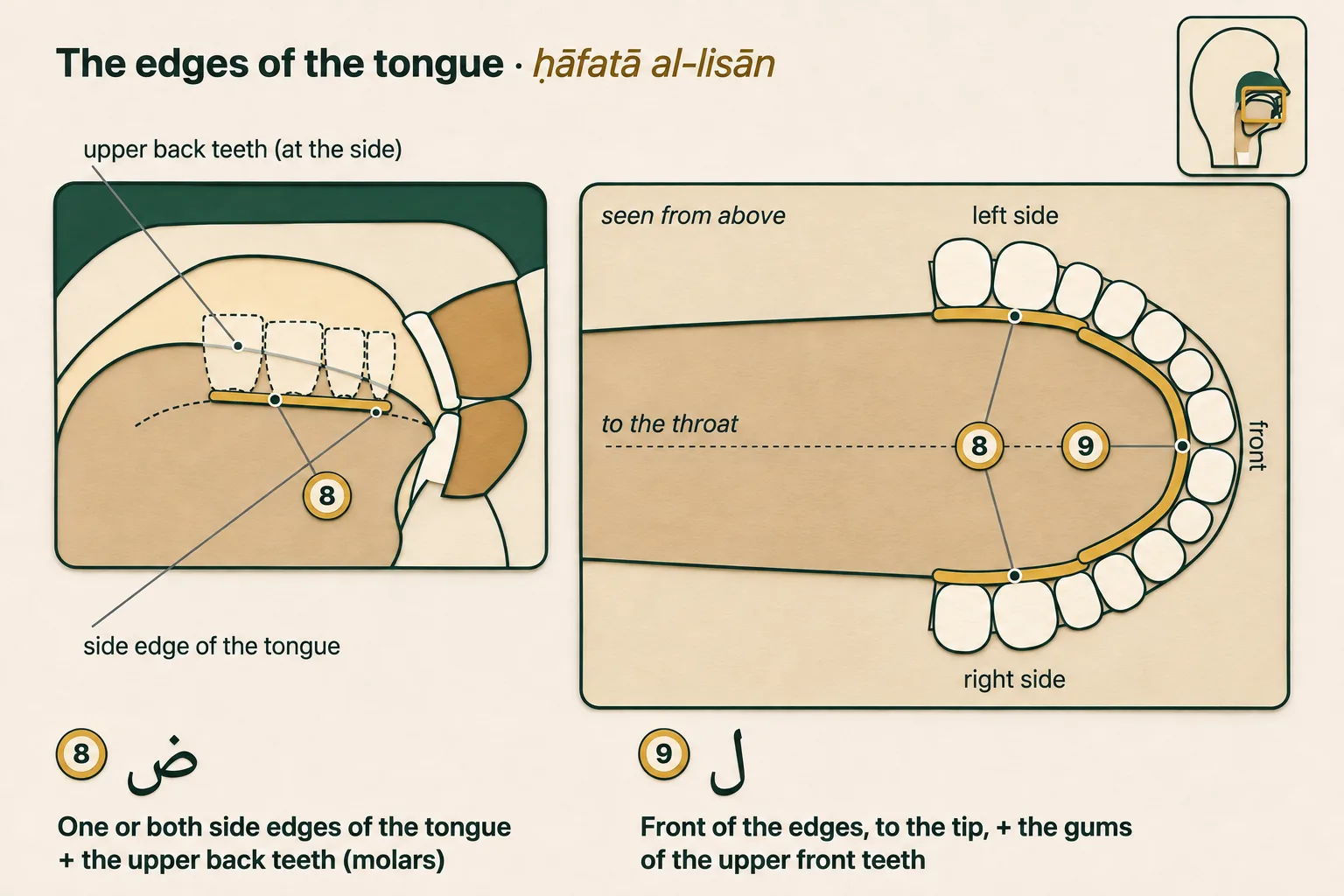
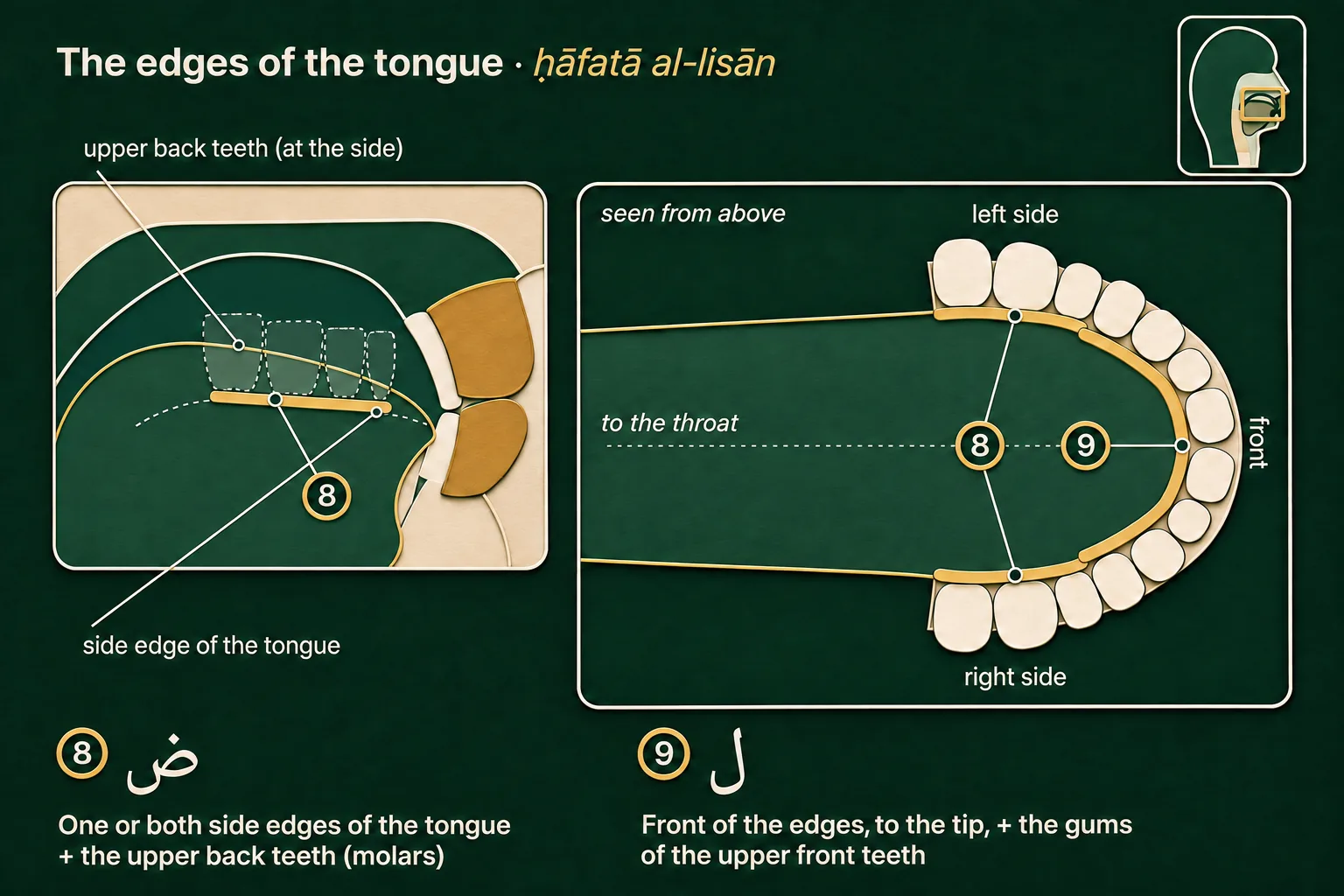
Try it now Say each one aloud, then tap it.
You practiced these. They count in the drill below too.
Round 6 of 10
Tip of the tongue: ن ر ط د ت
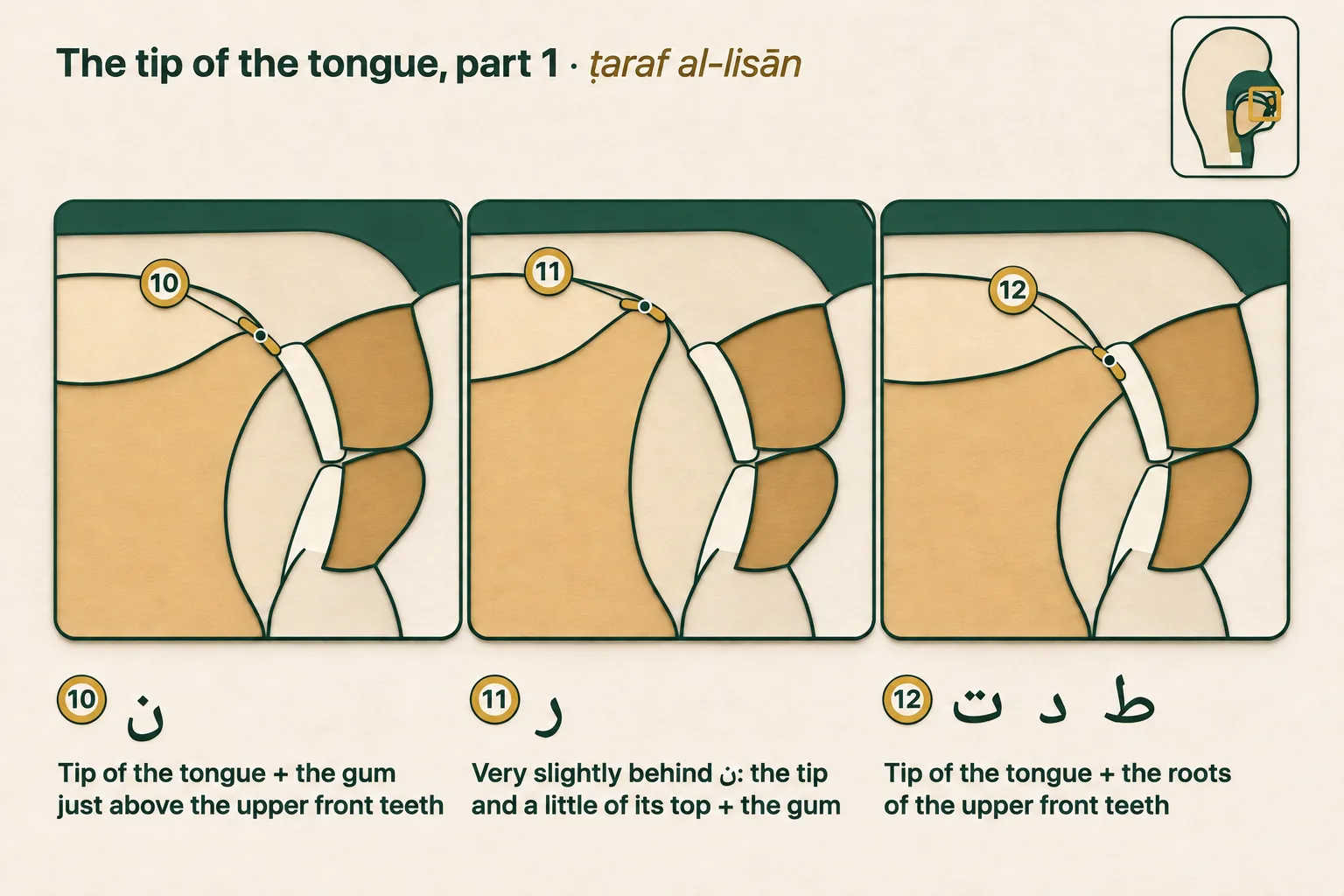
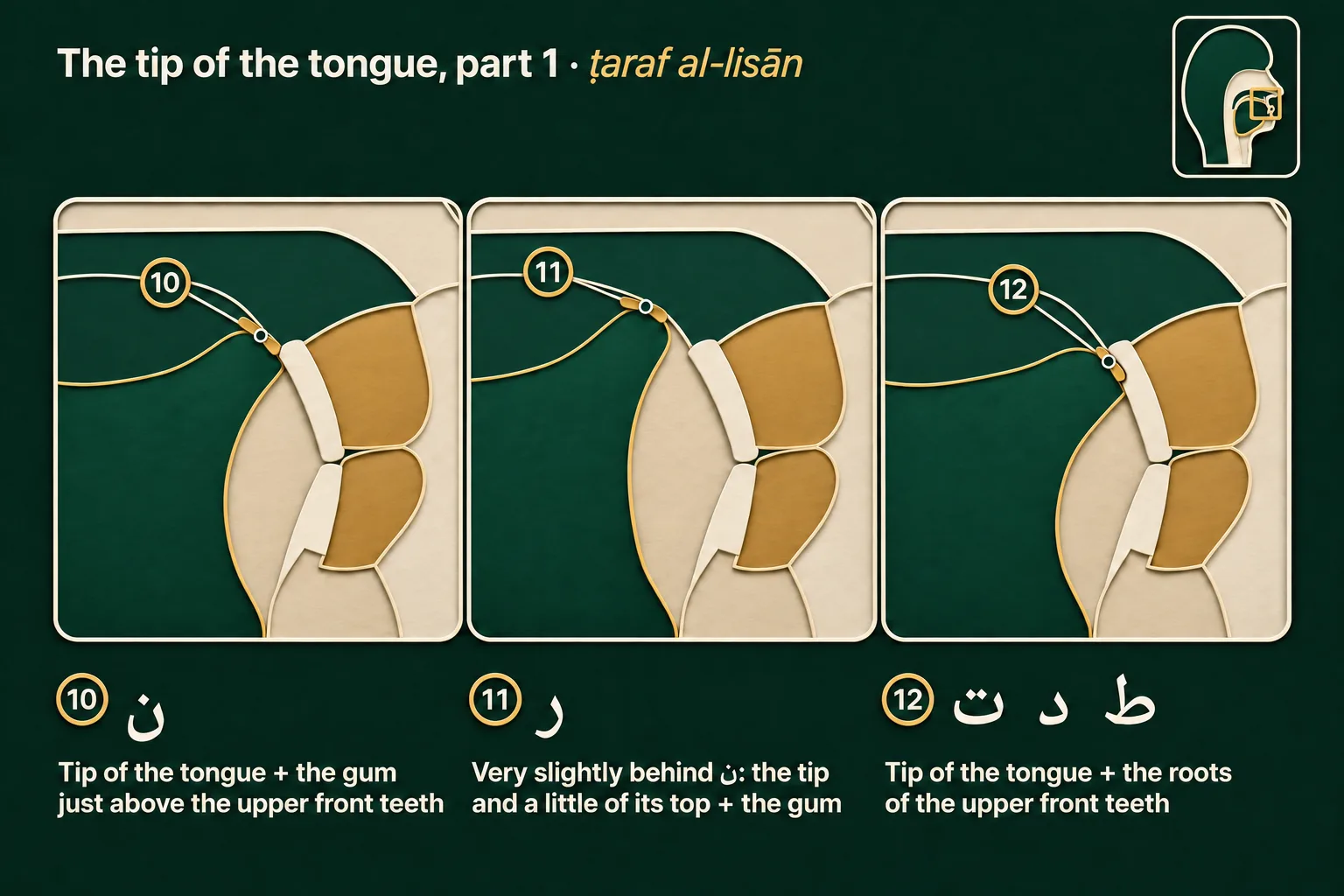
Try it now Say each one aloud, then tap it.
You practiced these. They count in the drill below too.
Round 7 of 10
Tip of the tongue: ص ز س ظ ذ ث
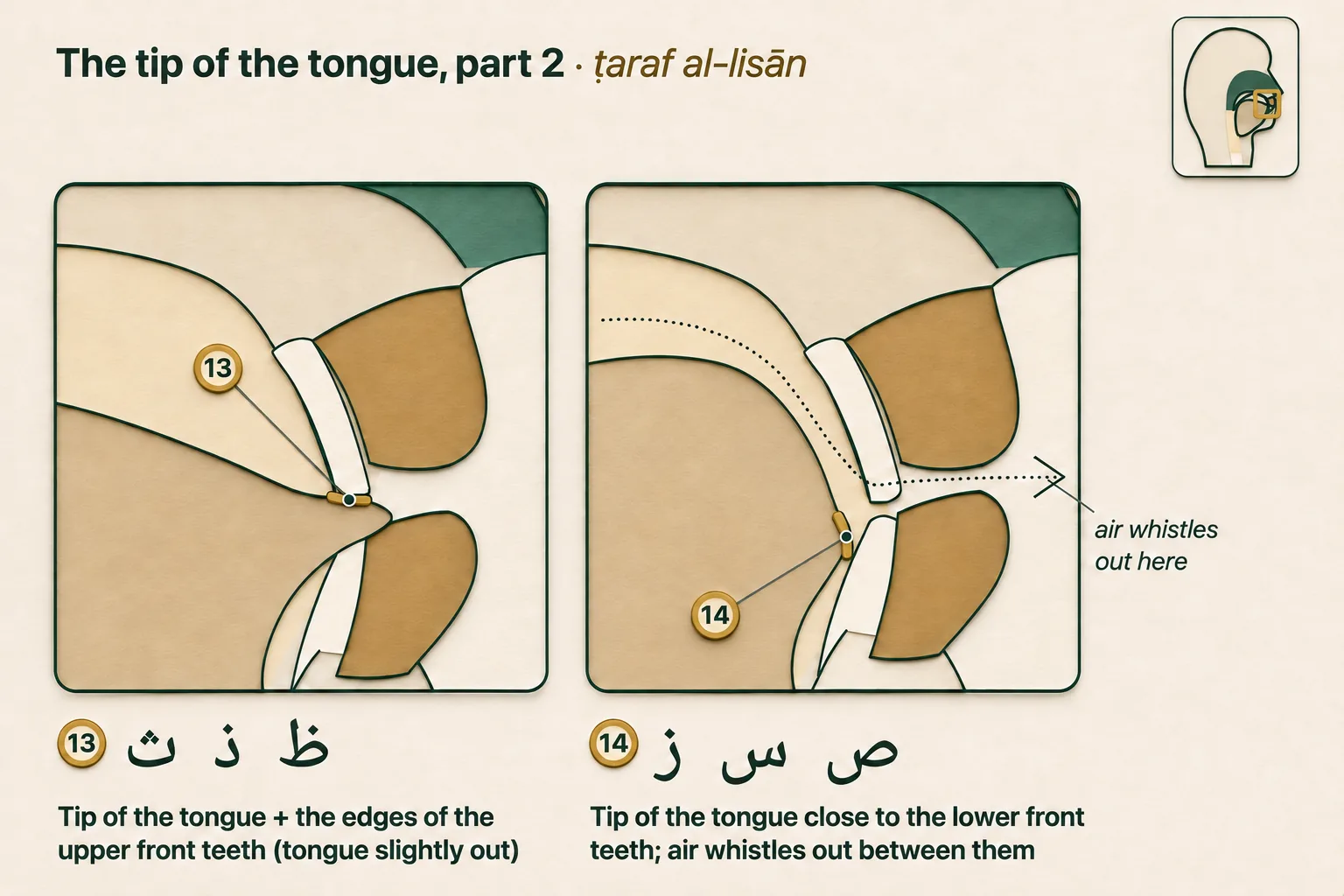
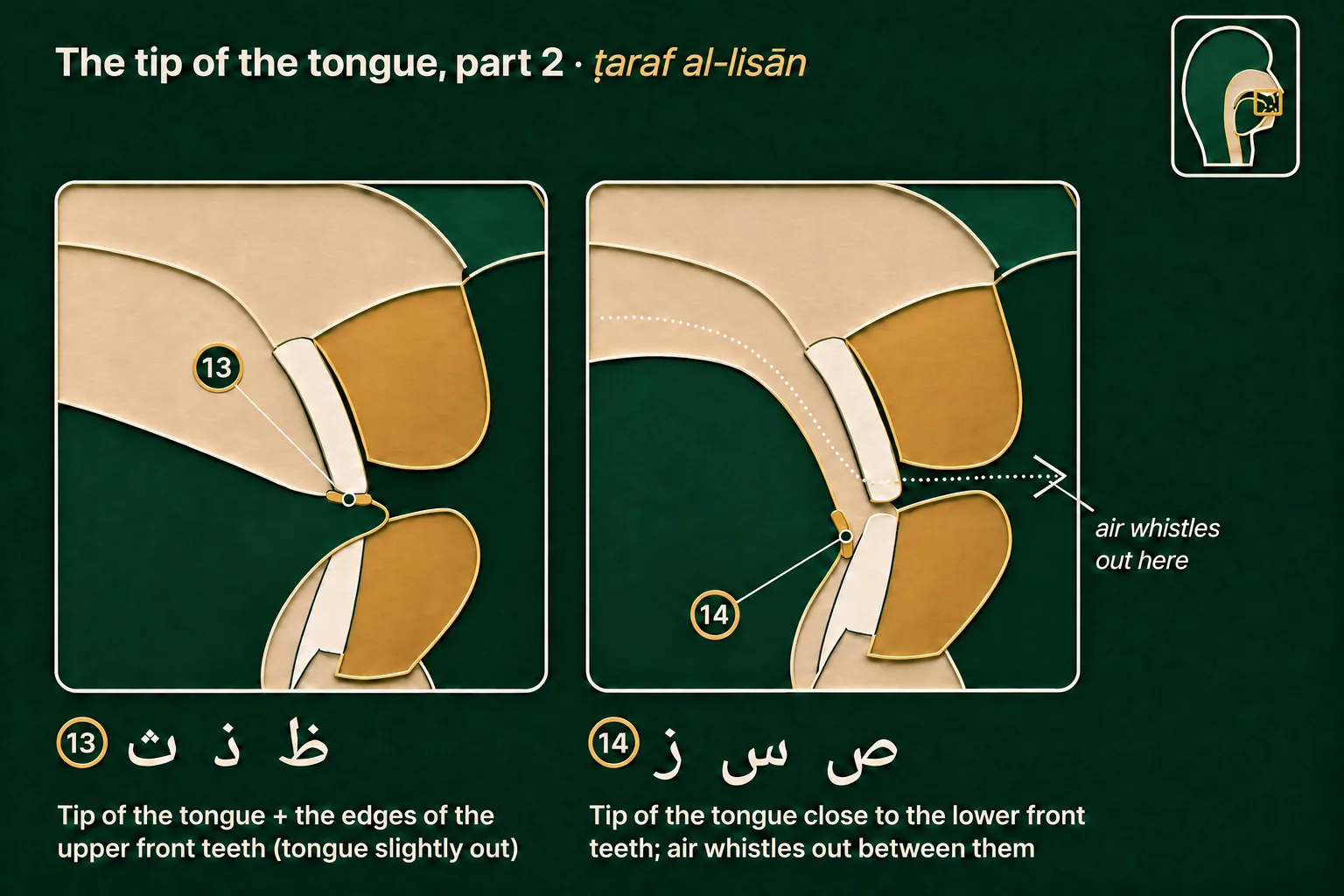
Try it now Say each one aloud, then tap it.
You practiced these. They count in the drill below too.
Round 8 of 10
The two lips
الشَّفَتانThis is the easiest zone to let slip, so mind your lips here. و needs the lips rounded and not touching; م needs them fully closed. ف is the one exception here: the inside of the lower lip against the tips of the upper front teeth.
Try it now Say each one aloud, then tap it.
You practiced these. They count in the drill below too.
Round 9 of 10
The empty space
الجَوۡفNot a contact point at all — the open cavity where the three long vowels live. و and ي appear here as well as above: in one place they are the sounds w and y, in another they stretch a vowel (lesson ten). Their recording for this zone is coming.
Try it now Say each one aloud, then tap it.
You practiced these. They count in the drill below too.
Round 10 of 10
The nose
الخَيۡشُومNo letters of its own. It is where the held n and m sound of lesson fifteen is made — pinch your nose while you say it, and if nothing changes, it is not there.
What you met in this lesson
- Five places in the mouth
- The throat
- The tongue
- The back and middle of the tongue
- The edges of the tongue
- Tip of the tongue
- Tip of the tongue
- The two lips
- The empty space
- The nose
You have finished the teaching. The drill below puts it all together.
The drill · read it aloud
Where each one is made
Read each card aloud, right to left.
The throat deepest, middle, nearest — in that order
The tongue back, middle, side, tip
The two lips
The empty space no contact at all
Mixed say each one, then name its zone. For wāw and yāʾ either zone counts
Pairs people confuse say both, twice — lesson three works on the difference
A short check
Can you read what this lesson taught?
Five quick questions, taken from this lesson. There is no score and no timer, and nothing is locked. Take it as often as you like.
Question 1 of 5
Where in the mouth is this letter made?
ب- The throat
- The tongue
- The two lips
- The empty space
Show the answer
Answer: The two lips. ب is made here: The two lips.
Question 2 of 5
Where in the mouth is this letter made?
د- The throat
- The tongue
- The two lips
- The empty space
Show the answer
Answer: The tongue. د is made here: The tongue.
Question 3 of 5
Where in the mouth is this letter made?
ج- The throat
- The tongue
- The two lips
- The empty space
Show the answer
Answer: The tongue. ج is made here: The tongue.
Question 4 of 5
Where in the mouth is this letter made?
ص- The throat
- The tongue
- The two lips
- The empty space
Show the answer
Answer: The tongue. ص is made here: The tongue.
Question 5 of 5
Where in the mouth is this letter made?
ر- The throat
- The tongue
- The two lips
- The empty space
Show the answer
Answer: The tongue. ر is made here: The tongue.
Question 5 of 5
Where in the mouth is this letter made?
س- The throat
- The tongue
- The two lips
- The empty space
Show the answer
Answer: The tongue. س is made here: The tongue.
Question 5 of 5
Where in the mouth is this letter made?
غ- The throat
- The tongue
- The two lips
- The empty space
Show the answer
Answer: The throat. غ is made here: The throat.
Question 5 of 5
Where in the mouth is this letter made?
ط- The throat
- The tongue
- The two lips
- The empty space
Show the answer
Answer: The tongue. ط is made here: The tongue.
Question 5 of 5
Where in the mouth is this letter made?
ح- The throat
- The tongue
- The two lips
- The empty space
Show the answer
Answer: The throat. ح is made here: The throat.
Question 5 of 5
Where in the mouth is this letter made?
ق- The throat
- The tongue
- The two lips
- The empty space
Show the answer
Answer: The tongue. ق is made here: The tongue.
Question 5 of 5
Where in the mouth is this letter made?
ء- The throat
- The tongue
- The two lips
- The empty space
Show the answer
Answer: The throat. ء is made here: The throat.
Question 5 of 5
Where in the mouth is this letter made?
ا- The throat
- The tongue
- The two lips
- The empty space
Show the answer
Answer: The empty space. ا is made here: The empty space.
The gate
Ready to move on?
You are ready to move on when, given a letter, you can point to roughly where in the five zones it is made. Roughly is enough here — exact comes from listening and correcting, not from a chart. To check yourself, record one row of the Mixed drill: each letter's name, its sound, and its zone. Listen back, then tap the cards to compare with me.
Record yourself
Read the lines this gate asks for, out loud, then listen back. You will hear what a listener hears.
Recordings stay on this device and are never uploaded. Delete any of them here at any time.
Nothing here is a score and nothing is timed. Each line is either true yet or not true yet. If you are unsure, it is not true yet.
Lesson 2 is marked complete. Well done — on to the next one when you are ready.
Next: lesson 3 · The sounds English does not haveThis course is free, with no ads. Monthly supporters help keep it that way. Support from $10 a month
Help shape this lesson
How was this lesson?
One tap. It goes straight to Hamza, and it is how the next version of this lesson gets better.
Received. Jazāk Allāhu khayran. Hamza reads every one.
Anonymous: no name, no account. How feedback is handled
Every Arabic word on this page comes from the book’s own build: Qur’anic words from the Uthmani text of Juz ʿAmma by sūrah, āyah and position, drill syllables assembled from letters and marks. Nothing is typed by hand.
Qur’anic text: Tanzil Quran Text (Uthmani), via alquran.cloud. Marks are normalized for display (the sukūn as the muṣḥaf prints it; tanwīn in its plain form, without the small mīm, as the book explains); the letters are unchanged.