Lesson 3 of 20: The sounds English does not have
Teaches The eight contrasts English speakers most need to learn by ear.
The teaching
Before the lesson · not counted
Warm-up · from earlier lessons
Say each card aloud, then tap it to check what it reads. Nothing here is saved or counted.
Round 1 of 6
What this lesson is
You start this lesson ahead: an English-speaking mouth already makes most of the twenty-eight. The rest tend to get quietly swapped for the nearest English sound. Because the swap is consistent, it sounds fine to you. This lesson needs your ears more than your eyes, which is why every pair has a recording.
Round 2 of 6
Each pair: the easier sound first
| ه | ح | ه is a breath from the deepest part of the throat. ح is higher, mid-throat: the throat narrows and the sound rasps |
| ء | ع | ء is a clean stop at the bottom of the throat. ع is higher, mid-throat: squeezed and voiced, not shut |
| ك | ق | Same kind of sound. ق is made further back, against the soft palate, and is heavy |
| خ | غ | Same place, and both heavy. خ is voiceless (breath only), غ is voiced (the voice hums) |
| ت | ط | ط is heavy. The tongue flattens, the back rises, the vowel after it darkens |
| س | ص | ص is heavy — the same s, sounded inside a bigger room |
| د | ض | ض uses the side of the tongue against the molars. The letter most learners take longest over |
| ذ | ظ | ظ is the heavy twin of ذ, not of ز |
Try it now Say each one aloud, then tap it.
You practiced these. They count in the drill below too.
Round 3 of 6
Light, then heavy
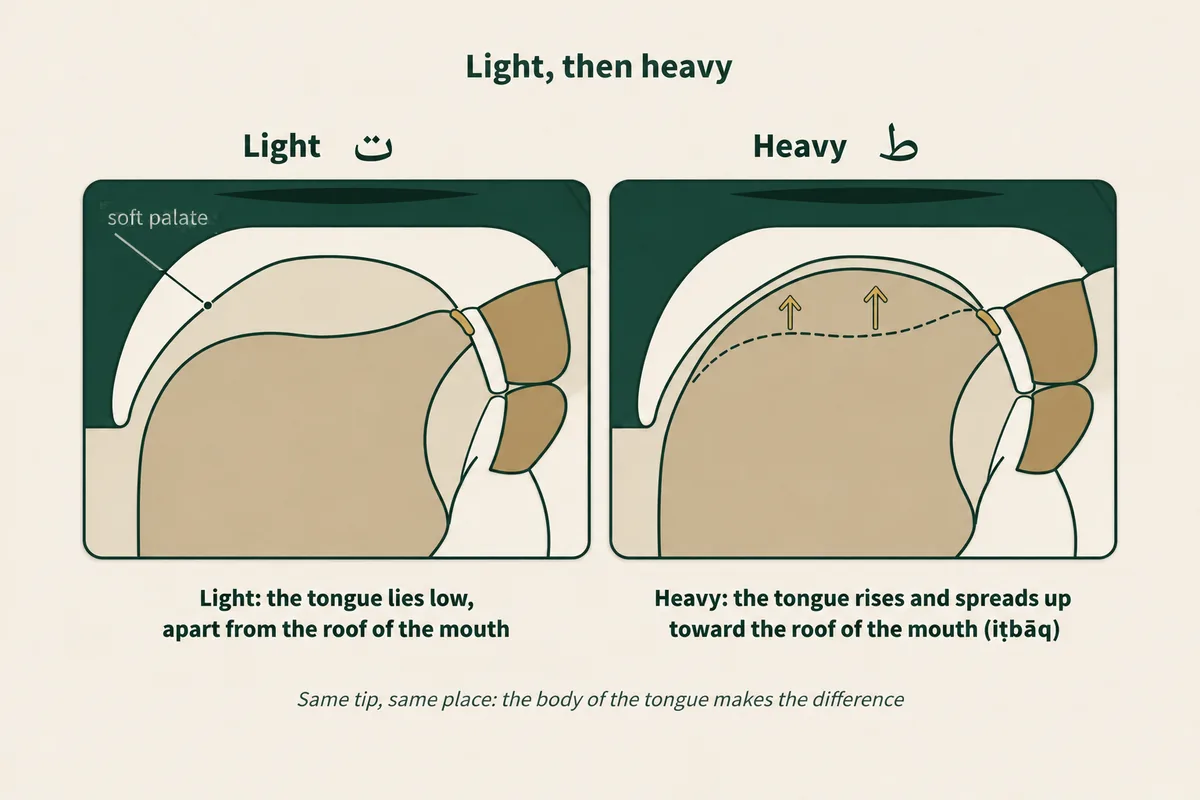
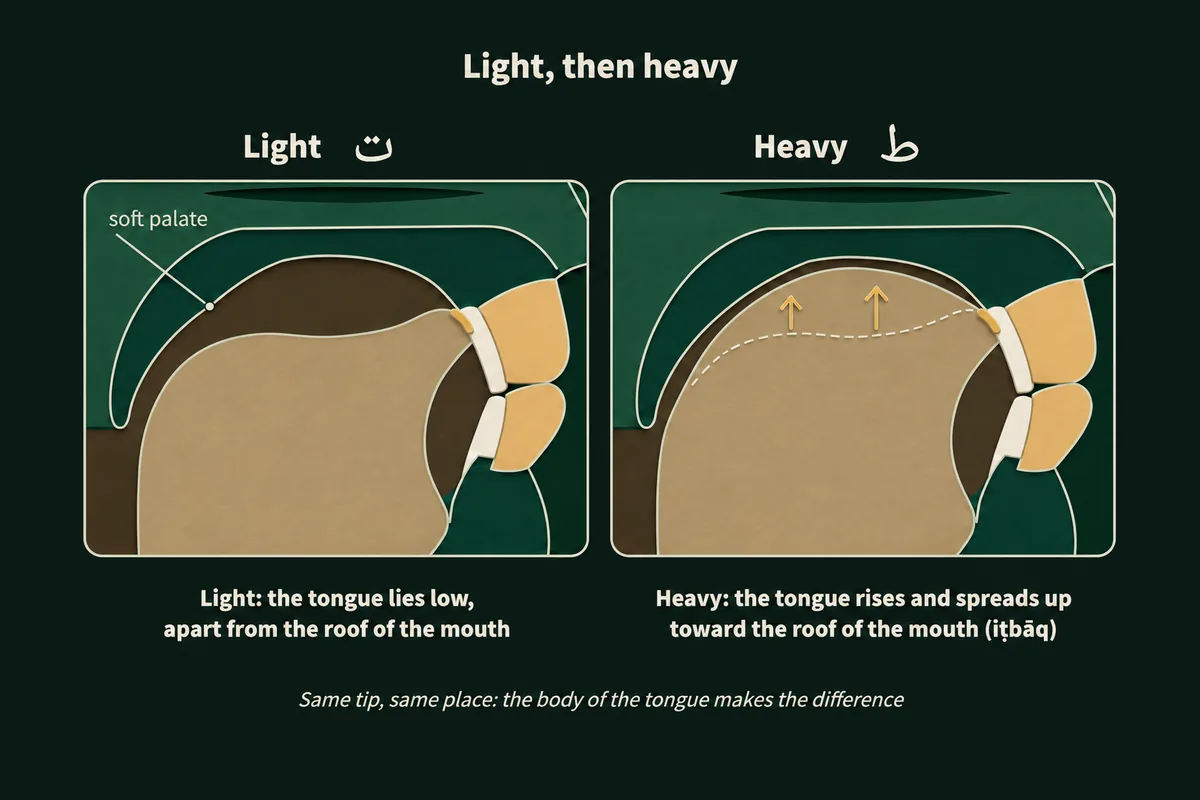
- Light: the tongue lies low, apart from the roof of the mouth.
- Heavy: the tongue rises and spreads up toward the roof of the mouth (iṭbāq).
- Same tip, same place: the body of the tongue makes the difference.
Try it now Say each one aloud, then tap it.
You practiced these. They count in the drill below too.
Round 4 of 6
The same eight, inside real words
| هُمۡ78:3 | حِسَابًا78:27 |
| أَلَمۡ78:6 | عَبَسَ80:1 |
| كَسَبَ111:2 | قُتِلَ80:17 |
| خُلِقَ86:5 | غُلۡبًا80:30 |
| تَذۡكِرَةٌ80:11 | بَطۡشَ85:12 |
| سَبۡعًا78:12 | صَفًّا89:22 |
| أَدۡبَرَ79:22 | ضَرِيعٍ88:6 |
| أَنذَرۡنَٰكُمۡ78:40 | يَنظُرُ78:40 |
Listen to these; do not try to read them yet. They use marks later lessons teach. Here they are only for the ear: the contrast is the lesson, not the reading.
Round 5 of 6
Out loud, both ways
Round 6 of 6
As pairs again, out loud
Each one carries a fatḥah: a consonant cannot be said alone, so a vowel is lent to you here. The mark itself is lesson five.
Try it now Say each one aloud, then tap it.
You practiced these. They count in the drill below too.
What you met in this lesson
- Each pair: the easier sound first
- Light, then heavy
- The same eight, inside real words
- Out loud, both ways
You have finished the teaching. The drill below puts it all together.
The drill · read it aloud
The eight pairs
Read each card aloud, right to left.
Two depths of the throat the deeper sound first, then the one higher up
The back of the mouth ك then ق, further back and heavy · خ then غ, both heavy: voiceless, then voiced
Light, then heavy the light letter first, then its heavy partner
Reversed second sound first now, so the order stops carrying you
The same sixteen, with a fatḥah a consonant cannot be said alone, so one is lent to you here — the mark itself is lesson five
As pairs again, out loud after ق ط ص ض ظ the vowel darkens; the throat and خ / غ pairs differ in depth and voice instead
Listening test A Listen — one sound from each row, in this order; write down which
Listening test B Listen — the rows in a new order
Show the answers
Answers. Test A — 1 ح · 2 ء · 3 ك · 4 غ · 5 ط · 6 س · 7 ض · 8 ذ. Test B — 1 خ · 2 ض · 3 ح · 4 س · 5 ك · 6 ظ · 7 ء · 8 ط.
A short check
Can you read what this lesson taught?
Five quick questions, taken from this lesson. There is no score and no timer, and nothing is locked. Take it as often as you like.
Question 1 of 5
What is this letter called?
ح- wāw
- khāʾ
- jīm
- ḥāʾ
Show the answer
Answer: ḥāʾ. ح is ḥāʾ.
Question 2 of 5
What is this letter called?
ع- ghayn
- ẓāʾ
- ʿayn
- sīn
Show the answer
Answer: ʿayn. ع is ʿayn.
Question 3 of 5
What is this letter called?
ط- ṭāʾ
- ṣād
- ḍād
- ẓāʾ
Show the answer
Answer: ṭāʾ. ط is ṭāʾ.
Question 4 of 5
What is this letter called?
ء- yāʾ
- dāl
- khāʾ
- hamzah
Show the answer
Answer: hamzah. ء is hamzah.
Question 5 of 5
What is this letter called?
ق- qāf
- hamzah
- fāʾ
- ʿayn
Show the answer
Answer: qāf. ق is qāf.
Question 5 of 5
What is this letter called?
ك- wāw
- kāf
- nūn
- hāʾ
Show the answer
Answer: kāf. ك is kāf.
Question 5 of 5
What is this letter called?
ظ- ṣād
- ḍād
- ẓāʾ
- ṭāʾ
Show the answer
Answer: ẓāʾ. ظ is ẓāʾ.
Question 5 of 5
What is this letter called?
ض- ṭāʾ
- ẓāʾ
- ḍād
- ṣād
Show the answer
Answer: ḍād. ض is ḍād.
Question 5 of 5
What is this letter called?
غ- hamzah
- ghayn
- fāʾ
- ʿayn
Show the answer
Answer: ghayn. غ is ghayn.
Question 5 of 5
What is this letter called?
ذ- dāl
- rāʾ
- dhāl
- zāy
Show the answer
Answer: dhāl. ذ is dhāl.
Question 5 of 5
What is this letter called?
ص- ẓāʾ
- ṭāʾ
- ṣād
- ḍād
Show the answer
Answer: ṣād. ص is ṣād.
Question 5 of 5
What is this letter called?
س- qāf
- nūn
- sīn
- shīn
Show the answer
Answer: sīn. س is sīn.
The gate
Ready to move on?
You are ready to move on when you score eight out of eight on both listening tests, and your own recording of all eight pairs sounds like two different sounds each time. Not perfectly — distinctly.
Many people find this lesson slow going, and that is normal. ض takes weeks and there is no trick: it is a movement your mouth has never made. A recording is more honest than your ear in the moment — and when you can, let someone who reads well hear you.
Record yourself
Read the lines this gate asks for, out loud, then listen back. You will hear what a listener hears.
Recordings stay on this device and are never uploaded. Delete any of them here at any time.
Nothing here is a score and nothing is timed. Each line is either true yet or not true yet. If you are unsure, it is not true yet.
Lesson 3 is marked complete. Well done — on to the next one when you are ready.
Next: lesson 4 · One letter, four shapesThis course is free, with no ads. Monthly supporters help keep it that way. Support from $10 a month
Help shape this lesson
How was this lesson?
One tap. It goes straight to Hamza, and it is how the next version of this lesson gets better.
Received. Jazāk Allāhu khayran. Hamza reads every one.
Anonymous: no name, no account. How feedback is handled
Every Arabic word on this page comes from the book’s own build: Qur’anic words from the Uthmani text of Juz ʿAmma by sūrah, āyah and position, drill syllables assembled from letters and marks. Nothing is typed by hand.
Qur’anic text: Tanzil Quran Text (Uthmani), via alquran.cloud. Marks are normalized for display (the sukūn as the muṣḥaf prints it; tanwīn in its plain form, without the small mīm, as the book explains); the letters are unchanged.