Part 1 · The mouth · Lesson 1 of 16
What tajwīd is, and is not
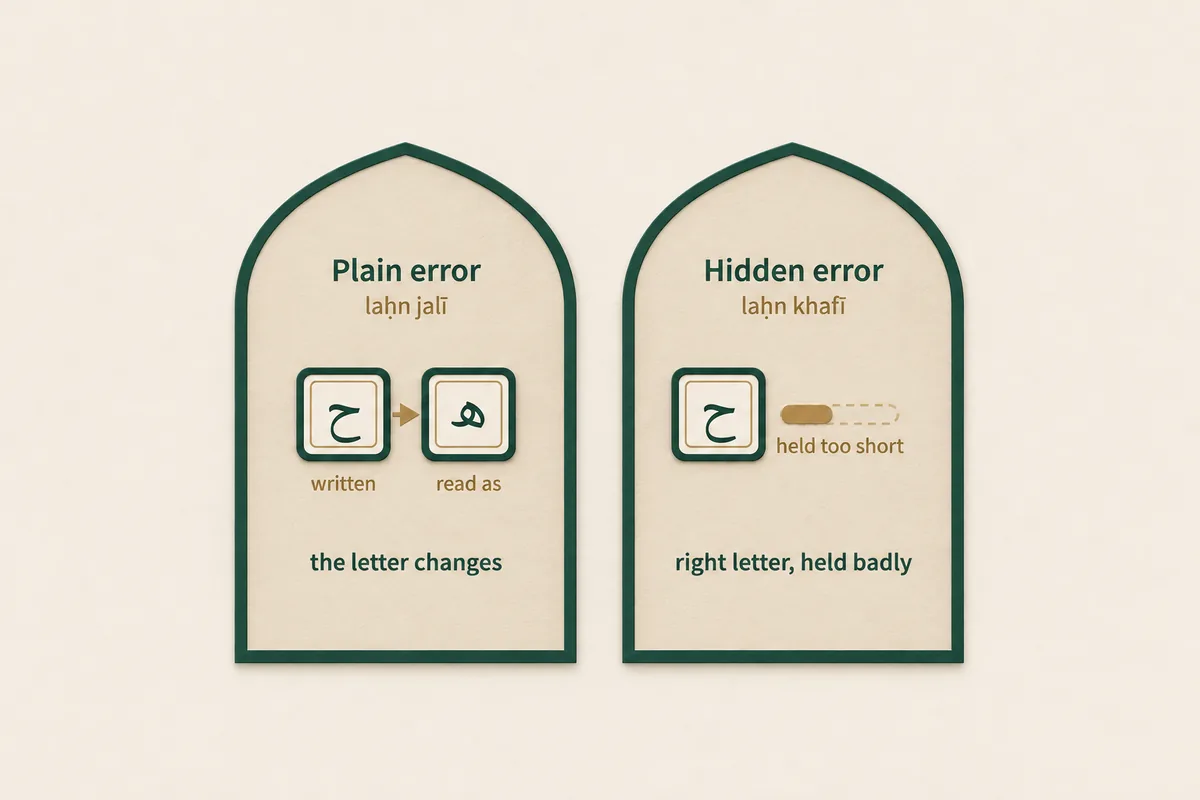
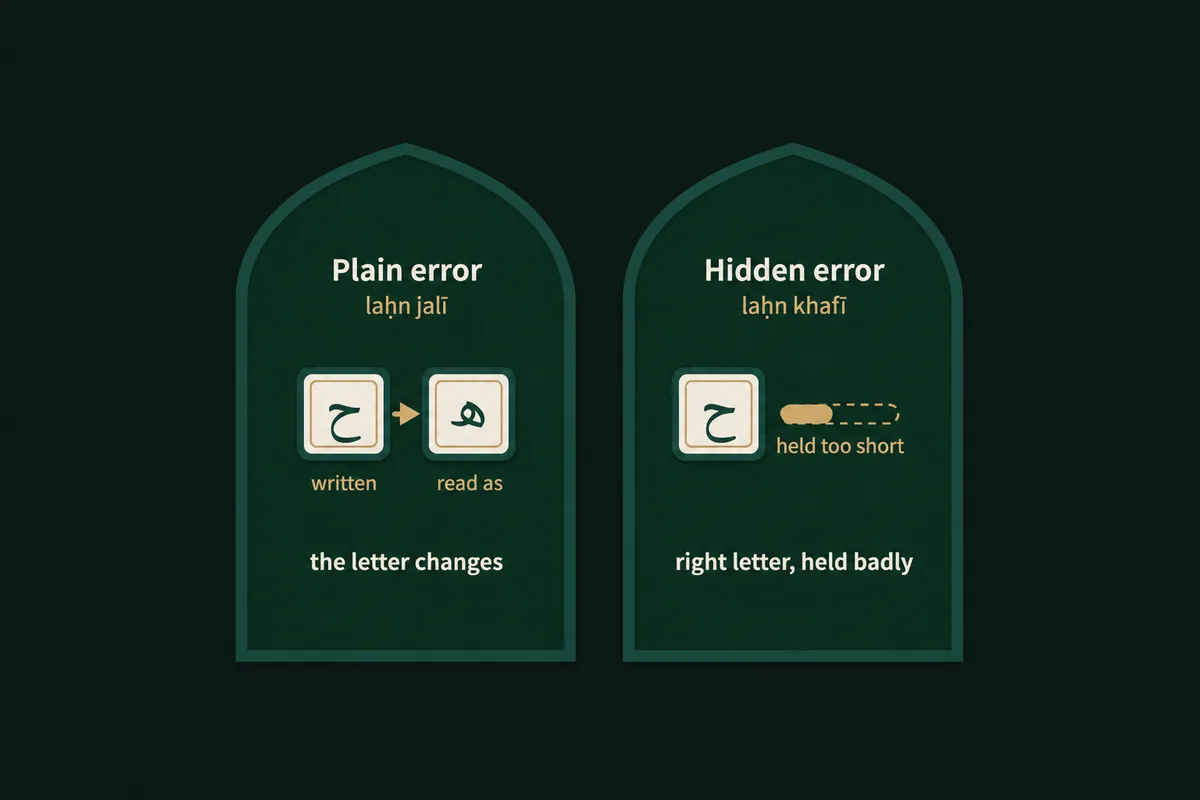
The two kinds of error, and which of them is not a matter of taste.
The rule
Tajwīd means giving each letter its due: its place, and the qualities that belong to it. Every rule in this course is either where a letter is made or what happens to it next to another letter.
Laḥn jalī — the plain error
A letter swapped for another letter, a vowel for another vowel, a length that changes a word: reading ح as ه. These are not matters of beauty. They change what is written, and correcting them is obligatory.
Laḥn khafī — the hidden error
The letter is right and something about how it is held is not: a ghunnah too short, an ikhfāʾ not quite hidden, a length that changes from one āyah to the next. The word survives; the recitation is weak rather than wrong.
Almost everything in the first book was the first kind. Almost everything in this course is the second. That sets what it can promise: it will not stop you reading the wrong word — you already stopped — it will stop you reading the right word badly.
Before you begin reading. The istiʿādhah is said at the start of a sitting — once is enough for the whole sitting, wherever you begin. The basmalah is said at the head of every sūrah except at-Tawbah, which is not in Juz ʿAmma. Starting partway into a sūrah, saying it is your choice, and better said than not. Joining the istiʿādhah, the basmalah and the first āyah may be done in any of four ways — all of them permitted, so take one and stop thinking about it.
Between two sūrahs: three ways, and one that is wrong
Juz ʿAmma holds thirty-seven sūrahs, so reciting it through means making this join thirty-six times. Any of these three is fine: stop after the sūrah, stop after the basmalah, then begin; run all three together in one breath; or stop after the sūrah, then join the basmalah to the sūrah that follows.
Never this one: joining the end of the sūrah to the basmalah, stopping there, and then starting the next sūrah. It makes the basmalah sound like the closing āyah of the sūrah you have just finished, which is not what it is.
4-question check
Spot the rule
A short self-check on what this lesson says. Choose an answer to see why. Nothing is saved or sent.
Question 1 of 4
Plain error or hidden error?
Reading ح as ه.- Plain error (laḥn jalī)
- Hidden error (laḥn khafī)
Show the answer
Answer: Plain error (laḥn jalī). A letter swapped for another letter changes what is written. Correcting it is obligatory.
Question 2 of 4
Plain error or hidden error?
A ghunnah held too short.- Plain error (laḥn jalī)
- Hidden error (laḥn khafī)
Show the answer
Answer: Hidden error (laḥn khafī). The letter is right; how it is held is not. The word survives, the recitation is weak.
Question 3 of 4
Plain error or hidden error?
A length that changes from one āyah to the next.- Plain error (laḥn jalī)
- Hidden error (laḥn khafī)
Show the answer
Answer: Hidden error (laḥn khafī). Inconsistent lengths are the hidden kind: the words survive, the recitation is weak rather than wrong.
Question 4 of 4
Plain error or hidden error?
A vowel read as a different vowel.- Plain error (laḥn jalī)
- Hidden error (laḥn khafī)
Show the answer
Answer: Plain error (laḥn jalī). A vowel for another vowel changes what is written, so it is the plain kind.
Lesson 1
The gate
The book ends every lesson with a gate. Move on when this is true of you:
You can say what makes a recitation wrong as opposed to merely weak, and give an example of each from your own reading.
Each gate has two halves: you must make the sound, and you must hear it when it is missing. Ask someone who reads well to listen to you.
Ticking it marks the lesson done in this browser only. Nothing is sent anywhere.
Lesson 1 is done. On to the next one when you are ready.
Next: lesson 2 · Seventeen points, five zonesThis course is free, with no ads. Monthly supporters help keep it that way. Support from $10 a month
Help shape this lesson
How was this lesson?
One tap. It goes straight to Hamza, and it is how the next version of this lesson gets better.
Received. Jazāk Allāhu khayran. Hamza reads every one.
Anonymous: no name, no account. How feedback is handled
From Tajwīd for Juz ʿAmma, lesson 1 — the free book by Hamza Abdul-Tawwaab. Āyāt from the Uthmani text the book uses.
Qur’anic text: Tanzil Quran Text (Uthmani), via alquran.cloud. Marks are normalized for display (the sukūn and staggered tanwīn as the muṣḥaf prints them); the letters are unchanged.