Lesson 9 of 20: Tanwīn
Teaches The doubled vowel at the end of a word, and the silent alif that sits under one of them.
The teaching
Before the lesson · not counted
Warm-up · from earlier lessons
Say each card aloud, then tap it to check what it reads. Nothing here is saved or counted.
Round 1 of 5
What this lesson is
Tanwīn is simpler than its name sounds. It is the short vowel written twice, and it adds an n to the end of the word. That is all it is, and it only ever happens at the end of a word. Listen
Round 2 of 5
The doubled vowel
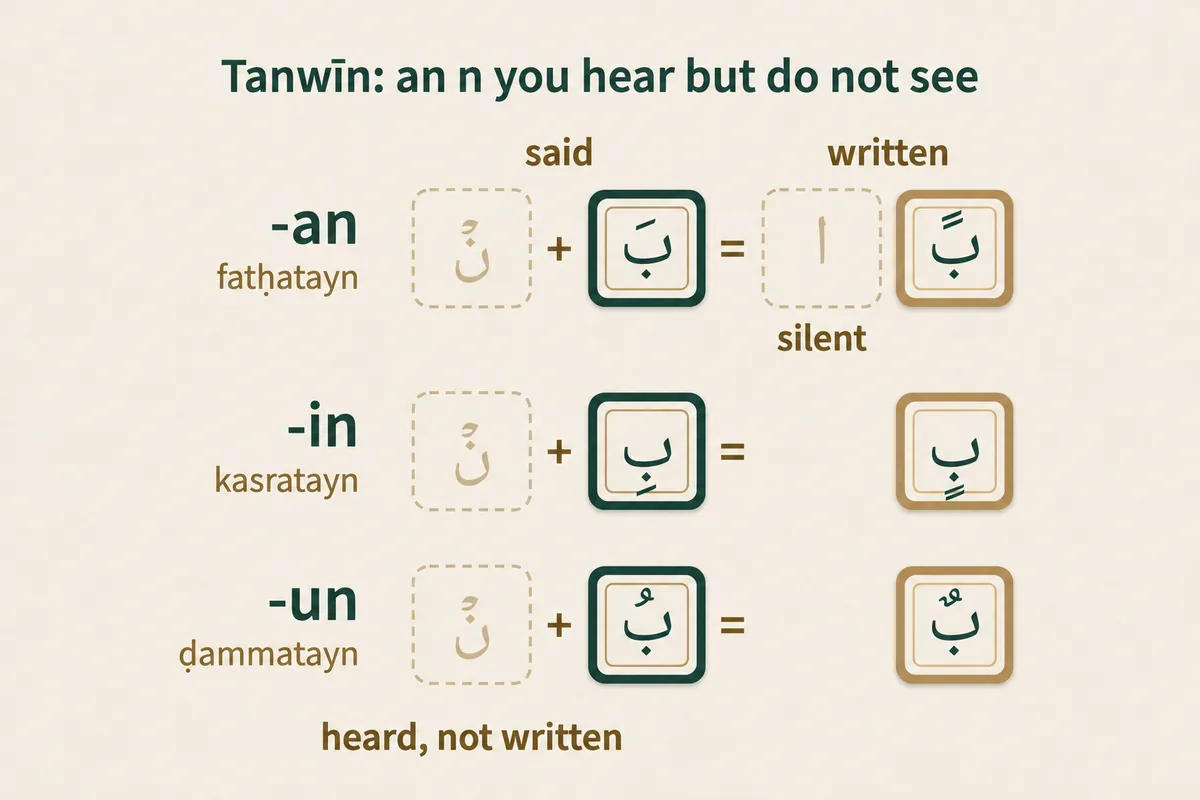
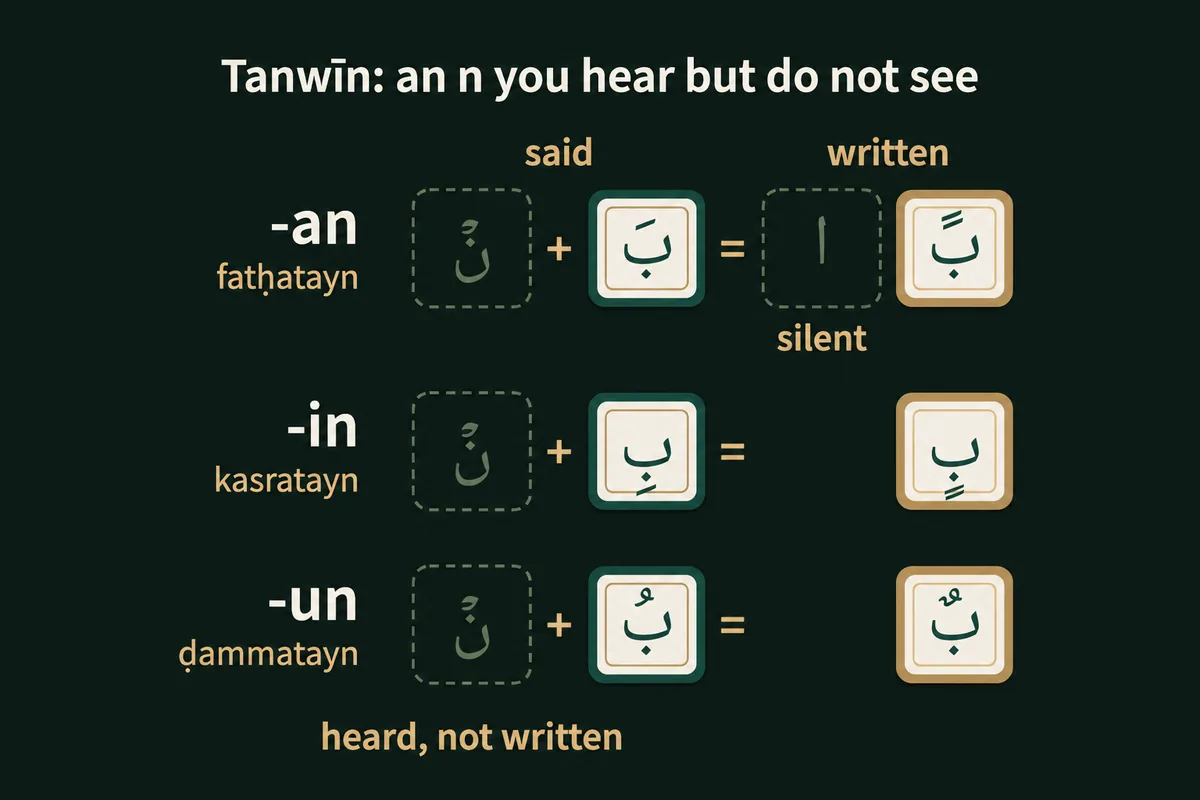
- fatḥatayn: -an, written with an alif after it, and that alif is silent
- kasratayn: -in
- ḍammatayn: -un
- The n is heard, not written.
The one trap. Fatḥatayn is almost always written on an alif — ـًا — and that alif is silent. It is a seat for the mark, not a sound. أَبَدًا is abadan, not abadā.
Almost every beginner trips on this, sometimes for months, so it is worth saying plainly.
| بً | fatḥatayn | says -an |
| بٍ | kasratayn | says -in |
| بٌ | ḍammatayn | says -un |
Round 3 of 5
Fatḥatayn
Try it now Say each one aloud, then tap it.
You practiced these. They count in the drill below too.
Round 4 of 5
Kasratayn
Try it now Say each one aloud, then tap it.
You practiced these. They count in the drill below too.
Round 5 of 5
Ḍammatayn
Try it now Say each one aloud, then tap it.
You practiced these. They count in the drill below too.
What you met in this lesson
- The doubled vowel
- Fatḥatayn
- Kasratayn
- Ḍammatayn
You have finished the teaching. The drill below puts it all together.
The drill · read it aloud
Tanwīn
Read each card aloud, right to left.
Fatḥatayn on its seat every one ends -an; not one ends in a long ā
Kasratayn
Ḍammatayn
Real words every tanwīn word in the juz you can already read whole
Two syllables, the second with tanwīn not words
A short check
Can you read what this lesson taught?
Five quick questions, taken from this lesson. There is no score and no timer, and nothing is locked. Take it as often as you like.
Question 1 of 5
How do you read this?
حٌ- ḥu
- ḥan
- khun
- ḥun
Show the answer
Answer: ḥun. حٌ is read ḥun.
Question 2 of 5
How do you read this?
غًا- ghan
- gha
- ghā
- ghun
Show the answer
Answer: ghan. غًا is read ghan.
Question 3 of 5
How do you read this?
رٌ- ran
- ru
- zun
- run
Show the answer
Answer: run. رٌ is read run.
Question 4 of 5
How do you read this?
ظَثًا- ẓathā
- ẓatha
- ẓathin
- ẓathan
Show the answer
Answer: ẓathan. ظَثًا is read ẓathan.
Question 5 of 5
How do you read this?
نًا- nā
- nan
- na
- nin
Show the answer
Answer: nan. نًا is read nan.
Question 5 of 5
How do you read this?
لٌ- lun
- lin
- lan
- lu
Show the answer
Answer: lun. لٌ is read lun.
Question 5 of 5
How do you read this?
ثِدٍ- thidin
- thidun
- thidi
- thidhin
Show the answer
Answer: thidin. ثِدٍ is read thidin.
Question 5 of 5
How do you read this?
غَتًا- ghatin
- ghata
- ghatan
- ghatā
Show the answer
Answer: ghatan. غَتًا is read ghatan.
Question 5 of 5
How do you read this?
خِجٍ- khijun
- khijin
- jijin
- khiji
Show the answer
Answer: khijin. خِجٍ is read khijin.
Question 5 of 5
How do you read this?
مِحٍ- miḥan
- miḥin
- mijin
- miḥi
Show the answer
Answer: miḥin. مِحٍ is read miḥin.
Question 5 of 5
How do you read this?
ظًا- ẓun
- ẓā
- ẓa
- ẓan
Show the answer
Answer: ẓan. ظًا is read ẓan.
Question 5 of 5
How do you read this?
جًا- jan
- jā
- jin
- ja
Show the answer
Answer: jan. جًا is read jan.
The gate
Ready to move on?
You are ready to move on when you read all three tanwīn endings correctly and never pronounce the seat-alif of fatḥatayn as a long vowel. Listen to your recording for that alif in particular.
Record yourself
Read the lines this gate asks for, out loud, then listen back. You will hear what a listener hears.
Recordings stay on this device and are never uploaded. Delete any of them here at any time.
Nothing here is a score and nothing is timed. Each line is either true yet or not true yet. If you are unsure, it is not true yet.
Lesson 9 is marked complete. Well done — on to the next one when you are ready.
Next: lesson 10 · The long vowelsThis course is free, with no ads. Monthly supporters help keep it that way. Support from $10 a month
Help shape this lesson
How was this lesson?
One tap. It goes straight to Hamza, and it is how the next version of this lesson gets better.
Received. Jazāk Allāhu khayran. Hamza reads every one.
Anonymous: no name, no account. How feedback is handled
Every Arabic word on this page comes from the book’s own build: Qur’anic words from the Uthmani text of Juz ʿAmma by sūrah, āyah and position, drill syllables assembled from letters and marks. Nothing is typed by hand.
Qur’anic text: Tanzil Quran Text (Uthmani), via alquran.cloud. Marks are normalized for display (the sukūn as the muṣḥaf prints it; tanwīn in its plain form, without the small mīm, as the book explains); the letters are unchanged.