Lesson 10 of 20: The long vowels
Teaches That a long vowel is its short vowel held, and the small alif that is said but not written full size.
The teaching
Before the lesson · not counted
Warm-up · from earlier lessons
Say each card aloud, then tap it to check what it reads. Nothing here is saved or counted.
Round 1 of 5
What this lesson is
Each short vowel has a long partner, and there is no new sound to learn. The long one is the same sound held for about twice as long — two counts. Say ba, then say ba and do not stop — that is bā. ListenRecording coming
Round 2 of 5
Short, then held
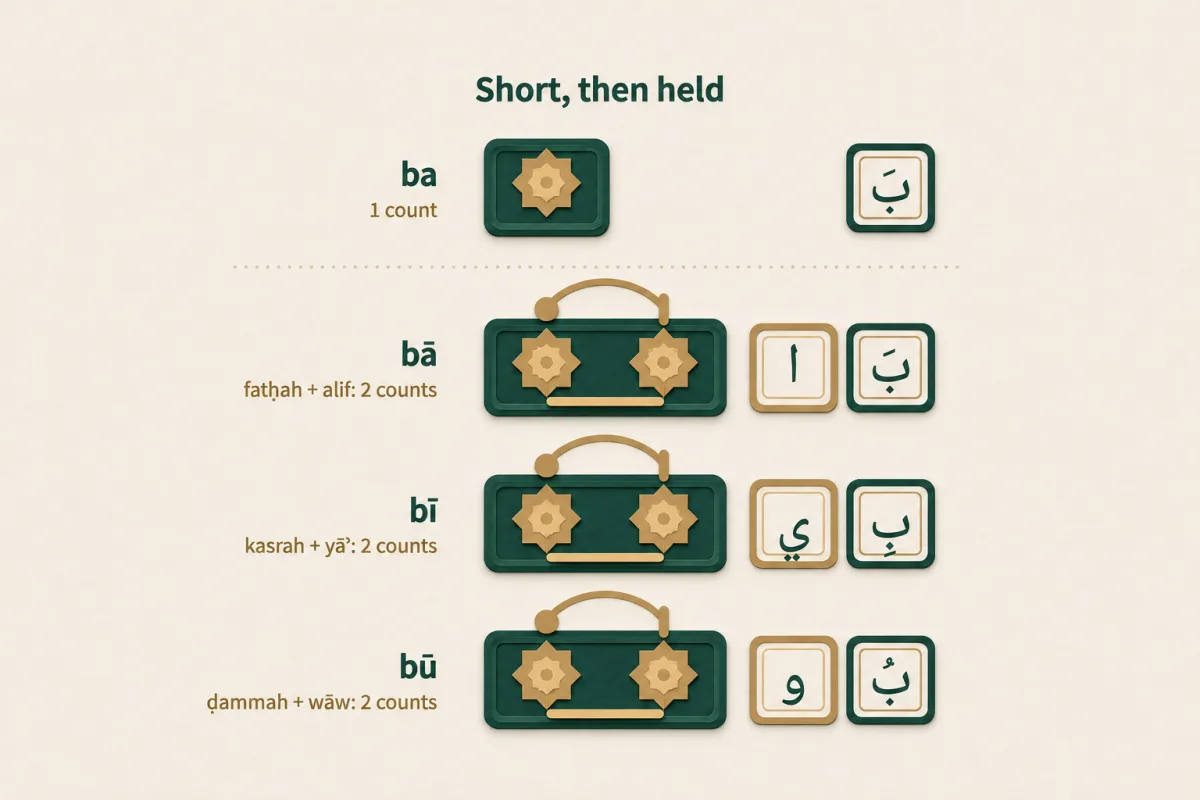
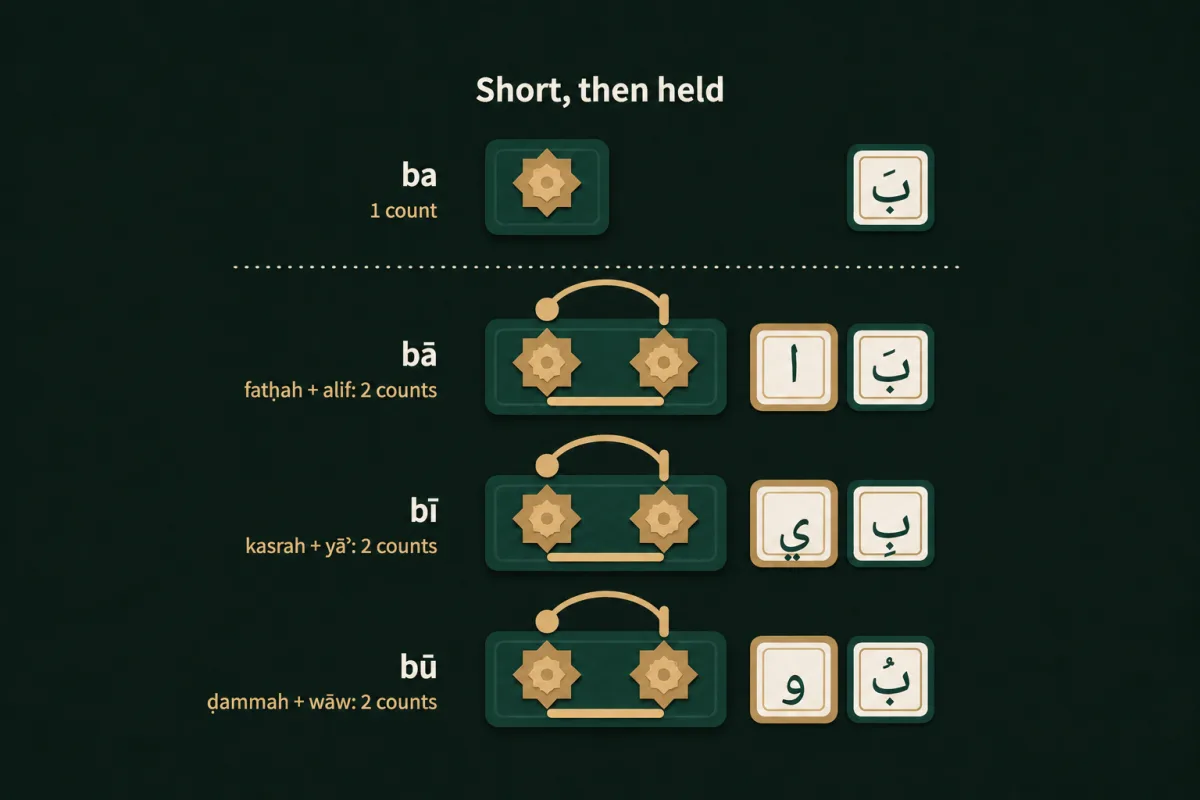
- ba: 1 count
- bā: fatḥah + alif, 2 counts
- bī: kasrah + yāʾ, 2 counts
- bū: ḍammah + wāw, 2 counts
The pattern is exact: the letter that lengthens always matches the vowel before it. If they do not match, it is not a long vowel — it is something else, and lesson fourteen is about that.
| Short | Long | Made by | ||
|---|---|---|---|---|
| بَ | ba | بَا | bā | fatḥah followed by ا |
| بِ | bi | بِي | bī | kasrah followed by ي |
| بُ | bu | بُو | bū | ḍammah followed by و |
Round 3 of 5
Held twice as long
Try it now Say each one aloud, then tap it.
You practiced these. They count in the drill below too.
Round 4 of 5
In real words
| كَانَ | kāna | 78:17 |
| يَقُولُ | yaqūlu | 89:24 |
| فِيهِ | fīhi | 78:3 |
| يَذُوقُونَ | yadhūqūna | 78:24 |
| قَرِيبًا | qarīban | 78:40 |
| قُلُوبٌ | qulūbun | 79:8 |
| حِسَابًا | ḥisāban | 78:27 |
Try it now Say each one aloud, then tap it.
You practiced these. They count in the drill below too.
Round 5 of 5
The small standing alif
Sometimes the alif is written as a tiny vertical stroke above the letter instead of full size beside it — بٰ. It is said exactly like a full alif. It is not a decoration and it is not optional.
It sits on some of the commonest words in the Qur'an — ذَٰلِكَ dhālika, هَٰذَا hādhā — and on the name of Allah's mercy in the basmalah.
Try it now Say each one aloud, then tap it.
You practiced these. They count in the drill below too.
What you met in this lesson
- Short, then held
- In real words
- The small standing alif
You have finished the teaching. The drill below puts it all together.
The drill · read it aloud
Short, then long
Read each card aloud, right to left.
Held twice as long say the short one, then the long one, back to back
All three lengthenings the letter always matches the vowel before it
Real words two counts on every long vowel
The small standing alif said exactly like a full one
And the tanwīn words from lesson nine you could not finish these before; now you can
A short check
Can you read what this lesson taught?
Five quick questions, taken from this lesson. There is no score and no timer, and nothing is locked. Take it as often as you like.
Question 1 of 5
How do you read this?
يَذُوقُونَ- yadhuqūna
- yadhūqūna
- yudhūqūna
- yādhūqūna
Show the answer
Answer: yadhūqūna. يَذُوقُونَ is read yadhūqūna.
Question 2 of 5
How do you read this?
كَانَ- kana
- kāni
- kāna
- kānu
Show the answer
Answer: kāna. كَانَ is read kāna.
Question 3 of 5
How do you read this?
حِسَابًا- ḥisābin
- ḥisaban
- ḥisābān
- ḥisāban
Show the answer
Answer: ḥisāban. حِسَابًا is read ḥisāban.
Question 4 of 5
How do you read this?
قُلُوبٌ- qulubun
- qūlūbun
- qulūbun
- qulūban
Show the answer
Answer: qulūbun. قُلُوبٌ is read qulūbun.
Question 5 of 5
How do you read this?
قَرِيبًا- qarībun
- qariban
- qarīban
- qārīban
Show the answer
Answer: qarīban. قَرِيبًا is read qarīban.
Question 5 of 5
How do you read this?
فِيهِ- fīhu
- fīha
- fihi
- fīhi
Show the answer
Answer: fīhi. فِيهِ is read fīhi.
Question 5 of 5
How do you read this?
يَقُولُ- yaqulu
- yaqūlu
- yaqūla
- yāqūlu
Show the answer
Answer: yaqūlu. يَقُولُ is read yaqūlu.
The gate
Ready to move on?
You are ready to move on when you hold every long vowel for about two counts — plainly longer than a short vowel, and not stretched further — and read the small standing alif as a full one.
You have just done your first piece of tajwīd. How long a vowel is held is a measured thing; the next lesson shows the one sign that asks for longer, and the tajwīd book gives each length its name. For now: two counts, and check them against the recording.
Record yourself
Read the lines this gate asks for, out loud, then listen back. You will hear what a listener hears.
Recordings stay on this device and are never uploaded. Delete any of them here at any time.
Nothing here is a score and nothing is timed. Each line is either true yet or not true yet. If you are unsure, it is not true yet.
Lesson 10 is marked complete. Well done — on to the next one when you are ready.
Next: lesson 11 · The wavy lineThis course is free, with no ads. Monthly supporters help keep it that way. Support from $10 a month
Help shape this lesson
How was this lesson?
One tap. It goes straight to Hamza, and it is how the next version of this lesson gets better.
Received. Jazāk Allāhu khayran. Hamza reads every one.
Anonymous: no name, no account. How feedback is handled
Every Arabic word on this page comes from the book’s own build: Qur’anic words from the Uthmani text of Juz ʿAmma by sūrah, āyah and position, drill syllables assembled from letters and marks. Nothing is typed by hand.
Qur’anic text: Tanzil Quran Text (Uthmani), via alquran.cloud. Marks are normalized for display (the sukūn as the muṣḥaf prints it; tanwīn in its plain form, without the small mīm, as the book explains); the letters are unchanged.