Part 4 · The cut letters · Lesson 16 of 16
Qalqalah
The bounce, its two sizes, and the fact that it is not a vowel.
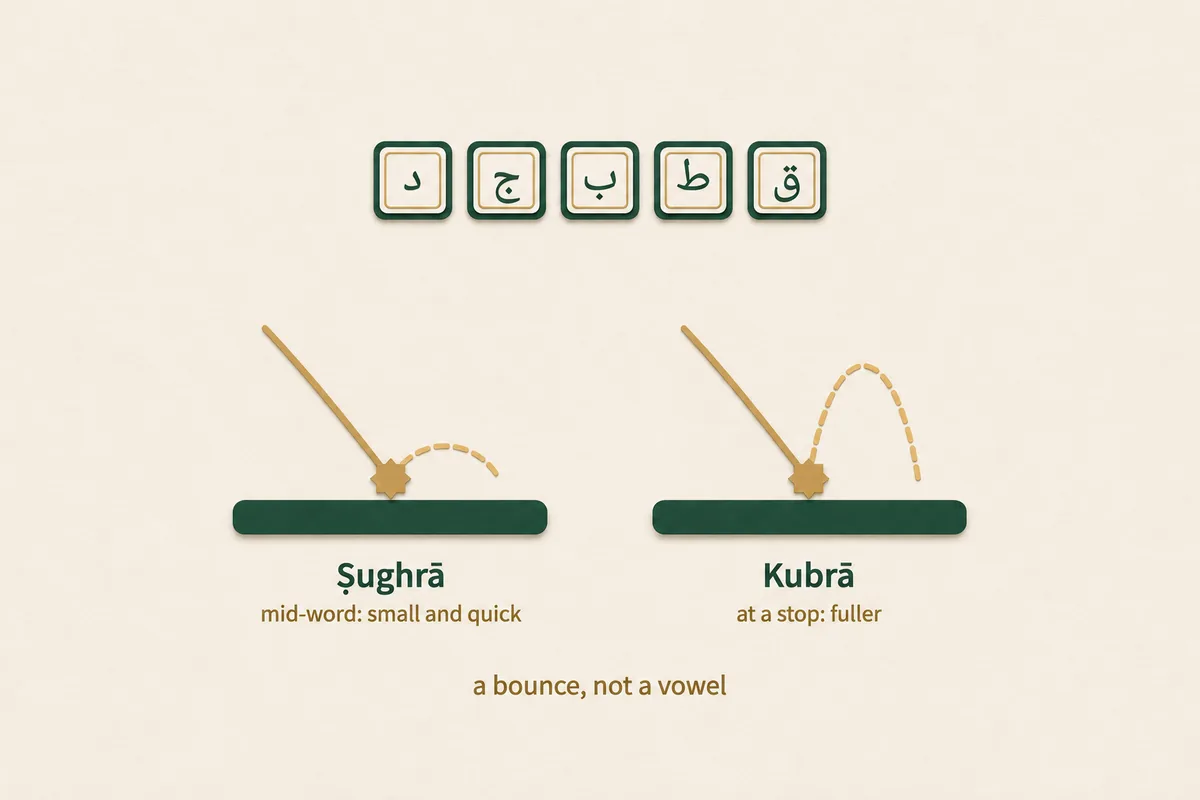
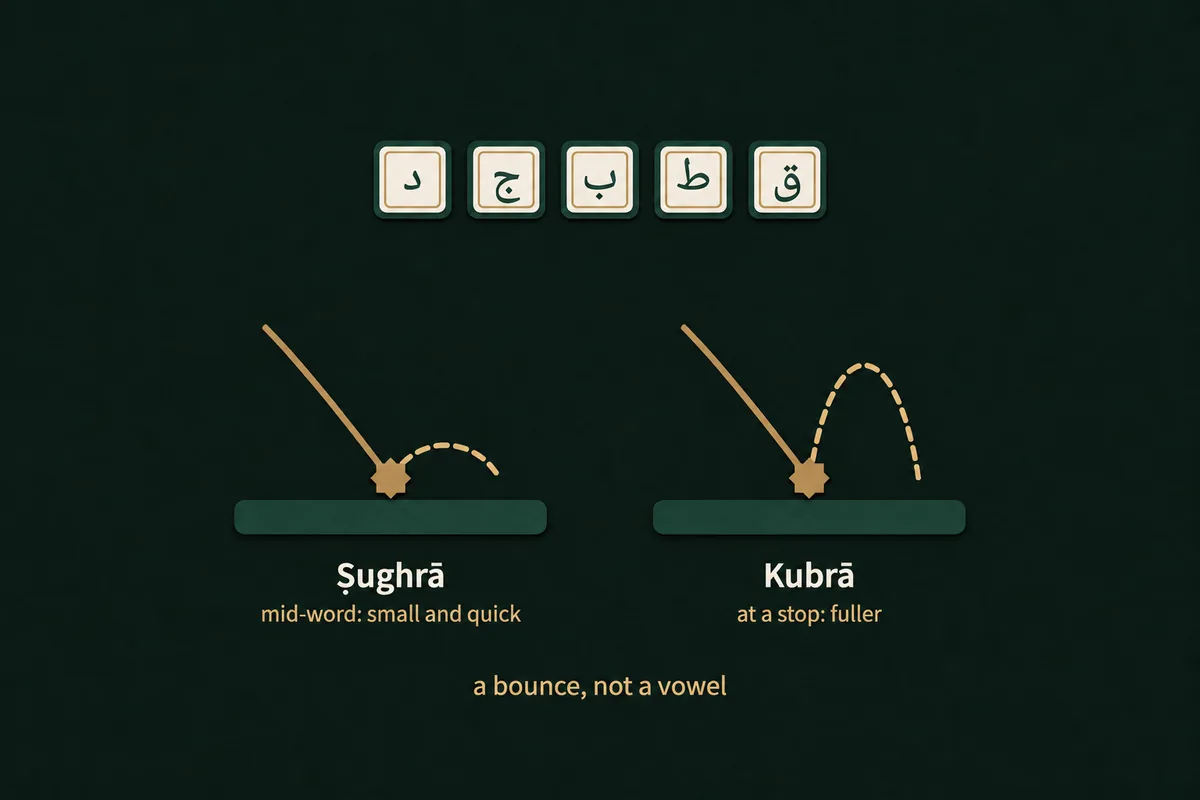
The rule
The last ruling in the book, and you have been doing it since the first one. Five letters — ق ط ب ج د — cannot be stopped silently. When one takes a sukūn, releasing it produces a small audible rebound.
Ṣughrā, the lesser: the letter carries a written sukūn and the word continues past it. Small and quick. 123 sites. Kubrā, the greater: you stop on the letter, so it takes a sukūn because you stopped. Fuller — and because it lands at the end of a breath, it is the one everybody hears. 70 āyāt end this way.
The bounce is not a vowel. It has no color of its own — not -i, not -u, not -a. If a listener can tell you which vowel you added, you added one, and you have put a letter into the Book that is not there. The test: stop on a word ending in ج and ask what they heard after it. The right answer is “nothing, but I heard the ج finish.”
Examples from Juz ʿAmma only
In Juz ʿAmma
The book’s own examples, in muṣḥaf order. Nothing is colored: the marks that decide the ruling are already printed in the words. Choose one to see it in its āyah.
The book’s own examples, in muṣḥaf order. Nothing is colored: the marks that decide the ruling are already printed in the words.
Every case in Juz ʿAmma, listed by sūrah: Qalqalah — the bounce
Ṣughrā
24 of 123 in the juzMid-word, small and quick.
- نَجۡعَلِ78:6
- وَخَلَقۡنَٰكُمۡ78:8
- سَبۡعࣰا78:12
- أَبۡوَٰبࣰا78:19
- سَبۡحࣰا79:3
- سَبۡقࣰا79:4
- أَبۡصَٰرُهَا79:9
- زَجۡرَةࣱ79:13
- ٱذۡهَبۡ79:17
- ٱلۡكُبۡرَىٰ79:20
- أَدۡبَرَ79:22
- لَعِبۡرَةࣰ79:26
- يُدۡرِيكَ80:3
- نُّطۡفَةٍ80:19
- فَأَقۡبَرَهُۥ80:21
- يَقۡضِ80:23
- صَبَبۡنَا80:25
- شَقَقۡنَا80:26
- مُّسۡتَبۡشِرَةࣱ80:39
- أُقۡسِمُ81:15
- وَٱلصُّبۡحِ81:18
- بِمَجۡنُونࣲ81:22
- وَلَقَدۡ81:23
- ٱلۡأَبۡرَارَ82:13
The example is underlined.
Kubrā
24 of 70 in the juzAt a stop — the one everybody hears.
- بِٱلشَّفَقِ84:16
- وَسَقَ84:17
- ٱتَّسَقَ84:18
- طَبَقࣲ84:19
- ٱلۡبُرُوجِ85:1
- ٱلۡمَوۡعُودِ85:2
- وَمَشۡهُودࣲ85:3
- ٱلۡأُخۡدُودِ85:4
- ٱلۡوَقُودِ85:5
- قُعُودࣱ85:6
- شُهُودࣱ85:7
- ٱلۡحَمِيدِ85:8
- شَهِيدٌ85:9
- ٱلۡحَرِيقِ85:10
- لَشَدِيدٌ85:12
- وَيُعِيدُ85:13
- ٱلۡوَدُودُ85:14
- ٱلۡمَجِيدُ85:15
- يُرِيدُ85:16
- ٱلۡجُنُودِ85:17
- وَثَمُودَ85:18
- تَكۡذِيبࣲ85:19
- مُّحِيطُۢ85:20
- مَّجِيدࣱ85:21
The example is underlined.
6-question check
Spot the rule
A short self-check, using only the book’s examples. Choose an answer to see why. Nothing is saved or sent.
Question 1 of 6
Which ruling is this?
نُّطۡفَةٍSūrat ʿAbasa 80:19- Qalqalah ṣughrā
- Qalqalah kubrā
Show the answer
Answer: Qalqalah ṣughrā. The letter carries a written sukūn mid-word: the lesser bounce, small and quick.
Question 2 of 6
Which ruling is this?
يُرِيدُSūrat al-Burūj 85:16- Qalqalah ṣughrā
- Qalqalah kubrā
Show the answer
Answer: Qalqalah kubrā. You stop on the letter at the āyah’s end: the greater bounce, the one everybody hears.
Question 3 of 6
Which ruling is this?
ٱذۡهَبۡSūrat an-Nāziʿāt 79:17- Qalqalah ṣughrā
- Qalqalah kubrā
Show the answer
Answer: Qalqalah ṣughrā. The letter carries a written sukūn mid-word: the lesser bounce, small and quick.
Question 4 of 6
Which ruling is this?
ٱلۡحَرِيقِSūrat al-Burūj 85:10- Qalqalah ṣughrā
- Qalqalah kubrā
Show the answer
Answer: Qalqalah kubrā. You stop on the letter at the āyah’s end: the greater bounce, the one everybody hears.
Question 5 of 6
Which ruling is this?
مُّسۡتَبۡشِرَةࣱSūrat ʿAbasa 80:39- Qalqalah ṣughrā
- Qalqalah kubrā
Show the answer
Answer: Qalqalah ṣughrā. The letter carries a written sukūn mid-word: the lesser bounce, small and quick.
Question 6 of 6
Which ruling is this?
تَكۡذِيبࣲSūrat al-Burūj 85:19- Qalqalah ṣughrā
- Qalqalah kubrā
Show the answer
Answer: Qalqalah kubrā. You stop on the letter at the āyah’s end: the greater bounce, the one everybody hears.
Lesson 16
The gate
The book ends every lesson with a gate. Move on when this is true of you:
Both sizes audible and distinct from each other, and neither carrying a vowel — at a stop someone else chooses, in unseen text.
Each gate has two halves: you must make the sound, and you must hear it when it is missing. Ask someone who reads well to listen to you.
Ticking it marks the lesson done in this browser only. Nothing is sent anywhere.
That was the last lesson. What is left is the juz read whole.
Read Juz ʿAmma wholeThis course is free, with no ads. Monthly supporters help keep it that way. Support from $10 a month
The run
That is the last rule. What is left is the juz read whole — first with the rules in mind, then a clean muṣḥaf with nothing marked at all.
Help shape this lesson
How was this lesson?
One tap. It goes straight to Hamza, and it is how the next version of this lesson gets better.
Received. Jazāk Allāhu khayran. Hamza reads every one.
Anonymous: no name, no account. How feedback is handled
From Tajwīd for Juz ʿAmma, lesson 16 — the free book by Hamza Abdul-Tawwaab. Āyāt from the Uthmani text the book uses.
Qur’anic text: Tanzil Quran Text (Uthmani), via alquran.cloud. Marks are normalized for display (the sukūn and staggered tanwīn as the muṣḥaf prints them); the letters are unchanged.