Part 3 · The lengthenings · Lesson 14 of 16
ʿĀriḍ and līn
What stopping does to a length — the most frequently exercised decision in the book.
The rule
Both rulings here exist only at a stop. Read straight through and neither applies.
Madd ʿāriḍ lil-sukūn is a madd letter followed by one more letter that you stop on. That final letter takes a sukūn because you stopped, and the madd before it stretches. 167 of the juz’s 564 āyāt end this way — close to a third, which makes it the single most repeated length decision you will make.
What it is not. A word ending on a madd letter with nothing after it is not ʿāriḍ — it is madd ṭabīʿī, and stopping changes nothing about it. 192 āyāt in the juz end that way. Confusing the two makes a student stretch a great many things that should stay at two.
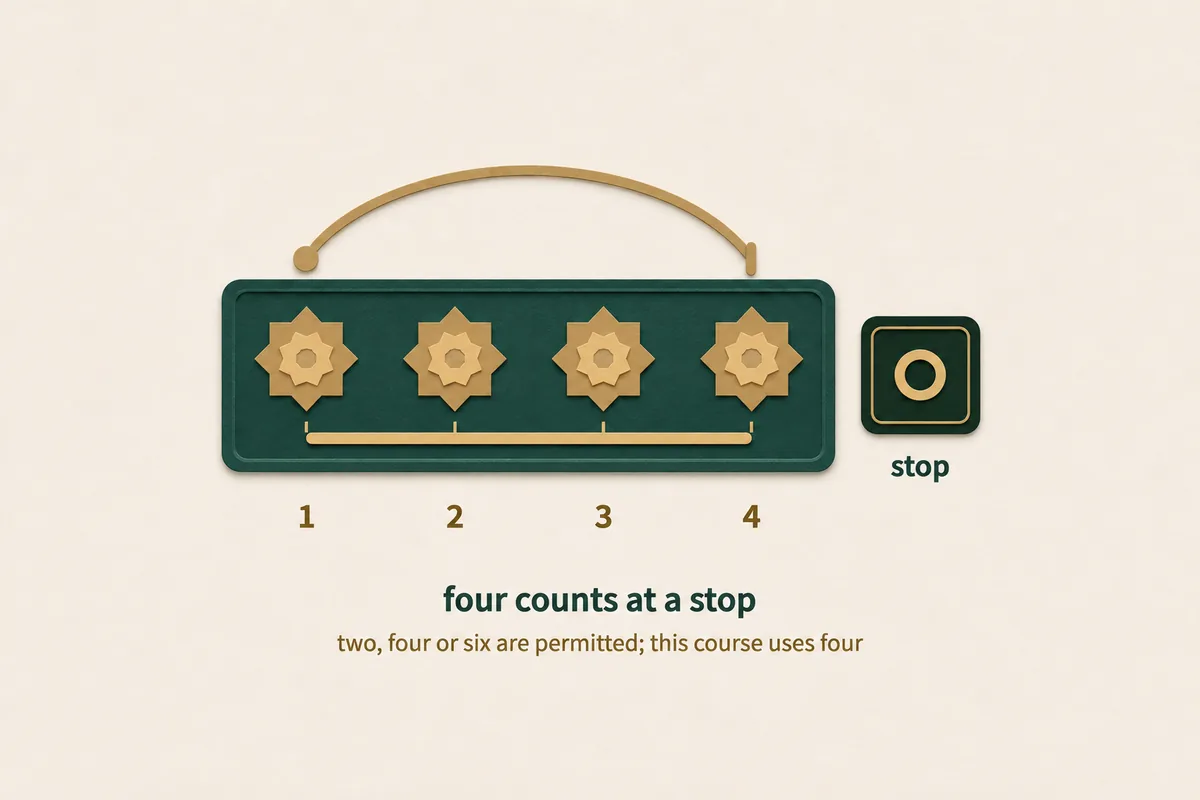
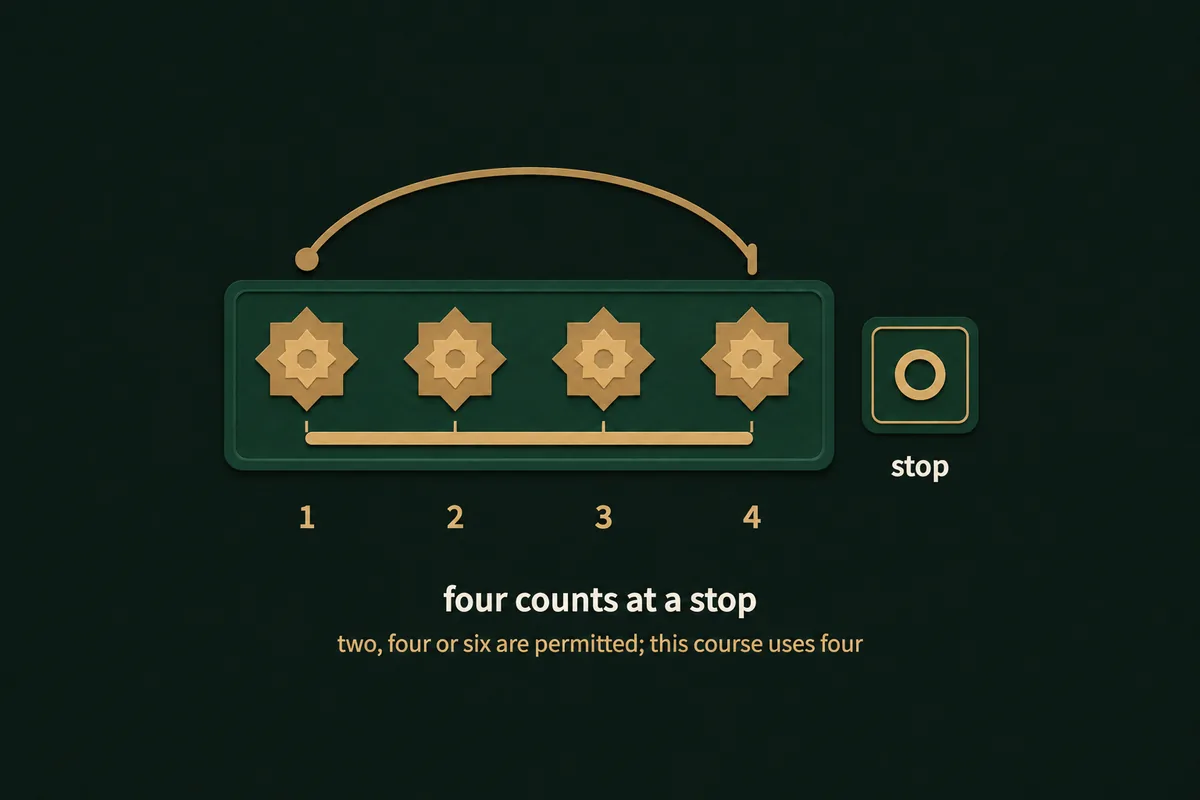
Madd līn is the soft pair from the first book — a fatḥah then a sākin و or ي — followed by one more letter you stop on. 85 words in the juz have that shape, and only 7 āyāt end on one; the rest are a madd līn only if you happen to stop there. A soft pair in the middle of a word is not one. Two, four or six are permitted; this course uses four, for both.
Examples from Juz ʿAmma only
In Juz ʿAmma
The book’s own examples, in muṣḥaf order. Nothing is colored: the marks that decide the ruling are already printed in the words. Choose one to see it in its āyah.
The book’s own examples, in muṣḥaf order. Nothing is colored: the marks that decide the ruling are already printed in the words.
Every case in Juz ʿAmma, listed by sūrah: The length at a stop · The soft length at a stop
ʿĀriḍ lil-sukūn
24 of 167 in the juzStop on the last letter; the madd before it stretches.
- يَتَسَآءَلُونَ78:1
- ٱلۡعَظِيمِ78:2
- مُخۡتَلِفُونَ78:3
- سَيَعۡلَمُونَ78:4
- أَخِيهِ80:34
- وَأَبِيهِ80:35
- وَبَنِيهِ80:36
- يُغۡنِيهِ80:37
- كَرِيمࣲ81:19
- مَكِينࣲ81:20
- أَمِينࣲ81:21
- بِمَجۡنُونࣲ81:22
- ٱلۡمُبِينِ81:23
- بِضَنِينࣲ81:24
- رَّجِيمࣲ81:25
- تَذۡهَبُونَ81:26
- لِّلۡعَٰلَمِينَ81:27
- يَسۡتَقِيمَ81:28
- ٱلۡعَٰلَمِينَ81:29
- ٱلۡكَرِيمِ82:6
- بِٱلدِّينِ82:9
- لَحَٰفِظِينَ82:10
- كَٰتِبِينَ82:11
- تَفۡعَلُونَ82:12
The example is underlined.
Līn at the end of an āyah
all 7 in the juzAll of them: the stop is already there. Four counts.
- عَيۡنَيۡنِ90:8
- وَشَفَتَيۡنِ90:9
- ٱلنَّجۡدَيۡنِ90:10
- قُرَيۡشٍ106:1
- وَٱلصَّيۡفِ106:2
- ٱلۡبَيۡتِ106:3
- خَوۡفِۭ106:4
The example is underlined.
Līn if you stop here
24 of 78 in the juzNot the end of an āyah: only if you stop on the word.
- ٱلَّيۡلَ78:10
- يَوۡمَ78:17
- ٱلۡيَوۡمُ78:39
- فِرۡعَوۡنَ79:17
- عَلَيۡكَ80:7
- وَٱلَّيۡلِ81:17
- لَقَوۡلُ81:19
- ٱلۡغَيۡبِ81:24
- بِقَوۡلِ81:25
- فَأَيۡنَ81:26
- يَوۡمُ82:17
- وَيۡلࣱ83:1
- لِيَوۡمٍ83:5
- بِيَوۡمِ83:11
- عَلَيۡهِ83:13
- يُسۡقَوۡنَ83:25
- فَٱلۡيَوۡمَ83:34
- فَسَوۡفَ84:8
- غَيۡرُ84:25
- وَٱلۡيَوۡمِ85:2
- ٱلۡفَوۡزُ85:11
- لَوۡحࣲ85:22
- بَيۡنِ86:7
- لَقَوۡلࣱ86:13
The example is underlined.
6-question check
Spot the rule
A short self-check, using only the book’s examples. Choose an answer to see why. Nothing is saved or sent.
Question 1 of 6
Which ruling is this?
أَمِينࣲSūrat at-Takwīr 81:21- ʿĀriḍ lil-sukūn
- Līn
Show the answer
Answer: ʿĀriḍ lil-sukūn. A madd letter, then one more letter that you stop on: ʿāriḍ, four counts at the stop.
Question 2 of 6
Which ruling is this?
ٱلۡبَيۡتِSūrat Quraysh 106:3- ʿĀriḍ lil-sukūn
- Līn
Show the answer
Answer: Līn. A fatḥah, then a sākin wāw or yāʾ, then one more letter you stop on. Two, four or six are permitted; this course uses four, for both.
Question 3 of 6
Which ruling is this?
مَكِينࣲSūrat at-Takwīr 81:20- ʿĀriḍ lil-sukūn
- Līn
Show the answer
Answer: ʿĀriḍ lil-sukūn. A madd letter, then one more letter that you stop on: ʿāriḍ, four counts at the stop.
Question 4 of 6
Which ruling is this?
ٱلنَّجۡدَيۡنِSūrat al-Balad 90:10- ʿĀriḍ lil-sukūn
- Līn
Show the answer
Answer: Līn. A fatḥah, then a sākin wāw or yāʾ, then one more letter you stop on. Two, four or six are permitted; this course uses four, for both.
Question 5 of 6
Which ruling is this?
يَتَسَآءَلُونَSūrat an-Nabaʾ 78:1- ʿĀriḍ lil-sukūn
- Līn
Show the answer
Answer: ʿĀriḍ lil-sukūn. A madd letter, then one more letter that you stop on: ʿāriḍ, four counts at the stop.
Question 6 of 6
Which ruling is this?
خَوۡفِۭSūrat Quraysh 106:4- ʿĀriḍ lil-sukūn
- Līn
Show the answer
Answer: Līn. A fatḥah, then a sākin wāw or yāʾ, then one more letter you stop on. Two, four or six are permitted; this course uses four, for both.
Lesson 14
The gate
The book ends every lesson with a gate. Move on when this is true of you:
Four counts on both at every stop, held from the first āyah of a sūrah to the last — and you do not stretch a word that merely ends in a madd letter.
Each gate has two halves: you must make the sound, and you must hear it when it is missing. Ask someone who reads well to listen to you.
Ticking it marks the lesson done in this browser only. Nothing is sent anywhere.
Lesson 14 is done. On to the next one when you are ready.
Next: lesson 15 · LāzimThis course is free, with no ads. Monthly supporters help keep it that way. Support from $10 a month
All six madds and their three lengths side by side, with how to tell them apart: types of madd.
Help shape this lesson
How was this lesson?
One tap. It goes straight to Hamza, and it is how the next version of this lesson gets better.
Received. Jazāk Allāhu khayran. Hamza reads every one.
Anonymous: no name, no account. How feedback is handled
From Tajwīd for Juz ʿAmma, lesson 14 — the free book by Hamza Abdul-Tawwaab. Āyāt from the Uthmani text the book uses.
Qur’anic text: Tanzil Quran Text (Uthmani), via alquran.cloud. Marks are normalized for display (the sukūn and staggered tanwīn as the muṣḥaf prints them); the letters are unchanged.