Lesson 16 of 20: ال — the sun and the moon
Teaches The definite article — the — which begins a very large share of the words in the Qur'an, and behaves two different ways.
The teaching
Before the lesson · not counted
Warm-up · from earlier lessons
Say each card aloud, then tap it to check what it reads. Nothing here is saved or counted.
Round 1 of 6
What this lesson is
You will meet ٱل at the front of words very often, and the page always shows you how to read it. On the front of a word it is the.
Its alif carries a small mark, ٱ, which means: say a when you begin speaking here, and skip it entirely when you are continuing from the word before. The lām is the interesting half. Sometimes you say it and sometimes it vanishes into the next letter, and the page tells you which, every time. ListenRecording coming
Round 2 of 6
Look at the lām
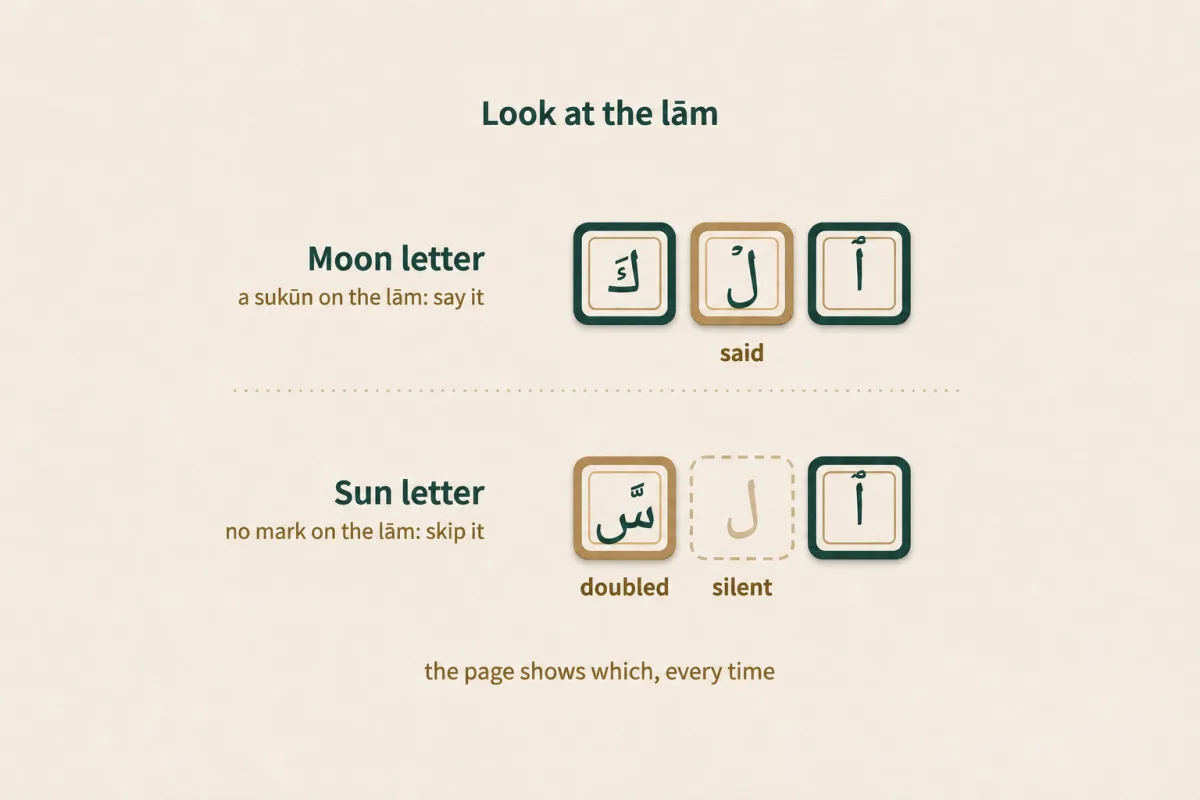
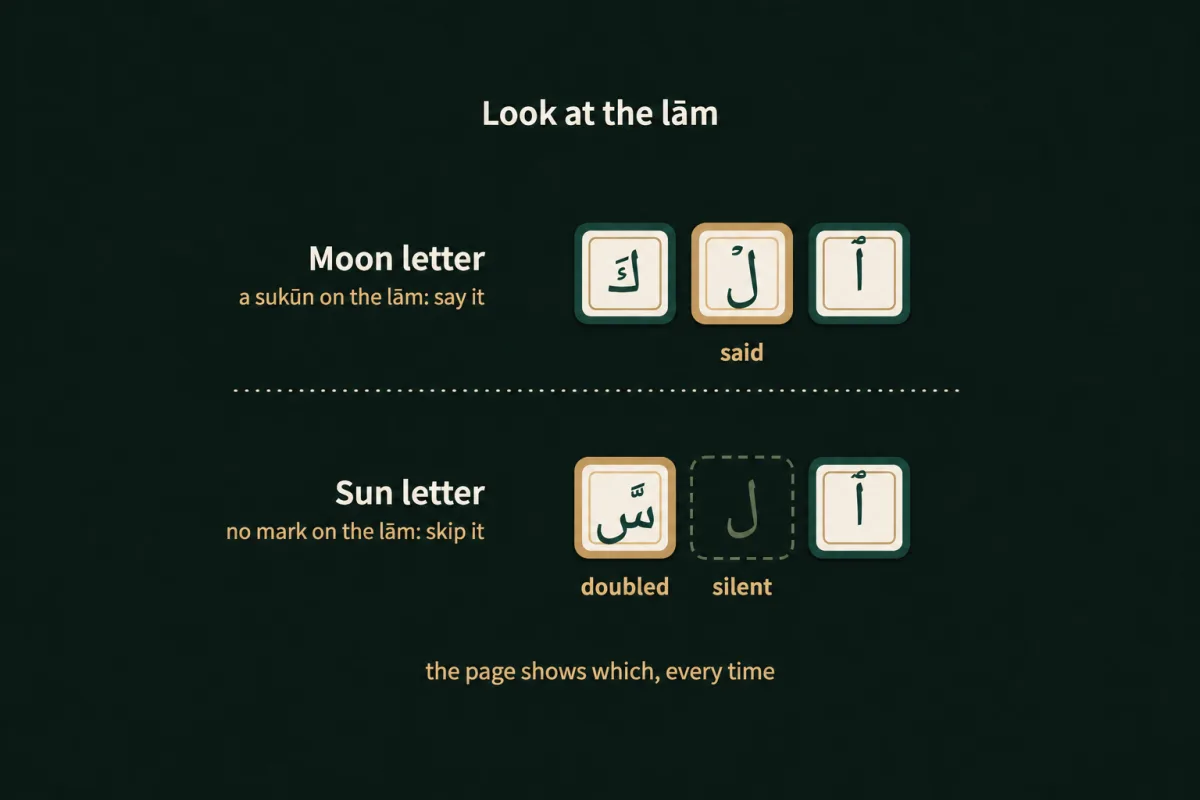
- Moon letter: a sukūn on the lām, so say it.
- Sun letter: no mark on the lām, so skip it; the next letter is doubled.
- The page shows which, every time.
| What you see | What you do | |
|---|---|---|
| A sukūn on the lām — ٱلۡ | Say the lām | a moon letter follows |
| No sukūn on the lām, and a shaddah on the next letter | Skip the lām; double the next letter | a sun letter follows |
You do not have to memorise which fourteen letters are which. You have to look at the lām. Checked against every definite-article word in Juz ʿAmma, this holds without exception.
Try it now Say each one aloud, then tap it.
You practiced these. They count in the drill below too.
Round 3 of 6
Moon — the lām is said
| ٱلۡعَظِيمِ | al-ʿaẓīmi | 78:2 |
| ٱلۡأَرۡضَ | al-arḍa | 78:6 |
| ٱلۡفَصۡلِ | al-faṣli | 78:17 |
| ٱلۡجِبَالُ | al-jibālu | 78:20 |
| ٱلۡيَوۡمُ | al-yawmu | 78:39 |
| ٱلۡمَرۡءُ | al-marʾu | 78:40 |
| ٱلۡكُبۡرَىٰ | al-kubrā | 79:20 |
Try it now Say each one aloud, then tap it.
You practiced these. They count in the drill below too.
Round 4 of 6
Sun — the lām goes; the next letter doubles
| ٱلرَّحۡمَٰنِ | ar-raḥmāni | 78:37 |
| ٱلنَّبَإِ | an-nabaʾi | 78:2 |
| ٱلنَّهَارَ | an-nahāra | 78:11 |
| ٱلصُّورِ | aṣ-ṣūri | 78:18 |
| ٱلسَّمَآءُ | as-samāʾu | 78:19 |
| ٱلرُّوحُ | ar-rūḥu | 78:38 |
| ٱلنَّاسِ | an-nāsi | 83:2 |
The name ٱللَّهِ. Its long ā has no written alif: read Allāh. The tajwīd book teaches the weight of its lām.
Try it now Say each one aloud, then tap it.
You practiced these. They count in the drill below too.
Round 5 of 6
With a letter in front
When a letter is attached in front. وَ and, فَ so, بِ with — written onto the article. They mean you are always continuing, so the alif is never said: وَٱلنَّٰزِعَٰتِ is wan-nāziʿāti. And when the word itself begins with ل, the article's lām and the word's lām are written as one lām carrying the shaddah:
Round 6 of 6
Joined on: the alif stays silent
Try it now Say each one aloud, then tap it.
You practiced these. They count in the drill below too.
What you met in this lesson
- Look at the lām
- Moon — the lām is said
- Sun — the lām goes; the next letter doubles
- With a letter in front
You have finished the teaching. The drill below puts it all together.
The drill · read it aloud
Sun and moon, unsorted
Read each card aloud, right to left.
Decide from the lām no list to remember — the mark on the page tells you
The same words again, shuffled
The lām words one lām on the page, two in the mouth
With a letter in front always continuing: the alif is never said
A short check
Can you read what this lesson taught?
Five quick questions, taken from this lesson. There is no score and no timer, and nothing is locked. Take it as often as you like.
Question 1 of 5
How do you read this?
ٱلۡعَظِيمِ- al-ʿaẓīma
- aʿ-ʿaẓīmi
- al-ʿāẓīmi
- al-ʿaẓīmi
Show the answer
Answer: al-ʿaẓīmi. ٱلۡعَظِيمِ is read al-ʿaẓīmi.
Question 2 of 5
How do you read this?
ٱلۡأَرۡضَ- al-urḍa
- al-arḍa
- al-arḍi
- al-ārḍa
Show the answer
Answer: al-arḍa. ٱلۡأَرۡضَ is read al-arḍa.
Question 3 of 5
How do you read this?
ٱلنَّبَإِ- an-nabaʾi
- an-nābaʾi
- an-nabaʾa
- al-nabaʾi
Show the answer
Answer: an-nabaʾi. ٱلنَّبَإِ is read an-nabaʾi.
Question 4 of 5
How do you read this?
ٱلرُّوحُ- ar-rūḥa
- ar-rūḥi
- al-rūḥu
- ar-rūḥu
Show the answer
Answer: ar-rūḥu. ٱلرُّوحُ is read ar-rūḥu.
Question 5 of 5
How do you read this?
ٱلصُّورِ- aṣ-ṣūra
- aṣ-ṣūru
- al-ṣūri
- aṣ-ṣūri
Show the answer
Answer: aṣ-ṣūri. ٱلصُّورِ is read aṣ-ṣūri.
Question 5 of 5
How do you read this?
ٱلنَّهَارَ- an-nahāri
- an-nāhāra
- an-nahāra
- al-nahāra
Show the answer
Answer: an-nahāra. ٱلنَّهَارَ is read an-nahāra.
Question 5 of 5
How do you read this?
ٱلرَّحۡمَٰنِ- ar-rāḥmāni
- ar-riḥmāni
- ar-raḥmāni
- al-raḥmāni
Show the answer
Answer: ar-raḥmāni. ٱلرَّحۡمَٰنِ is read ar-raḥmāni.
Question 5 of 5
How do you read this?
ٱلۡجِبَالُ- al-jubālu
- aj-jibālu
- al-jibālu
- al-jībālu
Show the answer
Answer: al-jibālu. ٱلۡجِبَالُ is read al-jibālu.
Question 5 of 5
How do you read this?
ٱلۡيَوۡمُ- al-yawmu
- al-yawmi
- ay-yawmu
- al-yāwmu
Show the answer
Answer: al-yawmu. ٱلۡيَوۡمُ is read al-yawmu.
Question 5 of 5
How do you read this?
ٱلۡفَصۡلِ- al-faṣlu
- al-fāṣli
- al-faṣli
- af-faṣli
Show the answer
Answer: al-faṣli. ٱلۡفَصۡلِ is read al-faṣli.
Question 5 of 5
How do you read this?
ٱلنَّاسِ- an-nāsa
- al-nāsi
- an-nāsi
- an-nāsu
Show the answer
Answer: an-nāsi. ٱلنَّاسِ is read an-nāsi.
Question 5 of 5
How do you read this?
ٱلسَّمَآءُ- as-samāʾu
- as-samāʾa
- al-samāʾu
- as-sāmāʾu
Show the answer
Answer: as-samāʾu. ٱلسَّمَآءُ is read as-samāʾu.
The gate
Ready to move on?
You are ready to move on when you read ال correctly against unseen words, both ways, deciding from the page — saying the alif when you begin on the word, and skipping it when you continue.
Record yourself
Read the lines this gate asks for, out loud, then listen back. You will hear what a listener hears.
Recordings stay on this device and are never uploaded. Delete any of them here at any time.
Nothing here is a score and nothing is timed. Each line is either true yet or not true yet. If you are unsure, it is not true yet.
Lesson 16 is marked complete. Well done — on to the next one when you are ready.
Next: lesson 17 · Starting a wordThis course is free, with no ads. Monthly supporters help keep it that way. Support from $10 a month
Help shape this lesson
How was this lesson?
One tap. It goes straight to Hamza, and it is how the next version of this lesson gets better.
Received. Jazāk Allāhu khayran. Hamza reads every one.
Anonymous: no name, no account. How feedback is handled
Every Arabic word on this page comes from the book’s own build: Qur’anic words from the Uthmani text of Juz ʿAmma by sūrah, āyah and position, drill syllables assembled from letters and marks. Nothing is typed by hand.
Qur’anic text: Tanzil Quran Text (Uthmani), via alquran.cloud. Marks are normalized for display (the sukūn as the muṣḥaf prints it; tanwīn in its plain form, without the small mīm, as the book explains); the letters are unchanged.