Lesson 13 of 20: Sukūn
Teaches The mark that means no vowel here, and the five letters that bounce when it lands on them.
The teaching
Before the lesson · not counted
Warm-up · from earlier lessons
Say each card aloud, then tap it to check what it reads. Nothing here is saved or counted.
Round 1 of 4
What this lesson is
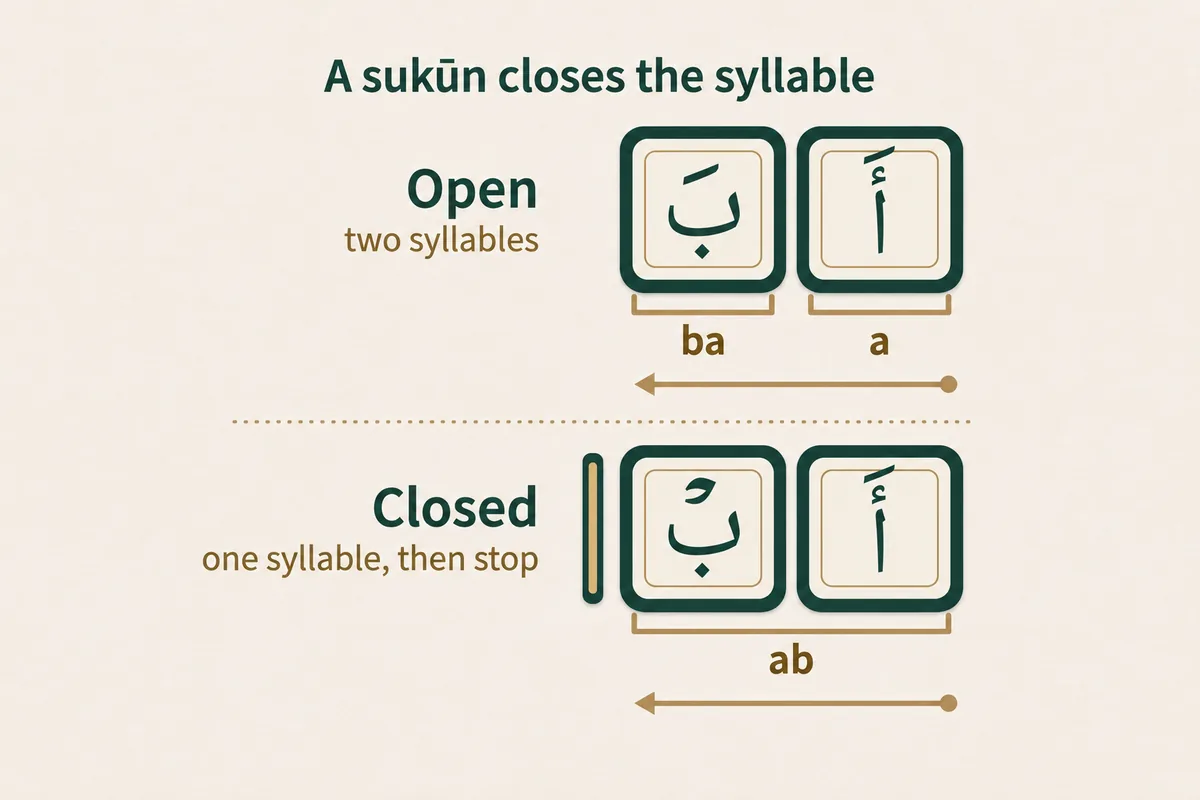
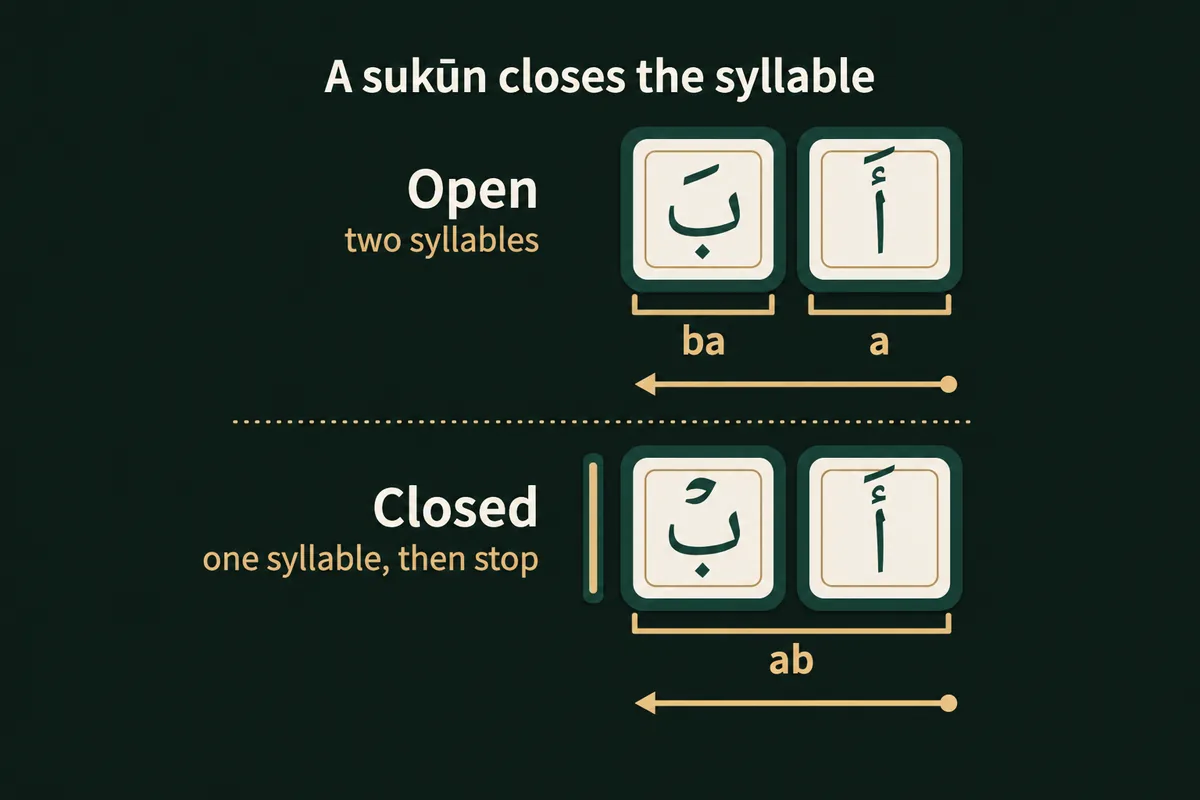
- Read right to left.
- Open: two syllables, a · ba.
- Closed: one syllable, then stop: ab.
This lesson adds the mark that closes a syllable. A sukūn is a small mark above a letter, shaped like the head of a little ح — بۡ. It means the letter has no vowel: you say the consonant and stop.
A letter carrying a sukūn is called sākin. This is what lets syllables stack into real words: أَلَمۡ is alam, not alama. ListenRecording coming
In some printed copies the sukūn is a small round circle. In this book, as in the Madinah muṣḥaf, a round circle means something else entirely (lesson eighteen) — so look at the shape.
Round 2 of 4
The plain sukūn
| أَلَمۡ | alam | 78:6 |
| هُمۡ | hum | 78:3 |
| كَانَتۡ | kānat | 78:21 |
| تِلۡكَ | tilka | 79:12 |
| سَبۡعًا | sabʿan | 78:12 |
| أَمۡرًا | amran | 79:5 |
| بَرۡدًا | bardan | 78:24 |
| يَسۡمَعُونَ | yasmaʿūna | 78:35 |
Try it now Say each one aloud, then tap it.
You practiced these. They count in the drill below too.
Round 3 of 4
The five that bounce
When a sukūn lands on one of these five, the letter cannot simply be stopped — it comes with a small audible rebound, like the b at the end of English cab said sharply.
| أُقۡسِمُ | the ق | 81:15 |
| بَطۡشَ | the ط | 85:12 |
| سَبۡعًا | the ب | 78:12 |
| نَجۡعَلِ | the ج | 78:6 |
| أَدۡبَرَ | the د | 79:22 |
| يُولَدۡ | the د again, at the end of the word | 112:3 |
Try it now Say each one aloud, then tap it.
You practiced these. They count in the drill below too.
Round 4 of 4
A bounce is not a vowel
The bounce is not a vowel. This is the part that takes practice. يُولَدۡ ends with a rebound on the d; it does not end in -di or -du. If someone can hear which vowel you added, you have added one — and so can you, on a recording.
Try it now Say each one aloud, then tap it.
You practiced these. They count in the drill below too.
What you met in this lesson
- The plain sukūn
- The five that bounce
- A bounce is not a vowel
You have finished the teaching. The drill below puts it all together.
The drill · read it aloud
Sukūn — the letter stops
Read each card aloud, right to left.
Closed syllables not words; cut the second letter clean
The five that bounce and only these five
Real words
Real words with a bounce in them
A short check
Can you read what this lesson taught?
Five quick questions, taken from this lesson. There is no score and no timer, and nothing is locked. Take it as often as you like.
Question 1 of 5
How do you read this?
بِسۡمِ- bismu
- bismi
- bisami
- bishmi
Show the answer
Answer: bismi. بِسۡمِ is read bismi.
Question 2 of 5
How do you read this?
مُهۡ- muh
- mah
- muhu
- muha
Show the answer
Answer: muh. مُهۡ is read muh.
Question 3 of 5
How do you read this?
كَذۡ- kad
- kadh
- kadhu
- kidh
Show the answer
Answer: kadh. كَذۡ is read kadh.
Question 4 of 5
How do you read this?
بَقۡ- buq
- baq
- baqu
- baf
Show the answer
Answer: baq. بَقۡ is read baq.
Question 5 of 5
How do you read this?
أَحۡقَابًا- uḥqāban
- aḥqāban
- akhqāban
- aḥaqāban
Show the answer
Answer: aḥqāban. أَحۡقَابًا is read aḥqāban.
Question 5 of 5
How do you read this?
لُزۡ- luz
- lur
- laz
- luza
Show the answer
Answer: luz. لُزۡ is read luz.
Question 5 of 5
How do you read this?
قَبۡ- fab
- qab
- qub
- qabu
Show the answer
Answer: qab. قَبۡ is read qab.
Question 5 of 5
How do you read this?
تَقۡ- taqa
- taq
- thaq
- tuq
Show the answer
Answer: taq. تَقۡ is read taq.
Question 5 of 5
How do you read this?
نَدۡ- nadh
- nadu
- nad
- nid
Show the answer
Answer: nad. نَدۡ is read nad.
Question 5 of 5
How do you read this?
يَقۡضِ- yaqaḍi
- yaqḍa
- yafḍi
- yaqḍi
Show the answer
Answer: yaqḍi. يَقۡضِ is read yaqḍi.
Question 5 of 5
How do you read this?
رِتۡ- rit
- ritu
- rut
- rith
Show the answer
Answer: rit. رِتۡ is read rit.
Question 5 of 5
How do you read this?
أَبۡوَٰبًا- abwāban
- abawāban
- abwābun
- abwāthan
Show the answer
Answer: abwāban. أَبۡوَٰبًا is read abwāban.
The gate
Ready to move on?
You are ready to move on when you cut a sākin letter cleanly with no vowel leaking after it, and the five bounce audibly without picking up a vowel.
Record yourself
Read the lines this gate asks for, out loud, then listen back. You will hear what a listener hears.
Recordings stay on this device and are never uploaded. Delete any of them here at any time.
Nothing here is a score and nothing is timed. Each line is either true yet or not true yet. If you are unsure, it is not true yet.
Lesson 13 is marked complete. Well done — on to the next one when you are ready.
Next: lesson 14 · The soft pairsThis course is free, with no ads. Monthly supporters help keep it that way. Support from $10 a month
Help shape this lesson
How was this lesson?
One tap. It goes straight to Hamza, and it is how the next version of this lesson gets better.
Received. Jazāk Allāhu khayran. Hamza reads every one.
Anonymous: no name, no account. How feedback is handled
Every Arabic word on this page comes from the book’s own build: Qur’anic words from the Uthmani text of Juz ʿAmma by sūrah, āyah and position, drill syllables assembled from letters and marks. Nothing is typed by hand.
Qur’anic text: Tanzil Quran Text (Uthmani), via alquran.cloud. Marks are normalized for display (the sukūn as the muṣḥaf prints it; tanwīn in its plain form, without the small mīm, as the book explains); the letters are unchanged.